
Skip

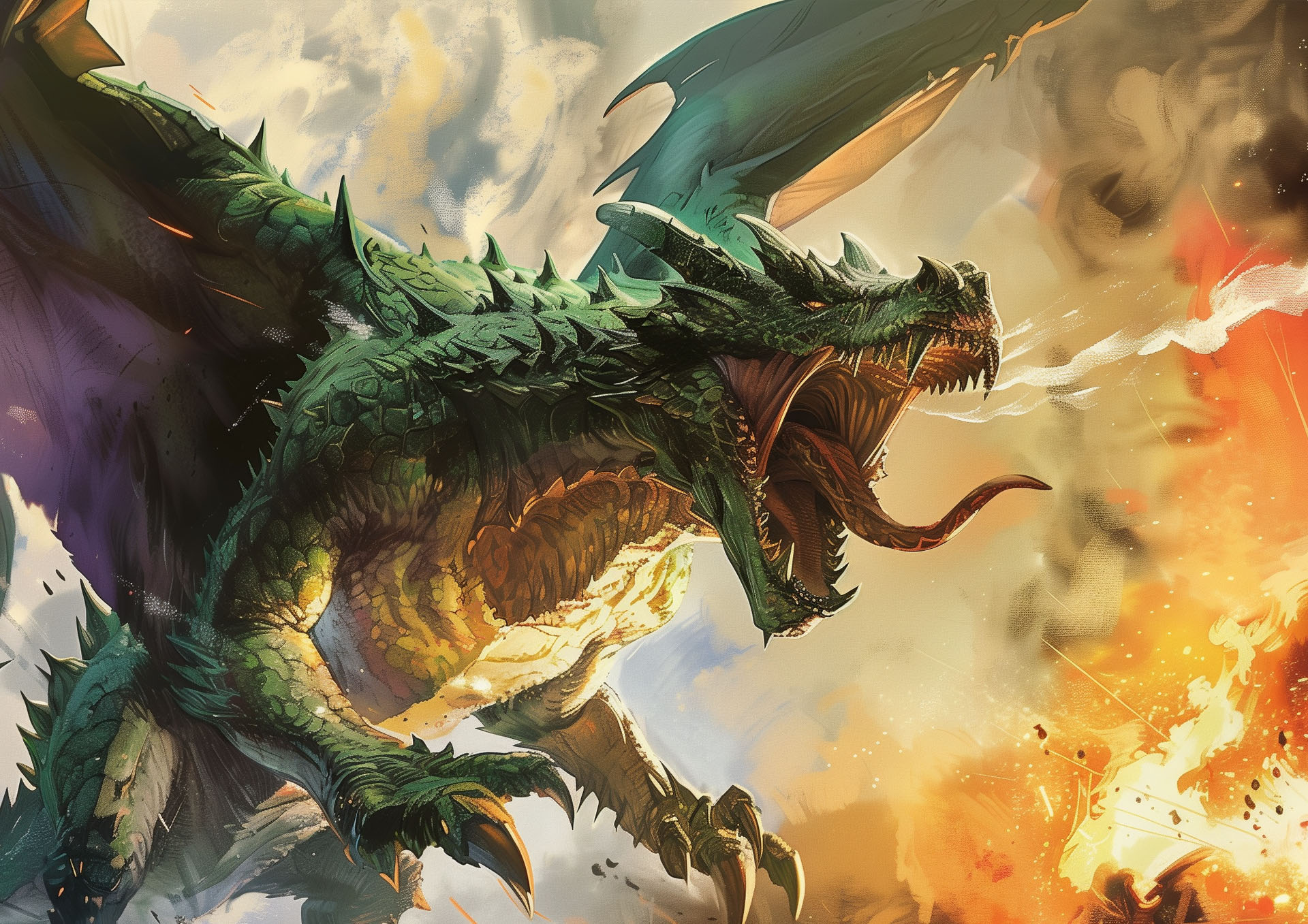
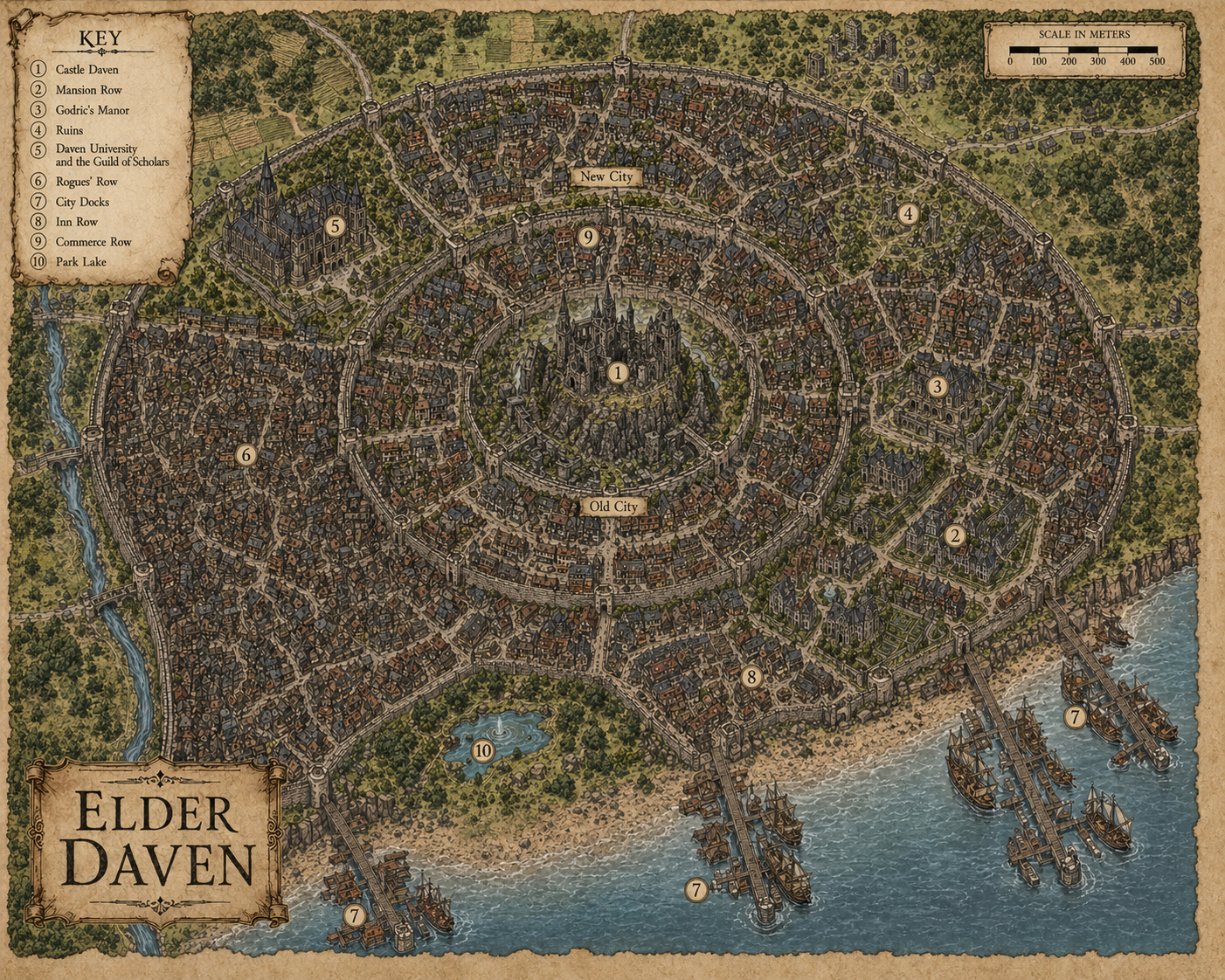
Elder Daven is the decaying "capital" of the former kingdom of Daven, and it still bears the wounds of its long subjugation under Saithith, the Lord of Gluttony. Though the city has been liberated from his rule, no true king has risen to restore order, and Elder Daven remains a place of crumbling grandeur, frightened citizens, ambitious criminals, false rulers, and sleepless nights. Its walls still stand, its docks still trade, and its ancient towers still catch the sunset, but beneath that stubborn life lies a city haunted by memory, hunger, and the restless dead.
Areas of Interest
General Information
Adventures in Elder Daven
Important Dates for the City
Castle Daven stands in the heart of the Old City, dark and massive upon its rocky mound. It is the ancient seat of the kings of Daven, but no king sits there now, and even Godric has not dared to take up residence beneath its towers.
The castle is a crumbling edifice, beautiful in the old Davonian way and terrible in the way of all places where too much evil has been done. Since the liberation, several attempts have been made to explore it, cleanse it, or reclaim it, and all have failed. Some parties never returned. Others came back missing men, memories, or courage.
Most citizens consider Castle Daven cursed, and they are probably right. The people give it a wide berth, making the sign of the Evil Eye when they pass too near its shadow. What waits inside is unknown, but the city has learned that ignorance is sometimes safer than discovery.
Mansion Row is the old quarter of the wealthy, a district of walled gardens, broken fountains, iron gates, and tall houses whose dark windows overlook the street. The manors here were once the pride of Elder Daven, and many remain beautiful, overgrown with ivy and carved with gargoyles, saints, kings, monsters, and stranger things.
The district is not what it was. Many noble families fled during the years of the Lord of Gluttony, while others were killed, corrupted, or folded into the new order of cowards and collaborators. Some houses now stand empty, some are occupied by merchants enriched by shipping, and some are held by men who keep more blades than servants.
Mansion Row looks peaceful from a distance, but its peace is mostly the peace of locked gates and paid guards. After nightfall, lanterns are shuttered, dogs are brought indoors, and even armed men prefer to travel in groups. The rich of Elder Daven have learned that stone walls keep out beggars better than ghosts.
Godric's Manor is the seat of "King" Godric, son of Godfrey Von Berengar, though his title is more ambition than fact. Godric rules only as far as the reach of his men's lances, and even that reach shortens considerably after dark.
The manor is heavily guarded by his Driddaren, mounted fighting men who call themselves knights and are called brigands by nearly everyone else. They wear armor, carry lances and swords, and ride with enough swagger to fool peasants, but few of them have the training or discipline of true knights. They are dangerous nonetheless, since a badly trained man with a lance can kill just as surely as a master.
Godric's household has the look of a court, but not the substance of one. Petitioners come because there is no one else to hear them, and he answers according to mood, advantage, and whatever pressure is being applied by Ludwig One-Ear. The result is not government, but it is sometimes close enough to pass for it.
The Ruins are what remains of a district that never recovered from the long evil of Saithith. Broken walls, roofless halls, fallen towers, and weed-choked courtyards fill this quarter, and the people of Elder Daven avoid it unless they are desperate, criminal, or foolish.
By day, scavengers pick through the stones for old iron, cut blocks, buried coin, and anything else that might be sold. By night, the place belongs to the dead, or to things close enough to the dead that no honest man cares about the distinction. Children dare each other to run to the first fallen arch and back, but no child does so twice.
There are whispers of buried cellars beneath the Ruins, some connected to the old temples that were torn down by order of the Lord of Gluttony. Others claim that secret ways lead toward Castle Daven, the sewers, and the older crypts beneath the city. These tales may be nonsense, but in Elder Daven nonsense has a habit of eating people.
Daven University is one of the few institutions in the city that still remembers what Elder Daven was before fear became its common language. Its halls are old, severe, and beautiful, rising apart from the press of the city like a monastery of learning. The Guild of Scholars keeps its chambers there, guarding books, maps, genealogies, legal records, and scraps of lore that others would gladly burn or steal.
The University survived Saithith by being useful, quiet, and lucky. Some masters compromised more than they now admit, while others hid books, students, and forbidden knowledge behind sealed doors and false walls. Hidden rooms are still discovered during renovations or by sheer chance, and not all of them are empty.
The scholars wield little open power, but knowledge is a kind of weapon in Elder Daven. Godric wants their legitimacy, Ludwig wants their records, Wolfstan wants their secrets, and Priestess Harnet wants their aid in understanding the horrors that walk after dusk. The Guild gives help carefully, for in Daven a misplaced word can do more harm than a dagger.
Rogues' Row is the most crowded and crooked district of Elder Daven, a maze of leaning houses, narrow alleys, hidden rooms, pawnshops, cheap taverns, and doors that open only after the right knock. It is not a romantic den of charming thieves. It is a hard place where hungry men learn quickly, and slow learners are found in gutters.
Wolfstan, head of the Thieves' Guild, is the best-known power in Rogues' Row, but even he operates under the shadow of Ludwig One-Ear. Wolfstan has men, blades, informants, and nerve, yet Ludwig controls the docks, the Seaman's Guild, and much of the coin entering the city. That makes Wolfstan dangerous, but not free.
The poor remain in Rogues' Row because they have nowhere else to go, and because the district has its own rough order. Thieves dislike undead as much as honest men do, since corpses carry little money and scare away business. For this reason, some streets in Rogues' Row are safer than they have any right to be, at least until one of the living decides to become a worse problem than the dead.
The City Docks are the lifeblood of Elder Daven. Ships from Selfhaven, Eruna, and the Gulf of Gor bring in varied goods, some lawful, some questionable, and some best not discussed in daylight. From Elder Daven, those goods are distributed to the inland cities of Daven, provided the roads are passable and the escorts are strong enough.
The city exports lumber, agricultural products, pickled fish, and small fishing boats, for Elder Daven was once known for shipbuilding. That glory is mostly past, but a few yards still work along the water, hammering together fishing craft and river boats under the eyes of hard men with ledgers.
The docks are effectively ruled by Ludwig One-Ear, head of the Seaman's Guild and agent of Rupert the Weasel King, ruler of the pirate colony of Selfhaven Archipelago. Ludwig is a crime boss, but he is also one of the reasons the city still functions. He understands that trade requires order, and so he provides order of the sort that can be bought, feared, and enforced in an alley.
Inn Row lies near the traffic of the docks and the safer ways into the Old City, and it is one of the few places where Elder Daven can still seem alive after sunset. Its inns, hostels, cookshops, stables, and drinking rooms serve sailors, carters, sellswords, merchants, refugees, scholars, smugglers, and the occasional wandering dwarf.
The lanterns of Inn Row burn late, but this is not cheerfulness. It is defense. Doors are barred, shutters are reinforced, and most common rooms keep a weapon behind the counter and a charm over the lintel.
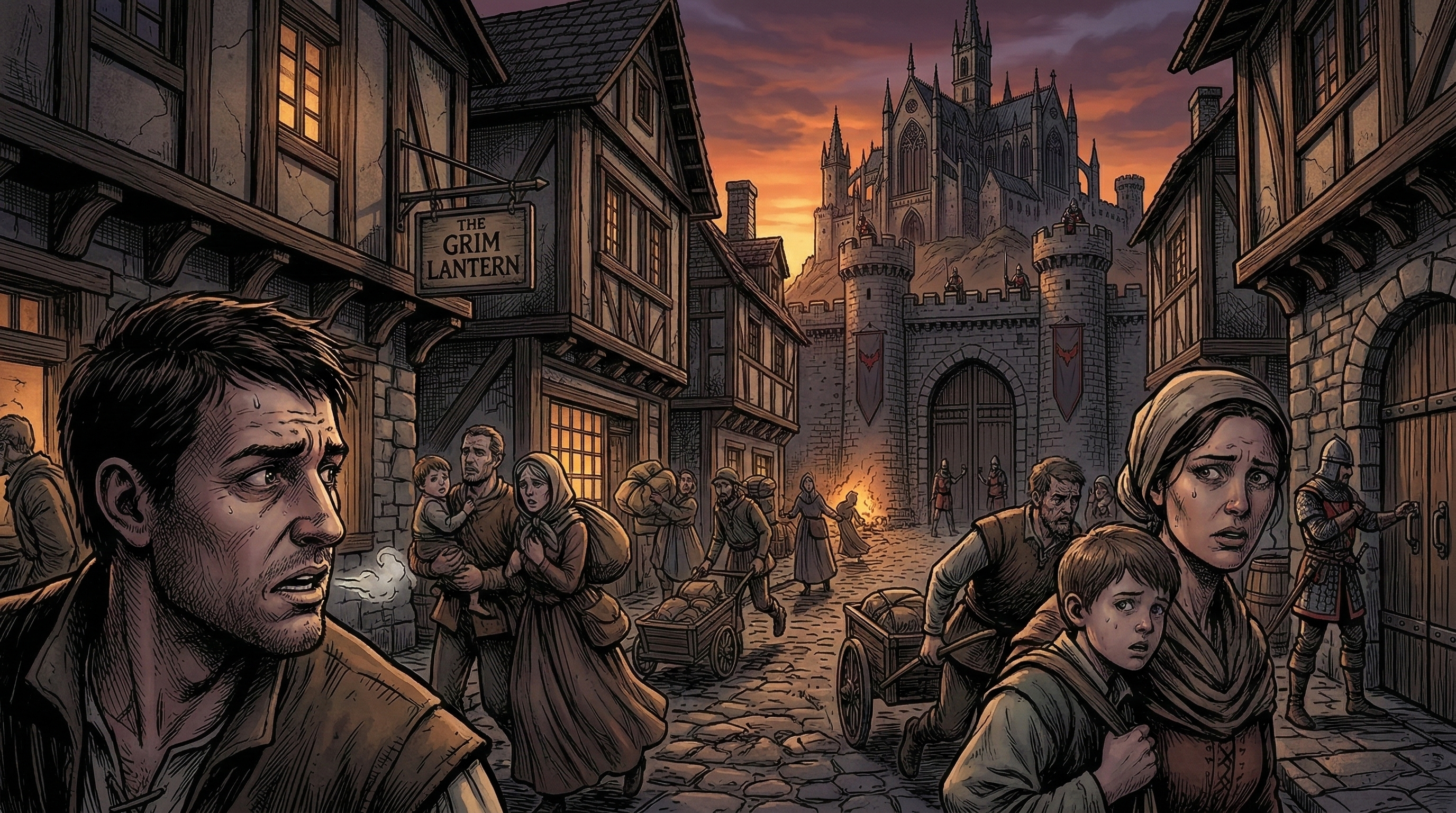
The Grim Lantern is typical of the district, which is to say that it is warm, crowded, nervous, and better than the street. Travelers usually learn the same lesson before their first dawn in the city. Pay for a room, tip the stableman, do not follow voices into alleys, and never assume that a knock at the door is made by the living.
Commerce Row is the mercantile heart of the Old City, where counting houses, warehouses, brokers, factors, moneychangers, guild offices, and guarded shops crowd the streets. It is one of the few districts where a man can still see the old prosperity of Daven, though even here that prosperity has a pinched and watchful look.
A buyer with silver can usually find something worth buying in Elder Daven, though not always legally and not always safely. Goods from Selfhaven pass through here, as do timber contracts, fish barrels, farm shipments, boat fittings, rope, sailcloth, and valuables quietly stripped from abandoned houses. Commerce Row smells of ink, salt, smoke, wet wool, and money.
Ludwig's influence is strong here, but Godric's men patrol the streets as well, which means merchants must often pay twice for the same protection. Still, the district functions because everyone powerful needs it to function. In a city where so much has failed, that alone makes Commerce Row important.
Park Lake is a remnant of gentler days, a green place within the city where old paths wind around dark water, cracked statuary, and trees that have grown too large for their original design. Once it was a place of promenades, music, courtship, and noble leisure. Now it is where washerwomen, children, beggars, and tired laborers come when they need to remember that the world contains more than stone walls and fear.
By daylight, Park Lake can seem almost peaceful. Birds gather there, ivy covers the old stonework, and the water reflects the towers of the city in a way that makes Elder Daven look whole again. That illusion rarely survives evening.
No one sensible lingers by the lake after dark. There are stories of pale figures among the trees, of ripples moving across the water when there is no wind, and of voices calling from the far bank in the accents of dead relatives. Priestess Harnet sometimes leads prayers near the lake for the poor, but even she leaves before the last light fails.
Elder Daven is ruled, in theory, by "King" Godric, son of Godfrey Von Berengar. In practice, his rule extends only as far as the reach of his men's lances. The city is near-anarchy, though not yet fallen into complete ruin.
Godric is not the only power in the city, and he may not even be the strongest. Rupert the Weasel King, ruler of the pirate colony of Selfhaven Archipelago, wields considerable influence through his agent Ludwig One-Ear. Ludwig is head of the Seaman's Guild, master of much of the dockside trade, and a crime boss with enough reach to make merchants bow and thieves reconsider their profession. He is also respected because, as Rupert's agent, he can arrange for the southern pirates to avoid raiding the city and its shipping lanes, most of the time.
Wolfstan, head of the Thieves' Guild, is also a force in Elder Daven. He commands cutpurses, burglars, spies, informants, and alley-men throughout Rogues' Row and beyond. Yet Wolfstan is firmly under Ludwig's thumb, and everyone who matters knows it, including Wolfstan.
Priestess Harnet, a cleric of Reeanan, holds little political power, but she may be the most beloved person in the city. She gives the peasants hope against the terrible Davonian nights, and hope is not a small thing in a place like this. Men with swords can hold a gate, but Harnet helps people endure the hours before dawn.
Elder Daven has about 8,000 living inhabitants. Most are human, with some half-orcs and the occasional wandering dwarf, usually a trader, mercenary, mason, smith, or foolhardy seeker of old things. The count does not include the dead, and here that omission matters.
It is whispered that dark spirits roam the night, along with the undead minions of the late Saithith. No one knows what their numbers might be, and no one with sense tries to count them. Every family knows at least one story of a neighbor, cousin, servant, or child who was seen after death walking where no living person should have been.
The city is poor compared to what it was, but it is not empty, and trade has a way of surviving even under bad kings, criminals, and ghosts. Coin still moves through the docks, the counting houses, the Seaman's Guild, and the hands of men who do not ask one another too many questions.
The city imports varied products from Selfhaven to the south and then distributes them to the cities of Daven. It exports lumber, agricultural products, pickled fish, and small fishing boats. Elder Daven was once famous for its ships, and though that craft has greatly declined, enough skill remains to keep the old reputation from becoming a complete lie.
The economy is depressed, and anyone who says otherwise is either selling something or stealing something. New City has become increasingly depopulated, except around the docks, where trade keeps men close to work and close to danger. In Elder Daven, hunger pushes people into streets that fear would otherwise empty.
King Godric sponsors a force of approximately 40 Driddaren, mounted knights armed with lances and swords. They are called knights because Godric calls them knights, but they are not well trained, and in truth they are little more than brigands with horses. Their courage varies, their discipline is poor, and their loyalty depends on pay, plunder, and Godric's ability to look strong.
It is unlikely that Godric could raise many more men. Elder Daven has bodies enough, but not trust, money, or faith in leadership. A call to arms from Godric might bring some frightened citizens, some opportunists, and some men hoping to loot before the city fell, which is not the same thing as an army.
The Driddaren do serve one useful purpose. Their patrols in Old City keep the streets safer than they would otherwise be, and even a corrupt guard can be better than no guard when the dead are moving. Ludwig's men also help maintain order, not out of charity, but because trade cannot flourish if the port becomes a slaughterhouse.
Elder Daven City is ancient, decaying, and still beautiful. Since the liberation, no strong leadership has arisen to unify the city or the kingdom, and anarchy reigns in most places where fear does not. The old walls still stand, the gates still close, and the towers still watch the roads and sea, but a city is more than stone.
New City, the area outside the inner walls, has become increasingly depopulated. Empty houses lean over silent lanes, gardens have gone to seed, and whole blocks seem to be waiting for someone to admit that they are abandoned. The area surrounding the docks remains much inhabited, because the docks mean work, and work means bread.
Old City, inside the Inner Walls, is much safer. The Driddaren patrol its streets, Godric's authority has some bite there, and Ludwig's men have reasons to prevent total disorder.
When night falls, the character of the city changes. Folk hurry home, doors are barred, shutters are closed, charms are hung, prayers are said, and sensible people stay where there is light. The undead minions of the late Saithith, leaderless and purposeless, wander the streets seeking only to kill the living.
The port remains the lifeblood of the city. At least half the citizens earn their living in a profession connected in some way to the docks: shipping, fishing, boatbuilding, warehousing, hauling, guarding, recording, bribing, smuggling, or stealing from one of the former. Without the docks, Elder Daven would become a mausoleum with walls.
Under Saithith, the Lord of Gluttony, Elder Daven suffered horrors that are still not fully spoken aloud. The temples were torn down by his order, the noble houses were broken or bent, and the dead began to matter in ways the living could not ignore. His rule left stains that no liberation has yet washed clean. The liberation ended Saithith's rule, but it did not heal the city. His undead minions remained, leaderless and purposeless, and the living powers of Daven failed to unite under a strong ruler. Elder Daven was freed from its master, only to discover that freedom without order can look very much like ruin. Today Elder Daven endures in a state between recovery and collapse. Its walls still stand, its docks still work, its people still pray, and its dead still walk. The city waits for a true ruler, a final disaster, or some stranger fate worthy of its long history.
Architecturally, Elder Daven is a remarkable place. Its buildings are often adorned with gargoyles and other statues meant to ward away evil spirits, and fanciful sculptures abound throughout much of the city. Faces of kings, saints, beasts, angels, demons, fish, wolves, and nameless things peer from roofs, arches, wells, bridges, and lintels.
The buildings withstand age and weather well, and over the years many have become overgrown with ivy, giving the city a quaint, historic look. This beauty is not false, exactly, but it is misleading. Some say the beauty of Elder Daven is nothing but a whitewashed sarcophagus covering a decaying corpse, and the saying has lasted because it is hard to improve upon.
The city was once known for its large and striking temples, but almost all of these structures were torn down by order of the Lord of Gluttony. They have never been rebuilt. Their absence can still be felt, not merely as gaps in the skyline, but as wounds in the soul of the place.
At sunset, Elder Daven is at its most beautiful and most fearful. Castle Daven catches the dying light, the walls glow like old bone, the windows of Inn Row kindle one by one, and the streets fill with people hurrying to be somewhere else. The city has not died, but neither has it been saved.
Elder Daven is a city made for adventure, though few who live there would use so cheerful a word. The place is full of old evil, weak rulers, desperate men, hidden lore, criminal bargains, and doors that should have remained closed. Adventurers who come here may find work quickly, but they should not expect clean motives, grateful patrons, or simple endings.
Godric wants Castle Daven reclaimed, or at least explored far enough that he can claim some symbolic connection to the old kings. He will not say this openly, since everyone knows he is afraid of the place, but his agents may hire adventurers to enter the castle, map its lower halls, and recover any relic of the royal line. The problem is that the castle does not seem entirely fixed in the present, and some rooms may still remember the reign of Saithith.
The adventurers might find old royal treasures, undead courtiers, mad survivors from earlier expeditions, or evidence that something beneath the castle is calling the dead toward it. If they succeed, Godric will want the credit. Ludwig will want whatever records or valuables they found. The scholars will want the truth, which may be the most dangerous prize of all.
Renovations at Daven University have uncovered a sealed passage behind a collapsed lecture hall. The Guild of Scholars believes it may lead to hidden archives from the early time of Saithith, or possibly to chambers used by masters who secretly resisted him. They need protection, discretion, and people willing to go where elderly scholars with bad knees cannot.
Inside, the party might discover forbidden books, old temple relics, records of noble betrayals, or a student society that never truly died. The danger need not be only physical. A recovered document might prove that one of the city's current powers collaborated with Saithith, or that a supposedly extinct bloodline still has a living heir.
A ship from Selfhaven arrives at the docks with half its crew missing, its captain locked in his own cabin, and a cargo that Ludwig One-Ear refuses to let anyone inspect. Soon after, dockworkers begin disappearing, and strange sounds are heard from a sealed warehouse near the water.
Ludwig may hire the adventurers to solve the matter quietly, or one of his enemies may hire them to expose it publicly. Either way, the cargo could be a smuggled relic, a bound undead thing, a cursed idol from the Gulf of Gor, or a living prisoner meant for someone powerful in the city. If the party crosses Ludwig, they had better solve the mystery before his patience runs out.
Wolfstan is tired of living under Ludwig's thumb. He approaches the adventurers through intermediaries and asks them to steal a ledger from the Seaman's Guild, one that records bribes, pirate arrangements, smuggling routes, and the names of respectable citizens who have been doing business with Selfhaven. With it, Wolfstan believes he can break Ludwig's hold over Rogues' Row.
The job is dangerous, but the aftermath may be worse. If the ledger becomes public, the city could erupt into factional violence. If Ludwig recovers it, Wolfstan's people will be butchered. If Godric gets it, he may use it badly. The adventurers may have to decide whether Elder Daven is better served by truth, blackmail, or silence.
The poor who gather near Park Lake have begun seeing dead relatives standing among the trees after sunset. At first these figures only watched, but now they whisper names, reveal secrets, and beckon the grieving toward the water. Priestess Harnet fears that something beneath the lake is feeding on sorrow.
The adventurers may be asked to guard one of Harnet's night vigils, investigate the old statuary around the lake, or descend through a half-flooded maintenance stair from the days when the park was first built. The thing in the lake may be an undead spirit, a remnant of Saithith's magic, or a forgotten shrine twisted by years of fear and neglect.
Scavengers in the Ruins have found a stairway leading down into the buried remains of one of the temples torn down by order of the Lord of Gluttony. The first men who entered came back with old silver, broken holy symbols, and a sickness that made them dream of endless feasting in the dark.
Priestess Harnet wants the temple cleansed. The Guild of Scholars wants it studied. Ludwig wants anything valuable removed before the priests or scholars can claim it. Godric wants to be seen as the patron of the expedition, provided he does not have to go himself. The buried temple may contain relics of Reeanan, imprisoned spirits, undead gluttons, or evidence of how Saithith first broke the city.
Rumor spreads that the true crown of Daven has been found in a private collection on Mansion Row. Godric claims it at once, insisting that it belongs to him by blood and right. Ludwig wants it because a crowned Godric would be harder to control. The scholars doubt the crown is genuine, while several desperate nobles suddenly remember ancient claims of their own.
The adventurers may be hired to guard the crown, steal it, authenticate it, destroy it, or find out who planted it. The matter could be a simple fraud, a political trap, or something worse. If the crown is truly ancient, it may carry the blessing of the old kings, or the last malice of Saithith.
The Driddaren have begun losing men on night patrol in Old City. Godric blames cowardice, then desertion, then conspiracy, but the bodies that are found tell a different story. Something is hunting armed men in the safest part of Elder Daven, and it seems to know the patrol routes.
The adventurers might be asked to accompany the Driddaren, investigate the dead, or pose as a patrol to draw out the killer. The culprit could be an intelligent undead servant of Saithith, a living assassin trying to weaken Godric, or one of the Driddaren themselves transformed by something taken from Castle Daven.
A traveler at the Grim Lantern dies in the night, though his room was locked from within. By morning, his body is gone, the mirror is cracked, and every guest in the inn has dreamed the same dream of a road leading to Castle Daven. The innkeeper wants the matter handled quietly before word spreads and ruins what business he has left.
The missing corpse may be walking the streets, or it may have been taken by something that uses dreams as doors. The adventurers could discover that the traveler carried a map, a royal token, or a message meant for someone at the University. In Elder Daven, even a single dead man can become a civic problem.
Ludwig's arrangement with Rupert the Weasel King has kept the southern pirates from raiding Elder Daven's ships most of the time. Now that arrangement is failing. A Davonian fishing boat has been taken, the crew hanged from its mast, and a message carved into the deck says that Rupert no longer speaks for all of Selfhaven.
Ludwig wants the offenders punished, but he cannot act openly without exposing how much power Selfhaven has in the city. Godric sees a chance to look like a real king. Merchants are terrified, sailors are refusing to crew ships, and Wolfstan is already looking for advantage. The adventurers may have to sail south, negotiate with pirates, uncover a rival captain, or discover that something from Elder Daven's own past is stirring trouble across the water.
5915-Daven, a general of Farland from Lorindish stock, founds the city of Daven, later to be known as Elder Daven. This marks the foundation of the kingdom of Daven.
5931-Daven falls in a raid upon (Elder) Daven by Goblins from Goblin Bay. The Goblins are tracked down and destroyed. Daven's eldest son Dortmund becomes King.
5950-Lord Pastor of Orland starts a revolution against King Tomas II of Orland.
5952-Pastor, with help from Daven, secedes from Orland and founds the kingdom of Cairn Cadez in western Orland.
c. 6020-The Farlandish Empire ends. Henceforth it is known as the Kingdom of Farland, and its kings are known as High Kings because most of the other countries eventually become subordinate allies or are forced to pay tribute.
6035-Wizards, priests, and heroes of all sorts begin to flock to Farland.
6397-Baron Jorland III of Cairn Cadez invades Daven on the secret prodding of Orland's King, Lestek I. He conquers the border town of Kestrel with monetary aid from Orland.
6399-Jorland is driven out of Kestrel, and it is renamed Victoria. He flees south to the town of Beath, but is attacked and slain by Prince Tael II, son of King Tael of Daven. Beath is renamed Baronsdoom.
6485-Daven, allied with Kelerak, invade Cairn Cadez. Orland comes to the aid of Cairn Cadez. The Plains War begins.
6490-Orland refuses to aid Cairn Cadez at the Battle of Sunsets. The kingdom is defeated and annexed by Daven.
6494-Daven sells the land where Cairn Cadez was to Orland for a suspiciously cheap price.
6560-Kale, the second son of King Orlock of Daven, cheated of an inheritance, goes off with his loyal followers and founds the Kingdom of Kale.
6615-Kale and Daven become involved in a border dispute. A minor war ensues.
6625-The conflict between Kale and Daven is resolved. Daven has expanded its Western border at the expense of Kale.
6850-Daven is troubled by a small pirate colony on an island to the south of her shores.
6855-Daven commissions a corsair, Robert the Blue, to destroy the pirate colony.
6858-Robert the Blue attacks and successfully destroys the pirate colony on Selfhaven archipelago.
6859-Robert the Blue double-crosses Daven and becomes a pirate himself. He harries the Southern coasts of the kingdom.
6860-Daven petitions the fleet of Farland for aid against the pirate.
6862-The fleet of Farland engages Robert the Blue and completely destroys his fleet. During the returning voyage, half of the fleet of Farland is lost due to a raging storm.
6900-The combined kingdoms of Kale and Daven attack Orland, beginning the Decadion War.
6903-King Alaric Von Basil of Daven is assassinated by the Orlandish assassin Roche.
6906-The Rio Plano is poisoned by raiders from Daven, killing much wildlife as well as people.
6981-Orland, with the help of Zeland and a legion from Farland, invades Daven.
6983-Daven falls to the combined might of the Eastern Alliance. It is annexed as Western Orland. The Eastern Alliance forces Kelerak to cease trade with Kale; Kale suffers greatly.
7001-The famous sage and wizard Seldorius of Farland makes his home on Hamor Island and renames it Wizard Isle. He begins to fabricate many magical items.
7005-Galadhel turns the Stone of Silence over to the Elves to use in putting a stop to the ceaseless wars that are marring the beauty of the lands. Unable to bear the parting, she passes from the Hinterlands.
7010-Abelard Von Basil, of the royal family of Daven, leads a successful revolt against the Orlandish invaders. With help from Kale and Kelerak, Orland is expelled and the Kingdom of Daven is refounded.
7020-Seldorius of Farland refounds the Cadre of the Wise, based on the original counsel founded by the Mage-King Keler.
7023-The Guild of Scholars is founded in Elder Daven.
7024-The Daven University is founded by Ewald Von Meinhart after contact with the mage Seldorius the Wise.
7029-Daven and Kelerak invade Orland but are repulsed with heavy losses at the Battle of Greenhill.
7039-Elves from the Summervale interfere in the Decadion War, and intercede with the powerful magic item, The Stone of Silence. Both sides make peace.
7045-The Elves move down the Elfin River and make the first interracial village in Dale. Some Elves move to the South Wood to keep an eye on Daven. The hero Celuthiel leads them.
c. 7080-The Wintervale begins to grow in strength, but this time the Dweller seems to have acquired some relic or power that greatly worries Seldorius and the Cadre of the Wise. The Dweller has made progress in unlocking the power of the Book of Seven.
7148-Daven is coerced after a minor skirmish into paying tribute to Farland.
c. 7260-Galen Stireck creates the vampire known as Kibor. Stireck is later slain by Kibor.
c. 7490-A new pirate colony is founded on Selfhaven archipelago.
c. 7650-Using the Book of Seven, the evil Dweller in the Wintervale starts recruiting seven mighty lords.
7744-The evil and very powerful vampire Kibor slays the king of Daven, Dakor Van Toulard V. Orcs are sighted in the hilly crags. Daven is thrown into chaos for a time.
7795-Elder Daven is attacked by a fleet of Ships, while simultaneously the army of the Lord of Gluttony besieges it. Reinforcements from Zeel City start to come. Aminas of the Shadow Walkers mounts an attack on the forces of evil, taking the Stone of Silence with him to use in the attack. This is against the original warning of Galadhel only to use the Stone in defense. The artifact disappears and Aminas is slain outside Elder Daven. Elder Daven falls, and the forces of Zeel are struck down by an evil plague. The Shadow Walkers from the South Wood put up a heroic fight but are hunted down and executed over the next year. Only a few escape. Daven is fully conquered by the Lord of Gluttony.
7910-The Lord of Envy begins a border war with Daven. The border shifts for several decades but eventually the Lord of Wrath puts a stop to the war and restores the original borders.
8015-Elie, a Priest of Heshtail secretly trains a band of heroes in how to destroy the undead blight that plagues Daven. The nameless band attempts to assassinate Saithith the Lord of Gluttony but are slain to a man.
8163-The Lord of Gluttony is slain and the land of Daven is liberated.
8166-King Godric comes to power in Elder Daven.
8169-The first whispers about the Guild of Slayers are heard in Elder Daven.
8170-The present.