
Skip

Hidden high in the Elfspires, Gloralion is the secret capital of the elves of the Belendale, a place called in the mannish tongues the Summervale. It is not a city one finds by wandering, nor a refuge one enters by luck. The ways into it are hidden by stone, thorn, water, and song, and the Elhil themselves say that no enemy has ever looked upon Gloralion.
To the Elhil, Gloralion is more than a capital. It is a memory preserved against the wearing of the world: a city of white stone, blue-green roofs, silver lamps, falling waters, and old music. It is the seat of Baranwë the Tall, Elvenking, and the last great dwelling east of the sea where the elder grace of the elves still abides nearly undiminished.
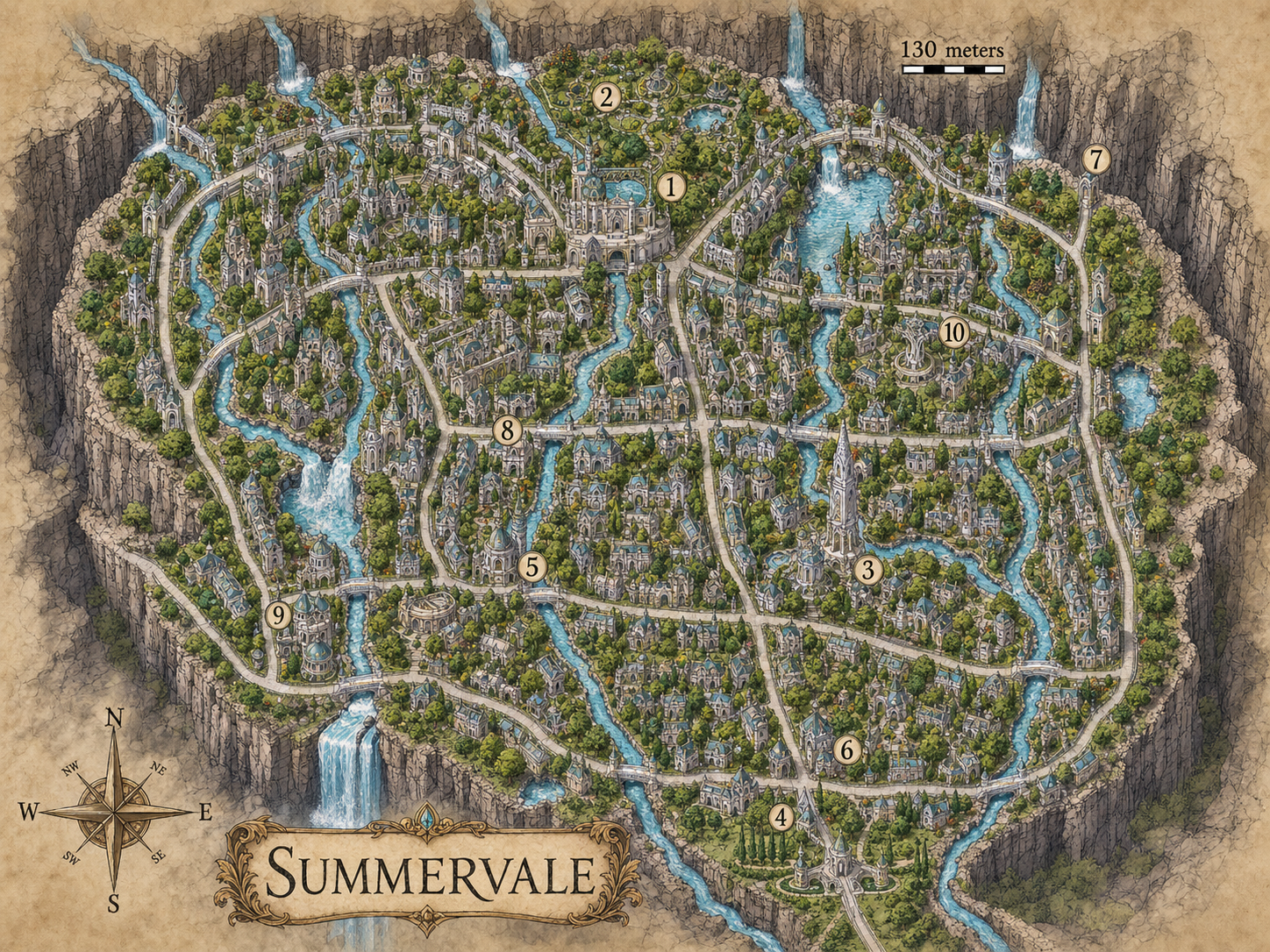
Key to Points of Interest in Gloralion
General Information About the City
Approaching the Hidden City
The Summervale
Magic in Gloralion
The Palace of the Elvenking. This is the dwelling of Baranwë the Tall, Elvenking of the Belendale. The palace is not a fortress in the mannish sense, though it is far from defenseless. It is a place of white towers, open halls, silver balconies, quiet courts, and blue roofs gleaming beneath the mountain light. Attached to the palace is the house of the sacred swan and the pool of Melim, where the bird dwells Few outsiders are permitted near the pool, and even among the Elhil it is approached with reverence. The shining light of the Sacred Swan changes those elves who often look upon it.
The Gardens of Gloralion, the Hatarglor. These gardens run around three sides of the city, reaching to the base of the rhan, the sheer cliffs that wall the vale. The Hatarglor are not ornamental gardens only. They are orchards, herb-gardens, flower walks, quiet bowers, and places of contemplation. In them grow fruits and blossoms that do not thrive elsewhere in the mountains, preserved by the strange temperance of the vale and by the patient craft of the Elhil.
The Tower of Silver, the Celoth. Here the histories of the Elhil are kept by the Order of Historians, the Ithilmin. The tower is slender, pale, and high-windowed, and at dawn its upper stones shine as if lit from within. The Ithilmin do not merely keep records. They preserve genealogies, songs, laments, royal decrees, maps of lost realms, accounts of ancient wars, and memories that other peoples would have allowed to die. The order is headed by Elrath of House Dinan, a revered scholar whose counsel is sought even by the Elvenking.
The Guard Post and the Three Gates. This guard post and way-station stands beside a sculpted hedge of beautiful but viciously thorned trees and bushes. The hedge is shaped by both hand and spell, and those who force their way through it often find that the thorns are not the only danger. Less than a quarter mile down the canyon lies the first gate, the Taurechant, a gate of thick and ancient wood. Beyond it stands the Gondechant, the gate of living rock. The final gate is the Garechant, an arching structure of white marble and steel that opens into Gloralion itself. No gate is merely a barrier. Each is a test, a watchpost, and a warning.
The Balwen, the School of Mages. Literally translated as the Craft School, the Balwen is the chief academy of Elhil spellcraft in the city. It is headed by Lord Singol of House Birlithe, a close friend and firm supporter of Baranwë. The Balwen teaches the high arts of the Spellsingers: illusion, conjuration, alteration, warding, and the subtle enchantments by which the Elhil preserve beauty against decay. Its students learn that magic is not merely power, but disciplined artistry. Whether all of them believe this lesson is another question.
The Headquarters of the Talranuil. The Talranuil, or Shadow Walkers, are the hidden blades and unseen eyes of Gloralion. They scout the secret approaches to the city, watch the borders of the Belendale, and strike against those enemies who must never be allowed to find the hidden ways. Their captain is Leanorfin of House Arduval, a grave and dangerous elf whose influence in the city is second only to the king, the great lords, and the gathered houses.
The Altapal, the High Walkways. These elevated walks, bridges, and cliffside balconies run along the higher walls and edges of the city, giving sweeping views over Gloralion, its waterways, gardens, and white towers. From the Altapal, one sees the whole hidden vale at once: the blue roofs, the shining bridges, the waterfalls descending from the rhan, and the palace rising near the northern heart of the city. The Altapal also give access to hidden passages and escape routes leading into the Elfspires. Some of these ways are known only to the king, the Talranuil, and a few ancient houses.
Rann Herran, the Street of Lords. This famous avenue contains the dwellings of many noble Elhil houses. The houses are not crude mansions of wealth and display, but old lineages embodied in stone, garden, symbol, and song. Here dwell the great families whose heads sit in the Meet-of-Elhil. House Dinan, House Birlithe, House Arduval, House Nirovir, and others maintain halls along or near this street, each marked by its own devices, trees, and ancestral memories.
Traervalann, the Halls of Art and Song. These public halls are given over to performance, recitation, debate, craft, music, and the display of art. To outsiders, Traervalann may seem impossibly refined, but among the Elhil it is also a civic space. Here old victories are sung, griefs are made bearable through beauty, young artists are judged, and the greatest works of the city are shown before the people. The Elhil do not separate art from memory, nor memory from identity.
Alutuar, the Glade of the God. This is the largest sacred place in Gloralion and the site of the famous Meet-of-Elhil. Like all true temples of the city, it is an outdoor place, for the Elhil do not willingly shut the divine away beneath a roof. The Alutuar is a broad glade of ancient trees, white stones, clear water, and green shadow. Here the heads of the noble houses gather when great matters must be spoken aloud before the people, the king, and the unseen powers.
Gloralion is ruled by Baranwë the Tall, Elvenking of the Belendale. His authority is ancient, personal, and deeply respected, though it is not wholly unchecked. Lord Singol of House Birlithe, master of the Balwen, supports Baranwë in almost all decisions, and Leanorfin of House Arduval, Captain of the Talranuil, is likewise a major influence in the city and a firm supporter of the Elvenking. The heads of the noble houses, when gathered in the Meet-of-Elhil, form the only body that may openly oppose the king, though this is rare and never done lightly.
The city has a population of about 5,100. Almost all are elves, though a small number of half-elves dwell there, along with a still smaller number of trusted guests or long-resident servants of allied peoples. Gloralion is not a mercantile city in the usual sense. It produces fine textiles, woven silks, illuminated manuscripts, sculpture, song-scrolls, musical instruments, crystal lamps, worked silver, fruits, herbs, rare flowers, and works of art. In truth, Gloralion exports culture more than goods, and it imports more than it exports.
The Hidden City is protected by 20 powerful Shadow Walkers of the Talranuil, 100 elven guards, and the Elvenking's High Guard, a company of 30 heavily armed and armored warriors. In time of grave peril, many more Elhil can be called to bow, blade, and spell.
Approaching the foot of the Elfspires, there is no obvious path up the mountain. The cliffs rise in cold ranks, snow gleams on the heights, and the wind seems to move through stone as much as through pine. At first the traveler sees only wilderness. Yet a careful set of eyes may at last alight upon a dried riverbed, its entrance choked with foliage, moss, and ancient growth. This is one of the lesser ways toward Gloralion, though even to call it a way is generous. It is a wound in the mountain healed over by time.
The climb is long and uncertain. The riverbed twists between walls of stone, vanishes beneath roots, opens into narrow shelves, and rises again among boulders worn smooth by waters that no longer run there. The air grows thin. Sounds fall away. Birds grow scarce. At length the path ends before a steep rock face that blocks all passage.
Then a firm voice speaks in Elvish from nowhere. "Haltha. Stand. Do not move, or you will be pierced with arrows."
Even eyes made sharp by danger will see no archers. No bowstring creaks. No mail rings. Yet the traveler who disobeys will learn that the warning was not ceremonial. To proceed requires the watchword, royal permission, or the escort of one whom the guardians already trust.
If the traveler speaks truly, the stone face shimmers like water under starlight. One may step through it and find, on the other side, a tall, raven-haired elf lowering his bow.
"You have spoken truly and may pass toward Gloralion, the Valley of Summer. I am Rana of House Nirovir. Follow me, if you will."
From there the guarded road bends through the hidden canyon and past the gates. First comes the Taurechant of thick wood, then the Gondechant of stone, and finally the Garechant, the white gate of marble and steel. The Garechant seems less opened by hand than persuaded by song. Passing beneath it, one beholds the beauty that is Gloralion, the Summervale.
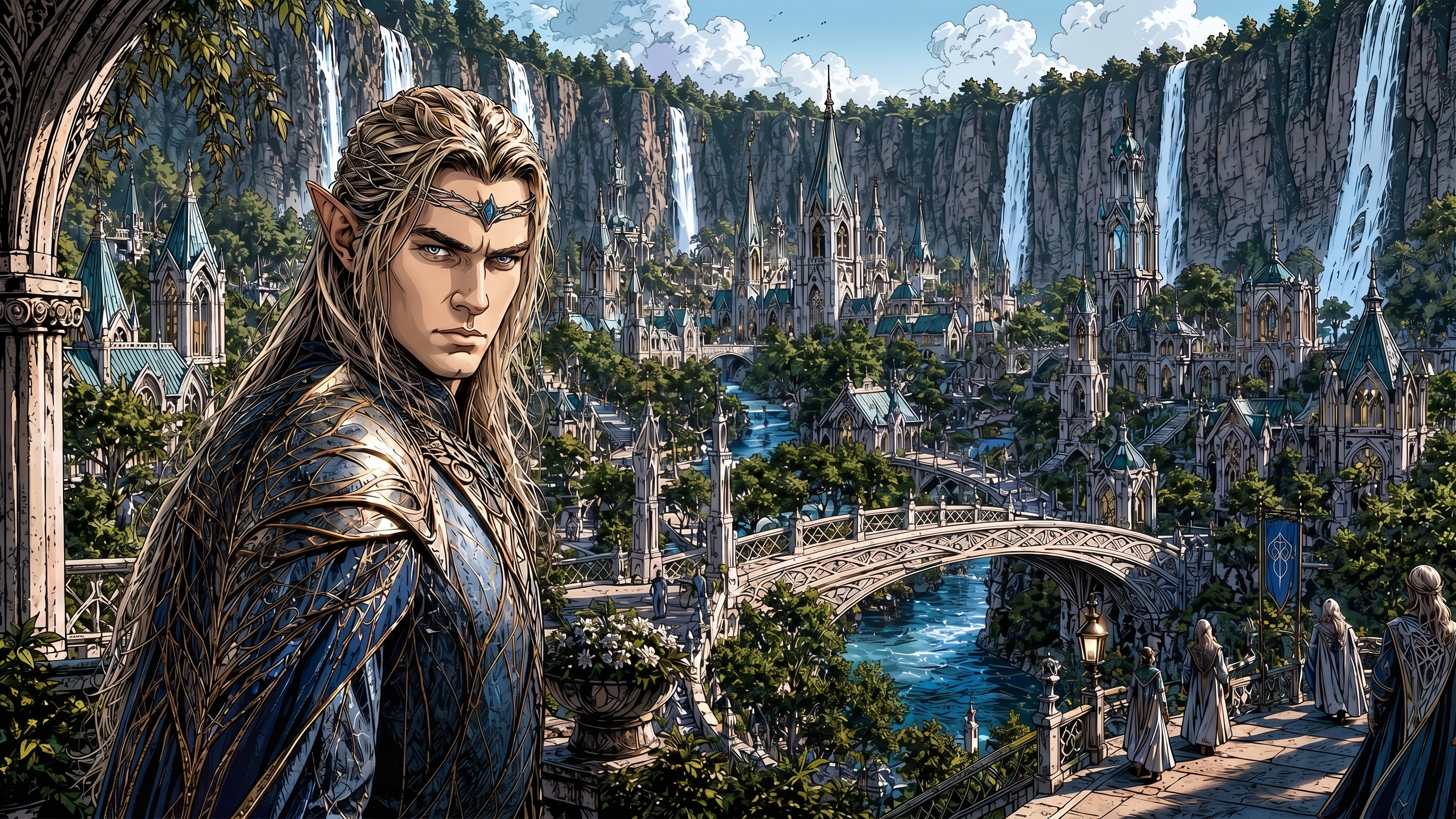
The first thing that strikes a traveler is the sound of the valamarana, the many singing waterfalls that plash and chime down the steep sides of the cliffs enclosing the vale. They fall in silver threads, white veils, and bright cataracts, and their voices are never quite the same from hour to hour. In the morning they sound clear and bell-like. At twilight they deepen, and their murmur seems to mingle with the first notes of evening song.
Twilight is a mystical time to the Elhil. If one enters Gloralion then, one may hear the voices of the city raised in unison, their melodies joining the falling waters. Harps answer from balconies and hidden courts. Flutes call from garden walks. The music moves through the vale without haste, as if the city itself is remembering something beautiful and sorrowful from before the first kingdoms of men.
The valley is broad, enclosed on every side by the sheer rhan, the cliff-walls of the Elfspires. It descends by subtle terraces toward the southern gate-road and the great falling waters below. The streams that enter from the cliffs do not merely pass through Gloralion. They shape it. The Elhil have guided them into channels, pools, gardens, and bright canals, so that the city seems less built beside water than woven through it.
At the southern edge of the vale, the waters plunge into hidden caves and over a steep precipice, vanishing into the secret darkness below the mountains. The gate-road climbs near this roaring fall, and many travelers remember that sound as their first and last impression of the Hidden City: water descending forever, as if the mountain itself were singing.
Even in winter, when the high winds of the Elfspires are bitter, Gloralion remains temperate. Snow falls lightly here, and often melts before it can whiten the streets. This strange comfort gave rise long ago to the Altarian word glorawe, which may be rendered in the mannish tongues as "summer-temperate," though the translation is poor. The word connotes not heat, but a comfortable resistance to change. In time, the Elhil came to use glorawe also of their own agelessness, setting it against the brerive, the "soon-winter," of the mortal races.
The streets of Gloralion are paved with smooth white stone. The buildings are chiefly of pale stone also, though their roofs gleam blue, green, and silver beneath the mountain light. Needle spires, open balconies, high windows, and slender buttresses rise everywhere, but the city never feels crowded or harsh. Its walls curve in graceful sweeps, its bridges are latticed like carved ivory, and even its towers seem to grow upward rather than merely stand.
Trees line the thoroughfares: lindens, beeches, white-barked rowans, and flowering trees whose petals drift but never seem to rot. As night descends, green, gold, and silver faerie-lights appear among their boughs. Some shine from crystal lanterns. Others are the work of Elhil magic, called into being by song and left to burn like gentle stars beneath the leaves.
Everywhere there is evidence of craft. Fountains stand in small squares. Statues gaze from gardens. Carved swans, leaves, stars, and running water appear over lintels and along the rims of pools. The bridges are slender and white, the balconies open, the doors painted or inlaid, and even the humblest dwelling is tended with a care that would shame the palaces of many younger kings.
From the higher walks the beauty of Gloralion can be understood at a glance. The city lies like a jewel cupped in stone: white streets crossing silver-blue waters, towers rising among trees, gardens climbing toward the cliffs, and waterfalls descending behind it all in veils of light. Many visitors first understand then why the Elhil speak of the Summervale not as a possession, but as a beloved thing kept alive against the griefs of time.
The people of Gloralion move with quiet purpose. Some greet a traveler warmly in the High Speech. Others pause and look with the calm, unreadable gaze of those who have watched many generations of men rise and vanish. Few are openly rude, but fewer still forget that every outsider is also a danger. Gloralion is courteous, but it is not naive.
"Ah, Gloralion," an elf is bound to say, with a look both proud and wistful. "The only abode east of the sea where dwells my heart."
The Elhil credit themselves with first bringing powerful magic into the world through the coming of the sacred swan. Whether this claim is history, myth, or something stranger, no wise scholar dismisses it too quickly. In Gloralion especially, the sacred swan is not treated as a mere symbol. It is bound to the identity of the Elhil and to their oldest understanding of beauty, memory, and power.
Many Elhil say that their race is the embodiment of magic. They do not usually mean by this that magic is a tool of domination, though their enemies might disagree. Rather, the Elhil claim that magic is artistry released from its slower physical restraints. A painter must labor with pigment, a sculptor with stone, and a singer with breath. Magic, they say, allows art to be delivered more quickly, more completely, and with fewer concessions to the stubbornness of matter.
For this reason, Elhil wizards are often called Spellsingers. They cast not through crude formula alone, but through the singing of magical words in voices trained for beauty, precision, and command. Their spellcraft is art, mathematics, memory, and will joined in song. In Gloralion, a spell badly sung is not merely ineffective. It is ugly, and ugliness in such matters is considered a moral failing as much as a technical one.
With magic, the Elhil create food, shape gardens, preserve stone, hide the ways into their secret homes, call light into crystal, and alter whole districts of their lands without leaving the scars that lesser peoples make with axe and fire. They are especially gifted in illusion, conjuration, and alteration, and they use these arts to ease the burdens of daily life so that more time may be given to music, craft, contemplation, and memory.
Yet there is another side to Elhil magic, and the wise do not ignore it. Magic that destroys, compels, deceives, and enforces one will upon another exists among the Elhil as surely as it exists among men, dwarves, and darker things. The Elhil answer that such magic is necessary in defense. The world changes violently, they say, and those who would preserve beauty must know how to resist those who would ruin it.
Perhaps this is true. Yet many scholars claim that magic as power and domination is also an Elhil invention, dating back into the mists before human kingdoms blossomed. Of this charge, the Elhil of Gloralion refuse to speak. They will discuss beauty, preservation, song, memory, and the Sacred Swan. But when asked whether the first spell of mastery and domination was sung by an Elhil voice, even the halls of Traervalann grow quiet.