
Skip

“To Elvenking Baranwë the Wise,
Hail, your majesty! As you requested, the following missive is a summary of our best information concerning that most dread creature, the Dweller in the Wintervale. Even writing the name seems a curse, yet I will press on for the sake of the free peoples of Farland. Be advised that the following knowledge is tentative and possibly erroneous. It is most difficult—and dangerous—to discover any of the secrets of the Denizen of the East. Though we used our best methods, including old-fashioned research and spying as well as spells of divination and seeing, much remained hidden from us, occluded by magics more powerful than any I have encountered.
Our research seems to confirm the conclusion hinted at by the greatest poem of Galdin Palantar: that the Dweller in the Vale began her existence as Talkana Silumiel, called Moondaughter, the most blessed and beautiful of all the elven race. Alas, because of her curiosity and ambition, she fell from the grace of Tal-Allustiel and into the hands of Vornoth, the Dark Walker, where she was tortured and perverted. It seems likely that she became the first of the orcs, the mother of the orcish species, and that she later had a hand in creating many of the evil creatures that follow the Walker-in-Darkness.
The gift of immortality, bestowed on all elves by Tal-Allustiel himself, was not taken by the Walker during her transformation. She has lived for many millennia and will not die a natural death. The Dweller was to be the hands of the evil god Vornoth upon the face of Núrion, designated by the Dark One himself to bring all living beings under his rule. She was tasked by the Dark God to forcibly sway all creatures on the face of the Shattered Jewel to the worship of Vornoth, thereby making him more powerful than the other gods and allowing him to win the Ontological War once and for all.
We speculate that after the Battle of the Sarum and the great Wars of Al-Dustriel, the Dweller made a concerted attempt to conquer Farland by founding the Orc Nation of Rothnog and using this organized kingdom to wage lethal wars upon the elves and dwarves. She apparently came very close to success, except that through her own vanity and hubris she allowed her nation to fragment and turn on itself. Thus her most promising early venture came to naught.
It seems that the Dark God, after two unsuccessful wars, grew wroth with Talkana, disappointed beyond measure that she had squandered two successive chances to subjugate the races of light before they grew powerful, as Vornoth knew they would if left free. Thus the Dark God punished Talkana, proclaiming, "Your ambition and vanity burn in your bosom like a fire. Now a fire shall indeed burn within you!"
And so it seems the Dark God made within the Dweller a raging fire, such that she felt herself consumed from within by the hottest flames. So fierce was this internal burning, this punishment of the god, that only the coldest temperatures could give her even an instant of respite. Thus Talkana had no choice: she fled back to her dark valley, and there, though she suffered torment unimaginable, she crafted magic never before seen on Núrion. She wrought a spell that would freeze her flesh and call down the very blizzards of winter upon her valley, that she might have a moment's relief from the burning affliction within her.
And thus, we think, the Wintervale—the valley of eternal ice and snow—was born. At its heart, in a hellish tower of translucent ice that juts like a fang from an evil city, now nameless, she came to dwell. Indeed, this tower, the epicenter of the spell of winter, was the only place on the Shattered Jewel where Talkana would not suffer limitless pain.
Vornoth made it known to the Dweller in the Wintervale that her only relief from his punishment, and thus her only escape from her self-imposed prison, was to conquer the continent of Farland once and for all. At first Talkana sought ways to thwart the god's sentence, learning more and more magic in the hope that she might lift the curse. But always she failed. Finally, resigned to the will of the god she both served and hated, the Denizen of the East set out to conquer Farland, hatching scheme upon scheme and limitless machinations that brought endless suffering and death to the realms.
She enjoyed various successes, from the reign of the foul realm of Stor-gris, which harried the Hinterlands for nearly a thousand years, to the banishment of the elves from their ancestral home. Yet never again was she able to come as close to success as she had been when the world was young, and so she continued to suffer.
The only time the Dweller left her sanctuary, as far as we are able to discern, was to fight personally in the Battle of the Death Downs. She knew that victory in this war was crucial, for it would mean the destruction of the fledgling human civilizations, and she foresaw that humans would become a great thorn in her side if they were not destroyed. But she failed at this too, and so great was the pain she suffered—partly from the battle and the explosion caused by the Crown of Aelfar, but mostly from the burning within her, unmitigated by her icy realm—that she vowed never again to leave the Frostspire.
Yet out of the jaws of defeat, the Dweller managed to snatch the seed of her ultimate victory: the Book of Seven, that wicked relic created by Vornoth in the depths of time. For many eons after this, the Dweller labored to unlock the secrets of this mysterious tome. With each passing decade and century her knowledge and power grew, and closer and closer she came to fully understanding its mysteries, until finally, in some fateful year unknown to us, she unlocked its last secret.
Then the darkness fell quickly over Farland. She used the Book, combined with her own near-godlike acumen in magic, to create the Seven Lords of Sin, seven creatures imbued by the Book of Seven with the power to weld the unruly dark folk hordes into disciplined fighting armies, the match for any in Farland at that time. And as the histories tell, these dark armies and these Deadly Lords swept over the continent like a shroud covering a corpse.
One might speculate that the Dark Conquest was a success in the eyes of the Dweller and her master, yet the Wintervale remains. Perhaps the Walker expected his agent to vanquish our people as well, or perhaps he demands that the lands to the south also be brought under his control. All we know is that the cursed place still stands, and we presume that the Dweller remains imprisoned within her spire.
As far as the Dweller's person is concerned, we were able to discover precious little. As the first orc, it is likely that she is some unique combination of elf and orc, made fiendish by the touch of the God of Darkness himself. No living elf or man has ever laid eyes on her visage. The histories do not tell of her features, and the strongest magics cannot penetrate her tower, so none know her face—if indeed her countenance, after her fall, resembles a face at all. Scrying on her tower is dangerous, because it risks attracting her attention.
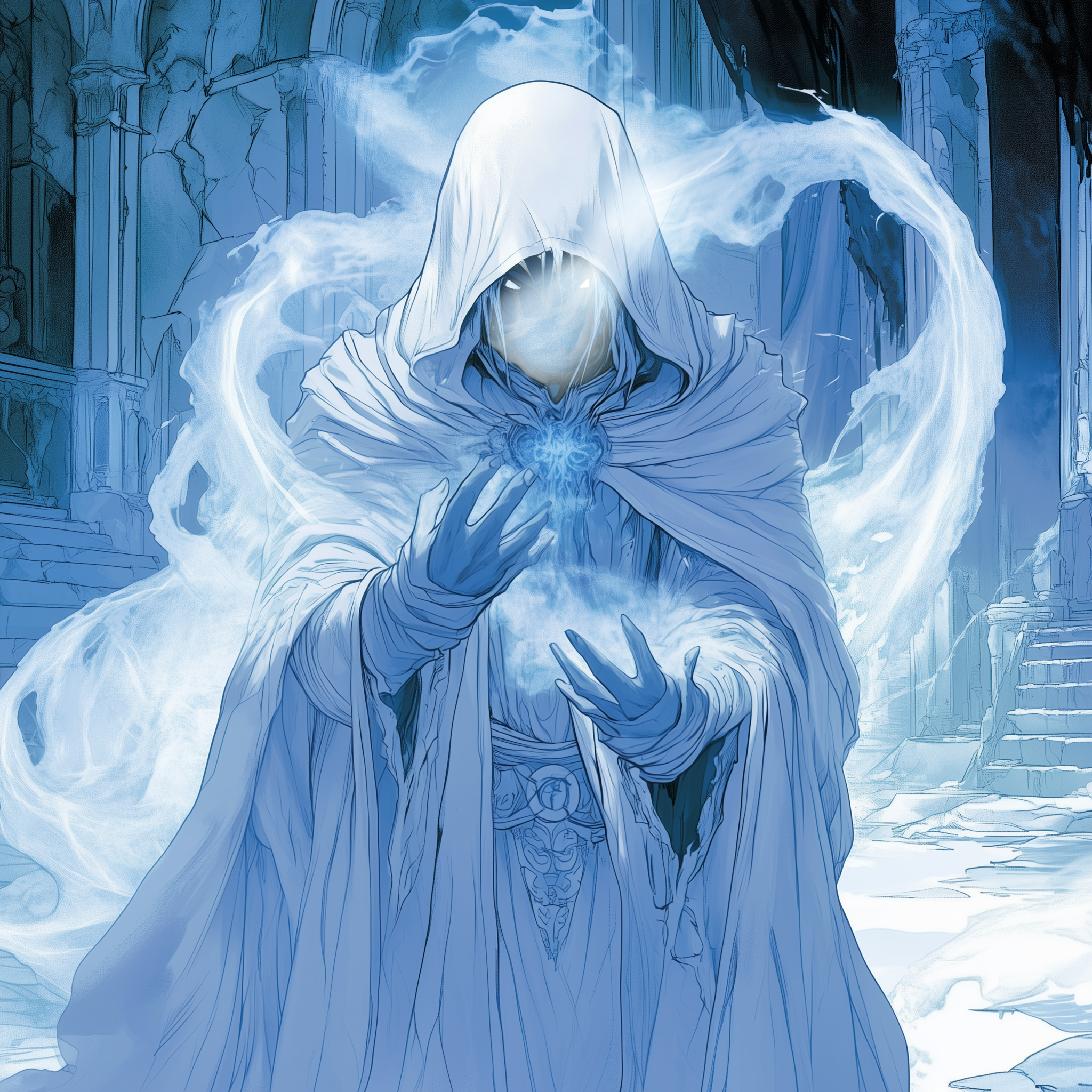
It is said that she goes clad in raiment of the purest white, and that frost plumes from her sleeves and cowl, an ever-present sign of the coldness she exudes, the ice that keeps her from burning alive. She is undoubtedly the greatest wielder of magic on all Núrion, able to bend to her will dweomers that would crush a lesser sorcerer. It would be folly to face her in combat, yet combat is not where her greatest skills lie. She is a master of manipulating others to do her bidding, sending them gladly to fight and die for her.
Yet ironically, this master of pawns always has been, and still remains, the pawn of another. She is well aware of this fact, we believe, and would escape her bonds if she could. Admittedly, this is pure speculation.
These facts, my liege, are all we could discern. I gladly leave this subject now to walk in the Valley of Summer, under the sun, far from that cursed creature, the very contemplation of whom chills me to the marrow.
May Tal-Allustiel grant you beauty.
--Singol of House Birlithe, Lord High Mage”
Medium humanoid (elf, orc), neutral evil
AC 21 Initiative +19Hit Points 480 (48d8 + 240)
Speed 30 ft.
Skills Arcana +15, History +15, Insight +13, Intimidation +14, Nature +13, Perception +13, Persuasion +14
Resistances Lightning, Poison
Immunities Charmed, Cold, Frightened, Necrotic, Paralyzed
Senses Truesight 120 ft., Passive Perception 23
Languages Dark Speech (common, wild, and secret), Elven, Farlandish, Kelevan, Kingdom Common, Old Speech
Challenge 25 (XP 75,000, or 90,000 in lair; PB +9)
Legendary Resistance (4/Day, or 5/Day in Lair). If the Dweller fails a saving throw, she can choose to succeed instead.
Fey Ancestry. The Dweller cannot be charmed, and magic can't put her to sleep.
The Book of Seven. The Dweller possesses the fell and powerful artifact called The Book of Seven. She used it to create the Lords of Sin; the Book has many other dangerous powers that she could put to terrible use (DM's discretion). An aura of death magic emanates from the Book of Seven when it is in the Dweller's possession. Each creature except the Dweller or her allies that ends its turn within 50 feet of the Book takes 16 (5d6) necrotic damage and 16 (5d6) psychic damage.
Death of an Immortal. The creature that causes the Dweller to be reduced to 0 hit points dies and cannot be raised or resurrected. Only the direct intervention of a deity can prevent this death or bring the creature back from the dead.
Multiattack. The Dweller makes three attacks, using Eldritch Burst or Freezing Touch in any combination.
Eldritch Burst. Melee Weapon Attack: +16, reach 5 ft. or range 120 ft., one target. Hit: 45 (6d12 + 6) Force damage.
Freezing Touch. Melee Weapon Attack: +16, reach 5 ft., one target. Hit: 15 (3d6 + 5) Cold damage plus 15 (3d6 + 5) Psychic damage, and the target has the Paralyzed condition until the start of the Dweller’s next turn.
Spellcasting. The Dweller casts one of the following spells, using Intelligence as the spellcasting ability (spell save DC 22):
At Will: Detect Magic, Detect Thoughts, Dispel Magic, Feather Fall, Fireball (level 6 version), Invisibility, Lightning Bolt (level 6 version), Mage Hand, Prestidigitation
2/Day Each: Dimension Door, Fly, Plane Shift, Prismatic Spray
1/Day Each: Cone of Cold (level 9 version), Chain Lightning, Finger of Death, Power Word Kill, Scrying
Protective Magic. The Dweller casts Counterspell or Shield in response to the spell’s trigger, using the same spellcasting ability as Spellcasting.
Legendary Action Uses: 3 (4 in Lair). Immediately after another creature’s turn, the Dweller can expend a use to take one of the following actions. The Dweller regains all expended uses at the start of each of her turns.
Freezing Teleport. The Dweller teleports up to 60 feet to an unoccupied space she can see, and each creature within 15 feet of the space she left takes 17 (3d10) Cold damage.
Attack. The Dweller makes an Eldritch Burst or Freezing Touch attack. She can’t take this action again until the start of her next turn.
All the Ages of the World. Creatures near the Dweller in the Wintervale suddenly feel the crushing weight of immortality. Constitution Saving Throw: DC 22, each living creature within 30 feet of the Dweller. Failure: 37 (10d6) Necrotic damage and a creature that fails this save is slowed as per the spell. A creature slowed by this effect must then make a DC 22 Constitution saving throw at the end of each of its turns. If it successfully saves three times, all effects from All the Ages of the World end. If it fails its save three times, it permanently turns to stone and is subjected to the petrified condition. The successes and failures don’t need to be consecutive; keep track of both until the target collects three of a kind. Once a creature saves three times against this effect or the original effect, it can't be affected by All the Ages of the World for 24 hours. Success: Half damage. Failure or Success: The Dweller can’t take this action again until the start of her next turn.
Ice Vulnerability. Creatures within 30 feet of the Dweller have vulnerability to cold and necrotic damage until initiative count 20 on the next round. Once a creature has been affected by this, it cannot be targeted by this Legendary Action again until 3 rounds have passed.
Force Cage. An invisible cage appears around a creature the Dweller can see within 120 feet of her. Dexterity Saving Throw: DC 22. Failure: The creature is enclosed in a force cage. The cage has no gaps or bars; instead it has six solid walls that totally enclose the creature. The creature in the force cage can do nothing to affect anything outside the cage, nor can anything outside the cage affect the creature inside it. To escape, the creature must use its action to make a Charisma check contested by the Dweller's. If the creature wins, it escapes the force cage and cannot be affected again until 3 rounds have passed. Otherwise, the cage disappears and the effect ends on initiative count 20 on the next round. Success: The creature is not enclosed in the force cage and cannot be targeted by this Legendary Action again until 3 rounds have passed.
The Dweller in the Wintervale is always found in her lair, the dreaded Frostspire in the heart of the Nameless City. Her lair is usually guarded by two ancient white dragons. No living things dwell around her lair; the area around it is an undead-haunted necropolis.