The Lord of Anger
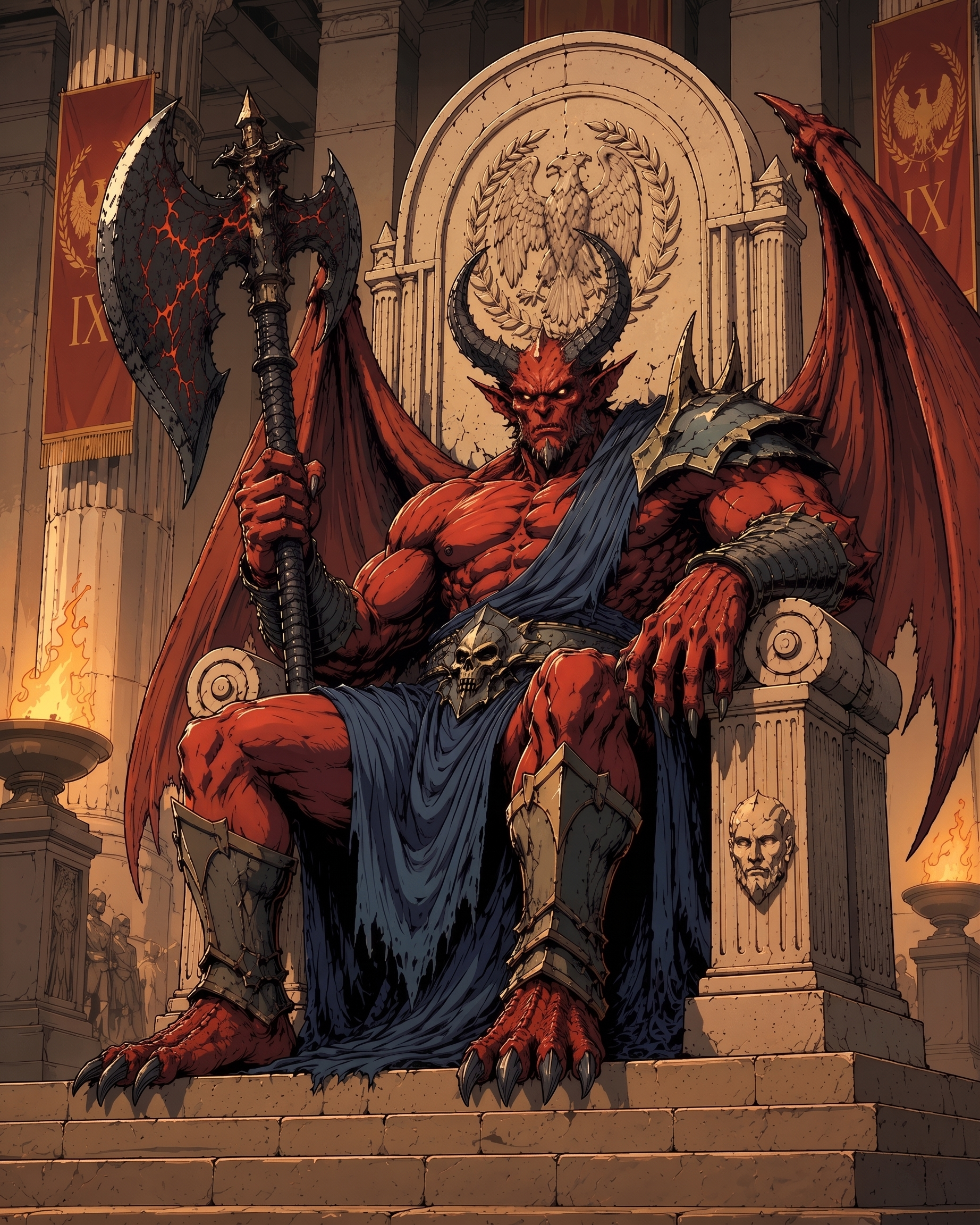
Nabarus / Bakahul, Emperor of Farland
Pit fiend devil Bbn2: CR 23; ECL 20; Size L; HD 18d8+162 + 2d12+18; hp 279; Init +12; Spd 50 ft (base 40 ft), fly 60 ft. (average); AC 45, touch 19, FF 37; BAB +18/+13/+8/+3; Epic Attack Bonus: +2; Grapple +37; Atk: +32/+32 melee (2d8 + 13, claws), +30/+30 melee (2d6 + 6, wings), +30 melee (4d6 + 6 plus poison plus disease, bite), +30 melee (2d8 + 6, tail slap), +36/+31/+26/+21 melee (3d6 + 23 + 1d6 electricity/crit x3, Large Greataxe +4 (Shocking burst)); SA Constrict 2d8+26, fear aura, improved grab, spell-like abilities, summon devil SQ Damage reduction 15/good and silver, darkvision 60 ft., immunity to fire and poison, resistance to acid 10 and cold 10, regeneration 5, see in darkness, spell resistance 32, telepathy 100 ft.; SR 32; AL LE as Nabarus/CE as Bakahul; SV Fort +22, Ref +21, Will +23; Str 37, Dex 27, Con 28, Int 26, Wis 26, Cha 25.
Languages spoken: Infernal, Blackspeech (Orc), and Farlandish.
Skills and Feats: Balance +10, Bluff +28, Climb +34, Concentration +30, Diplomacy +9, Disguise +28, Hide +25, Intimidate +30, Jump +40, Knowledge (Arcana) +29, Knowledge (Geography) +10, Knowledge (History) +10, Knowledge (Local) +10, Knowledge (Nature) +10, Knowledge (Nobility) +9, Knowledge (Other) +29, Knowledge (Planes) +11, Knowledge (Religion) +29, Knowledge [War] +10, Listen +29, Move Silently +29, Search +29, Spellcraft +31, Spot +29, Tumble +31; Armor Proficiency (Light), Armor Proficiency (Medium), Cleave, Great Cleave, Improved Initiative, Iron Will, Martial Weapon Proficiency, Multiattack, Power Attack, Quicken Spell-Like Ability, Shield Proficiency, Simple Weapon Proficiency.
Special Abilities: Damage Reduction, Darkvision, Fast Movement, Induce Mindless Rage, Rage, Regeneration, Spell Resistance, Uncanny Dodge.
Spell-Like Abilities: At will-blasphemy (DC 25), create undead, dominate monster (DC 27)*, fireball (DC 21), greater dispel magic, greater teleport (self plus 50 pounds of objects only), invisibility, magic circle against good, mass hold monster (DC 27), persistent image (DC 23), power word stun, telekinesis (DC 23)*, unholy aura (DC 26); 1/day-meteor swarm (DC 27) or implosion (DC 27)*. Caster level 18th. The save DCs are Charisma-based. The spells marked with an asterisk can only be used when the Lord of Anger's Bakahul personality is in control. Bakahul cannot use meteor swarm or wish.
Once per year a pit fiend can use wish as the spell (caster level 20th).
Induce Mindless Rage (Su): The Lord of Anger can cause another creature within 30 feet who fails a DC 21 WILL save to enter into an involuntary rage as if the creature were a second level barbarian. The rage cannot be ended by the afflicted creature. While in the rage, the creature gains all the regular benefits, but its intelligence score drops to 2 and the creature has difficulty determing friend from foe. The creature must succeed at an intelligence check DC 10 (with its new intelligence) in order to continue viewing previous allies as allies, and must pass this check for each ally on the field. Each creature not considered an ally is regarded by the raging character as an enemy. The raging victim will attack all creatures it deems enemies to the best of its abilities, beginning with the closest enemy. The victim is fatigued just as a barbarian when the rage ends. This ability can be used once per day.
Signature Possessions: Ring of protection +2, Potion of cure serious wounds, Bracers of armor +3, Brooch of shielding, Large greataxe +4 (shocking burst). As Emperor of Farland, Nabarus' resources are vast, and given enough time, he can acquire most items.
The story of the Lord of Wrath begins in the depths of the lower planes, paradoxically in Barathus and Malor at once. In an echo of Vornoth's betrayal of the other evil gods when he created the Book of Seven, the origin of the Captain of the Deadly Lords began when evil turned upon itself, each side seeking its own advantage.
Two mighty warlords, the Pit Fiend Nabarus and the Balor Bakahul, clashed in the Astral River, hurling their devilish and demonic armies against one another. Their forces took advantage of the weakened boundaries between the lower planes, boundaries made less certain by Vornoth, the Walker-in-Darkness, who traversed the planes of evil at will. Both fiends hoped that the destruction of such a powerful adversary would win them prestige in the eyes of the greater demons and devils above them. Yet the two were so evenly matched that neither could gain the upper hand. Their armies decimated, each returned to his infernal fortress to nurse his wounded pride: Nabarus stewing in cold resentment, Bakahul raging at the stalemate.
In his black-spired, lava-moated castle, the wily devil Nabarus hatched a plot to rise within the strict hierarchies of Hell. He began researching a demonic ritual that would allow him to absorb the power of Bakahul, increasing both his personal might and his infernal prestige. For several years he made little progress, and it seemed that such a rite might be impossible.
Then, in his search for forbidden knowledge, Nabarus contacted a powerful evil from another plane: the Dweller in the Wintervale herself. After extracting from him a promise of future service, the Dweller supplied the Pit Fiend with magical phrases drawn from the Book of Seven, the very key needed to unlock the ritual.
Nabarus then lured Bakahul to the Astral River under a flag of truce. There, in an act of pure betrayal, he uttered the magical words. In a blinding flash, he began to absorb the power of the Balor. Taken by surprise and overcome by fury, Bakahul cried out for aid to the darkest power of the lower planes: Vornoth himself.
Ordinarily, the Walker-in-Darkness would not have cared for the plight of a single demon, even one as mighty as Bakahul. In this instance, however, the Lord of Evil saw the chance to forge a useful tool. He answered the Balor's call, preserving Bakahul's consciousness even as the demon's body was destroyed forever.
Thus Nabarus and Bakahul were merged.
The Pit Fiend soon discovered that his victory had carried a terrible price. In moments of stress, rage, or injury, the personality of Bakahul struggled to the surface, fighting to seize control of Nabarus' body and undo the devil's designs. Nabarus had gained the Balor's power, but he had also made his enemy immortal within himself.
Filled with anger at this unexpected curse, Nabarus set aside his ambitions of rising through the hellish hierarchy and turned his efforts toward removing Bakahul from his being. Yet these efforts too were thwarted, for the Dweller in the Wintervale soon called in her favor. She summoned the Pit Fiend to Núrion to serve as the Captain of the Lords of Sin. Using the Book of Seven, she imbued him with the Dark Will, and, bound by his promise, Nabarus angrily agreed to become the Lord of Wrath. His dream of becoming an Overlord of Hell slipped away, perhaps forever. He led an assault on the greatest realm on the continent: the Kingdom of Farland. And he conquered it and set himself up to rule from the Far City.
Here, however, Vornoth's deeper plan came to fruition. The dark god knew that the Dweller had long chafed under his control and sought some means of escaping her sentence of doom. He knew the fallen elf would betray him if she believed she could do so safely. Therefore Vornoth spoke to the trapped consciousness of Bakahul, revealing to the raging and nearly insane demon that he owed his continued existence to the Walker-in-Darkness and that his present torment was the fault of the Dweller in the Vale.
Vornoth charged Bakahul with watching the Dweller's movements and reporting her machinations back to him. This was necessary because direct divine intervention on Núrion had been forbidden by the Council of the Gods. Because of this interdiction, Vornoth's awareness of events on Núrion was clouded, and the Dweller had become especially adept at hiding from his sight when she wished. Bakahul, hating the Dweller and seeing Vornoth as his salvation, agreed to spy upon his master.
Thus the Lord of Wrath contains not one fury, but two.
Nabarus' wrath is cold, disciplined, and calculating. Bound by oath to serve the Dweller, he seethes at the loss of his true ambition. The thought that he might once have become an Overlord of Hell pierces his heart like an icicle. His anger does not flare wildly; it hardens, sharpens, and waits.
Bakahul's wrath is altogether different. His anger is fiery, chaotic, and nearly uncontrollable. He burns with hatred for Nabarus, who stole his body; for the Dweller, whose schemes made his imprisonment possible; and for nearly every creature in existence. Only Vornoth is spared his hatred, for Bakahul regards the Walker-in-Darkness as the preserver of his soul and the author of his eventual revenge. When Bakahul gains control of Nabarus' body, he is sometimes able to master his fury long enough to use mighty magics and report to Vornoth on the doings of the Dweller. Yet this discipline never lasts for long.
In war, Nabarus is cold, guarded, and strategic. He surrounds himself with legions of hobgoblin troops and with the elite force known as the Crimson Lion Guard, preferring to let his soldiers bleed before he commits himself directly. He is no coward, but he is a devil: cautious, hierarchical, and careful with his power.
If Nabarus is wounded or driven to great anger, Bakahul strains against the prison of their shared flesh. The more injured or enraged the Pit Fiend becomes, the harder Bakahul is to resist. When the Balor at last seizes control, the Lord of Wrath changes utterly. He becomes more reckless, more direct, and far less tactical. Bakahul remains cunning, but his cunning is always threatened by the fire of his rage. Sooner or later, he gives himself over to fury and wades into combat with his fearsome magical greataxe.
This is why Nabarus-Bakahul is the truest embodiment of Wrath. He is not merely angry. He is anger divided against itself: cold vengeance chained to hot fury, calculation fused with frenzy, hatred made into a single monstrous will. In him, wrath is both the patience to plot for centuries and the impulse to tear the world apart in a single burning instant.