
Skip

General Information About the City
The City
Places of Interest
Magic in the Far City
Politics and Daily Life
Laws
Possible Adventures in the Far City
Important Dates
The Far City is the capital of the Kingdom of Farland, the seat of the Empire, and the greatest city still standing under the shadow of the Lords of Sin. It is called Gurz-Goi by those of its inhabitants who speak the Dark Speech, and the name is spoken with fear even by many who dwell within its walls.
The Lord of Wrath rules the Far City as captain of the Lords of Sin and Emperor of Farland and its client kingdoms. From the Palace of Wrath on Dominium Hill, he governs not merely by law, but by terror, spectacle, and the certainty that every ambitious man or creature in the city is being watched.
The Emperor is advised by his five Cancellors, though advice given to the Lord of Anger is a dangerous gift. The two most politically powerful Cancellors are War Hoth Lord Pirg, a mysterious creature of indeterminate race, and General Sumus Crassi, a ruthless human politician whose career has been built on calculation, intimidation, and the timely ruin of his rivals.
Rotgut the Wise, high priest of Vornoth in the Far City, wields great influence from the Great Temple of Vornoth, formerly sacred to Neltak. Even the Lord of Anger sometimes defers to Rotgut's judgments, not because he fears the priest as a man, but because the church of the Dark Walker has roots sunk deep into every district of the city.
The assassin's guild, called the College of Blood, has its nefarious hand in many dealings in the city. Its power lies less in open rule than in the simple fact that people are afraid to cross it, and in the Far City fear is a coin that spends better than gold.
Khadufel the Southerner, mage of the freelance company called the Eye, has begun to maneuver politically to gain power and renown in the city. He has not yet made a true name for himself among the old houses and imperial offices, but tales of the Southerner are beginning to be whispered in parlors, dining halls, and back rooms where ambitious men speak only after the servants have been dismissed.
The population of the Far City is usually estimated at between 100,000 and 150,000 souls, though no census can be trusted in a city where slaves vanish, prisoners are erased, and whole neighborhoods conceal their numbers from tax collectors. Most of the population is human, but a great many dark folk, including orcs, goblins, and hobgoblins, make the city their home. As much as one fifth of the population may be enslaved.
The Far City imports more than it exports, drawing food, timber, stone, luxury goods, slaves, and raw materials into its markets and through its harbor. It does produce pottery, textiles, weaponry, and metal goods, but its true export is its own culture: imperial law, military fashion, brutal spectacle, corrupt manners, and the idea that power is the only virtue that matters.
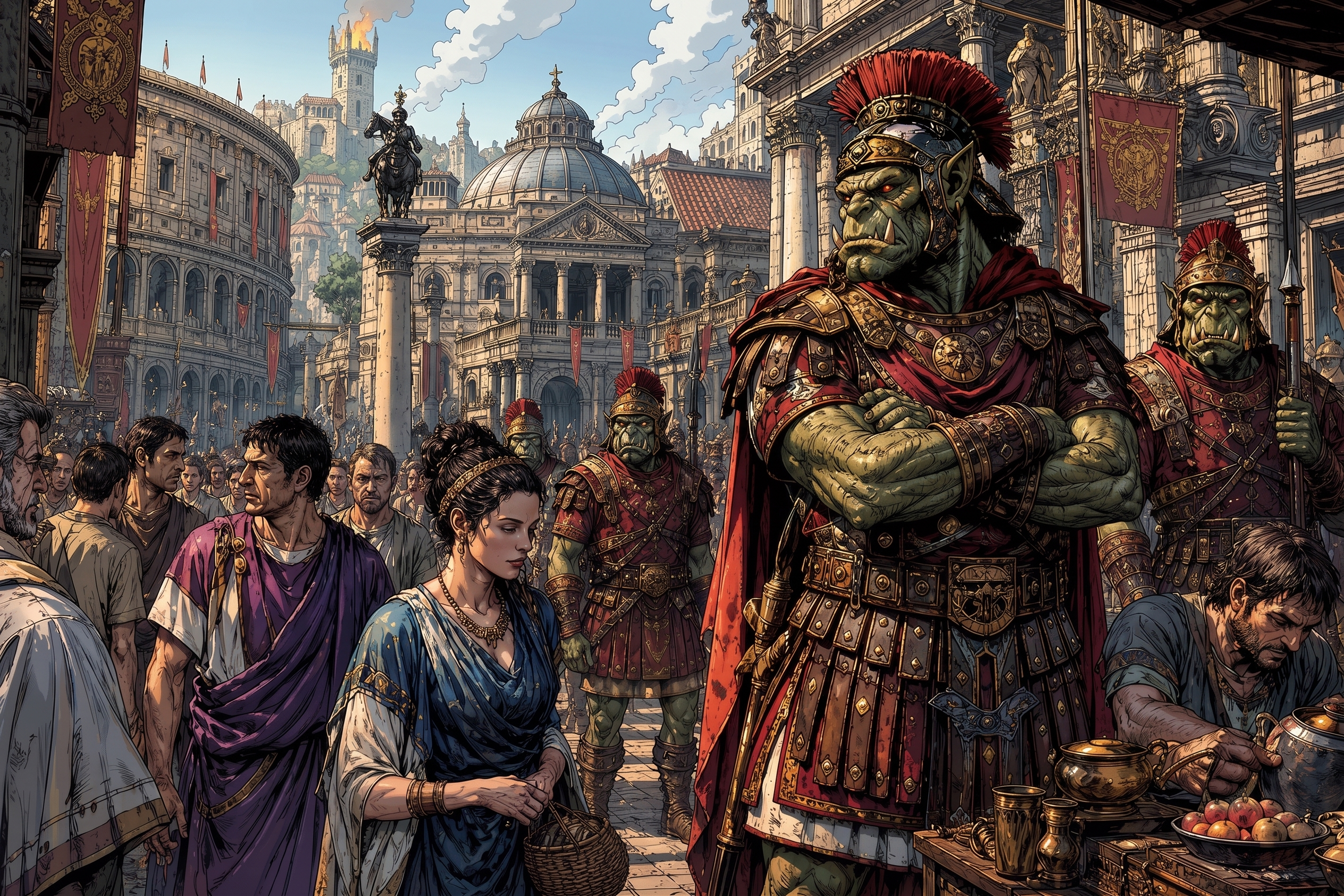
The Far City is one of the most militant communities on the continent. The Emperor keeps an entire hobgoblin legion there, the First Legion, called the Hawk Legion, which keeps order in the streets and makes certain that possible political rivals remember who owns the city. The Imperial bodyguard, called the Crimson Lion Guard, is also garrisoned in the city, although its soldiers are never far from the Emperor himself.
The Far City stands where river, bay, road, and empire meet. The famous Sendus River flows through the city and around its islands and quays before emptying into Siligian Bay, where ships from across conquered Farland crowd the docks under the eyes of imperial officials, guild factors, and hobgoblin guards.
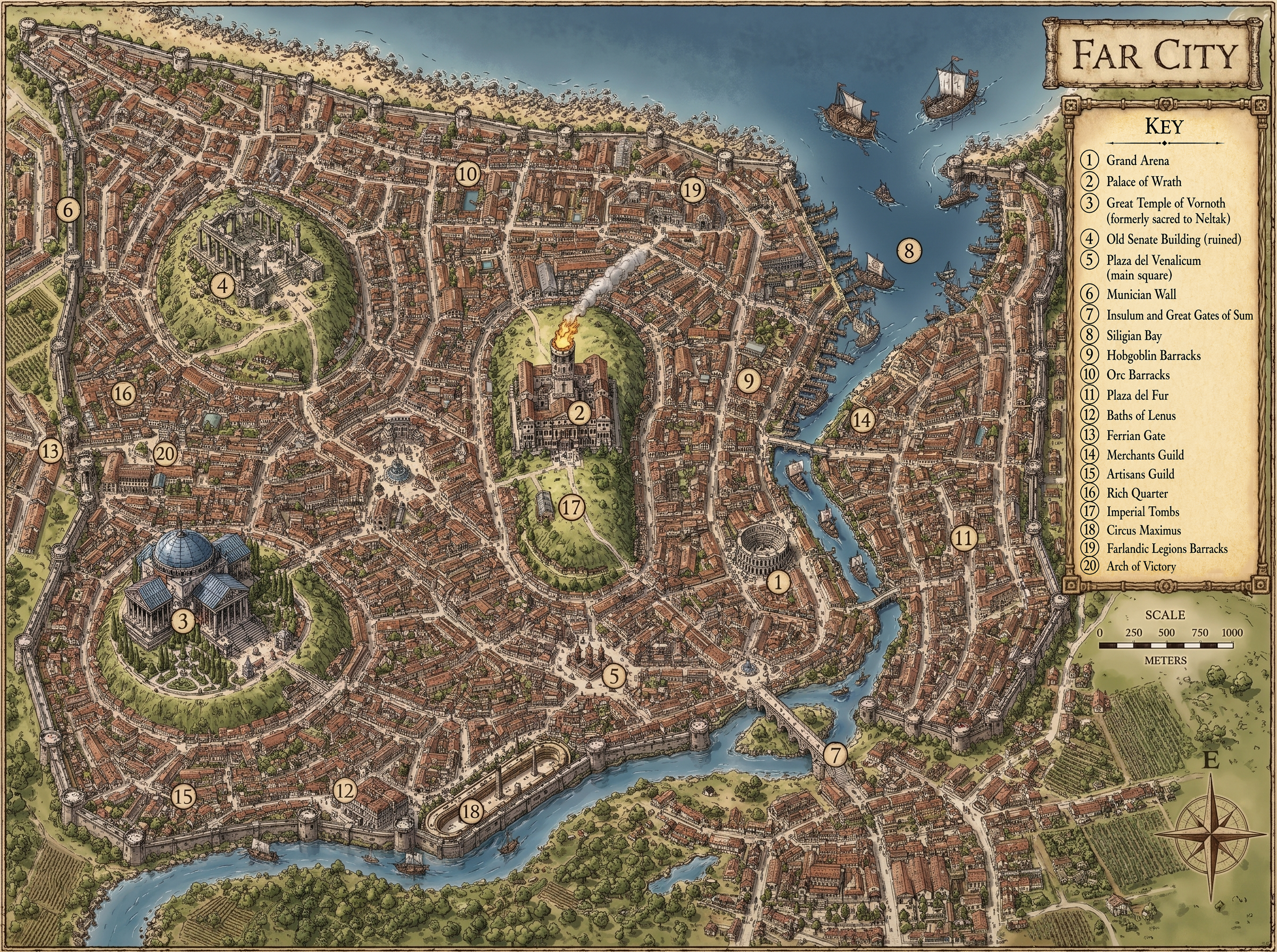
The city is dominated by three hills: Grandis Hill in the northwest corner, Carinas Hill in the northeast, and Dominium Hill in the center. Grandis Hill holds the ruined Old Senate Building, a grim reminder of the city that existed before the Lords of Sin broke it. Dominium Hill is crowned by the Palace of Wrath, where fire burns from the heights and smoke trails across the city like a permanent omen.
The Munician Wall still girds much of the city, strengthened by towers, gates, and old imperial stonework. The Ferrian Gate, the Insulum, and the Great Gates of Sum are among the best known entrances, though every gate is a place of inspection, bribery, and fear. To pass through them is to enter a city where the law has teeth and the guards enjoy using them.
The roads of the Far City are generally wide and well constructed, especially by the standards of the fallen age. Their names invariably begin with the Farlandish prefix "Wia," meaning way. Thus the main causeway, which crosses the Insulum and runs toward the Palace of Wrath, is called by the human populace the Wia Publius, after the founder of the Far City. The dark folk call it the Wia Burzgluk, meaning "the way to death."
Wherever more than two streets meet, a square called a plaza has been built. Each plaza has its own name and character, from the Plaza del Venalcium, the main square, to the Plaza del Fur, where merchants, informers, moneylenders, and officials all mingle beneath the same suspicious eyes. In the Far City even a fountain may be watched, and even a market song may carry a message.
Businesses of nearly every type and character can be found in the Far City. There are honest craftsmen, at least by the standards of the place, but there are also slave factors, relic sellers, poisoners, smugglers, corpse dealers, false priests, and men who will sell a legal document as readily as they will sell a knife. The black market thrives because the law is harsh, confusing, and unevenly enforced.
It is illegal to buy or carry weapons in the city without the proper papers. The black market will gladly supply these papers, as well as the weapons themselves, for a hefty price. The danger, of course, is that forged permission is still permission until the wrong soldier, clerk, or rival decides otherwise.
The Grand Arena and the Circus Maximus help keep the city quiet. The poor are given blood instead of bread, and many have learned to cheer while men die in the sand. The Arch of Victory stands nearby as a monument to imperial triumph, although there are still old citizens who know that victory and conquest are not the same thing as greatness.
The Great Temple of Vornoth rises where holier worship once stood, and its shadow lies across the city's soul. The Palace of Wrath, the Grand Arena, the ruined Senate, the barracks of orc, hobgoblin, and Farlandic soldiers, the Baths of Lenus, the Merchants Guild, the Artisans Guild, the Imperial Tombs, and the rich quarter all form parts of one vast machine. Some parts feed the people, some distract them, some exploit them, and some kill them when the first three fail.
1. Grand Arena. The Grand Arena is one of the most important buildings in the Far City, not because it governs the city, but because it helps keep the city governable. Here gladiators, slaves, condemned prisoners, monsters, and desperate volunteers fight and die before roaring crowds. The Emperor's officials know well that a starving populace is less likely to revolt if it is regularly fed blood.
2. Palace of Wrath. The Palace of Wrath stands on Dominium Hill and is the seat of the Lord of Anger. Fire burns from its heights, and the smoke that rises from it can be seen from much of the city. The palace is not merely a residence, but a fortress, court, prison, and symbol of imperial dominion.
3. Great Temple of Vornoth. The Great Temple of Vornoth was formerly sacred to Neltak, and that fact has never been forgotten by those few who still keep the old faith in secret. Now it is the stronghold of Rotgut the Wise and the center of the Dark Walker's worship in the city. Its rites are public enough to terrify the people, but its deepest ceremonies are hidden from all but the initiated.
4. Old Senate Building. The Old Senate Building lies in ruins on Grandis Hill, surrounded by open ground that seems almost too quiet for the Far City. In the elder days, the rulers of the city gathered there to debate and govern. Now it stands as a corpse of stone, useful chiefly as a warning that law without power is only memory.
5. Plaza del Venalcium. The Plaza del Venalcium is the main square of the Far City and one of its busiest public places. Traders, informers, priests, soldiers, beggars, and petitioners all pass through it, while the agents of greater powers watch from balconies, colonnades, and shaded doorways. Anything may be bought there, though some things are never offered openly.
6. Munician Wall. The Munician Wall is one of the great surviving works of old Far City engineering. Its towers and curtain walls still protect the city, though they could not protect its soul. The wall is manned by soldiers, customs officials, and spies, and its gates are places where a citizen's fate may turn on a seal, a bribe, or a careless word.
7. Insulum and Great Gates of Sum. The Insulum is the river island and causeway approach that carries traffic toward the heart of the city. The Great Gates of Sum stand as one of the most imposing entrances into the city proper, through which soldiers, merchants, slaves, and envoys pass under imperial eyes. To the human populace the road beyond is the Wia Publius, but many dark folk know it by the harsher name Wia Burzgluk.
8. Siligian Bay. Siligian Bay is the city's window to the wider world and the source of much of its wealth. Ships crowd its waters and docks, carrying grain, slaves, ore, timber, luxuries, weapons, and rumors from across Farland and beyond. The harbor is heavily watched, for the Empire knows that trade and treason often arrive on the same tide.
9. Hobgoblin Barracks. The Hobgoblin Barracks house troops whose discipline is feared even by other soldiers of the city. These warriors are often used to keep order in districts where ordinary guards would be ignored, bribed, or murdered. Their presence is a reminder that the Empire prefers obedience, but it will accept terror as a substitute.
10. Orc Barracks. The Orc Barracks are loud, violent, and dangerous even by the standards of the Far City. The orcs stationed there serve as shock troops, street enforcers, and muscle for imperial actions that require little subtlety. Citizens avoid the district after dark unless they have business with the military or no better choice.
11. Plaza del Fur. The Plaza del Fur is a place of merchants, factors, warehouses, and bargain-makers. Here the respectable economy and the black market almost touch hands, and it is often difficult to know where one ends and the other begins. A person looking for forged papers, prohibited goods, or a quiet introduction to the wrong people may begin the search here.
12. Baths of Lenus. The Baths of Lenus are among the city's most famous public baths, though the word "public" has different meanings depending on rank and coin. Nobles, officers, merchants, and courtesans come to bathe, gossip, negotiate, and spy. More political damage has been done in the steam rooms than in many council chambers.
13. Ferrian Gate. The Ferrian Gate is one of the major gates through the Munician Wall. It sees constant traffic, and the officials stationed there are notorious for extracting fees, favors, and information. Smugglers hate the gate, but they also use it, because every official has a price and every system has a crack.
14. Merchants Guild. The Merchants Guild controls a great deal of the city's legitimate trade and a not insignificant portion of its illegitimate trade as well. Its guildmasters are careful men and women who understand that coin must bend before power, but should never stop flowing. The guild survives by serving the Empire while quietly serving itself.
15. Artisans Guild. The Artisans Guild represents craftsmen, builders, smiths, potters, weavers, and other makers of useful things. It is less glamorous than the Merchants Guild, but no less necessary to the city's survival. The guild's workshops produce the goods by which the Far City arms itself, clothes itself, repairs itself, and reminds conquered lands of imperial taste.
16. Rich Quarter. The Rich Quarter is a district of walled villas, guarded courtyards, private shrines, and quiet streets that are cleaned more often than some poor citizens eat. Nobles, wealthy merchants, senior officials, and favored military officers dwell there behind gates and spells. They speak of the city's greatness while making certain they do not have to live like most of its people.
17. Imperial Tombs. The Imperial Tombs lie near Dominium Hill, built close enough to the Imperial Palace as a reminder to the former Emperors that even rulers become stone and bone. The tombs are no longer guarded or much watched, but they are rumored to be protected by curses and old magic. Some say the dead emperors do not rest easily now that a fiend sits where mortal rulers once held court.
18. Circus Maximus. The Circus Maximus is a vast arena for races, public games, military displays, executions, and imperial ceremonies. It is not as bloody as the Grand Arena every day, but it is no less political. The crowd gathered there can be made to cheer a chariot, a general, a law, or a hanging with equal fervor.
19. Farlandic Legions Barracks. The Farlandic Legions Barracks house human imperial troops, many of whom consider themselves the true heirs of the old military tradition. Their loyalty is watched carefully, for human soldiers remember more of the old city than hobgoblins do. The Emperor rewards them, uses them, and never fully trusts them.
20. Arch of Victory. The Arch of Victory commemorates the triumphs of the Empire and the conquest of its enemies. Its carvings show obedience, submission, victory, and imperial glory, though older citizens see other things in the stone. Like much of the Far City, it is impressive, beautiful, and morally diseased.
Magic is common in the Far City, though seldom innocent. People are used to paying for the spells that directly affect their lives and professions. A roofer may know a great deal about Feather Fall, and a craftsman certainly understands the value of Mending.
Most citizens are aware of the dangers of mind-affecting spells such as Charm Person, and many can recognize their effects if the signs are obvious enough. These spells are often used to assure servile loyalty, break resistance, and prevent slave revolts. A household with slaves may trust locks and chains, but a rich household trusts enchantment as well.
The courts of law often employ Zone of Truth, though no one in the Far City is foolish enough to believe that truth and justice are the same thing. Tax collectors use lie-detecting spells when coin seems to have gone missing, and civil projects are often expedited by Move Earth and similar magic. The defenses of the Far City were partly constructed using Wall of Stone, and houses of the wealthy are commonly protected by Alarm and other warding spells.
Magic is also used in the darker services of the state. Damaging and pain-inducing spells, combined with healing magic, are used with hideous effect by the Emperor's royal torturers. In the Far City, death is sometimes a mercy denied until every question has been asked twice.
The city is a hotbed of politics. Inter-guild and faction squabbling makes the Far City dangerous both figuratively and literally, and a man may be ruined by a bad contract as surely as by a poisoned cup. Assassination is illegal, but it is an ever-present danger, and the law against murder has never prevented the College of Blood from prospering.
Those who cross the Emperor or his minions are apt to disappear in the dead of night. Sometimes their bodies are found in the river, sometimes their names are removed from records, and sometimes their relatives are wise enough to pretend they never existed. Someone with ambition is bound to come to the notice of the city's powerful personages, and a powerful person who has avoided both betrayal and assassination for any length of time is a person, or creature, to be feared.
The mass of citizens in the Far City live in misery, especially since the Lord of Anger long ago disbanded the Public Dole. Starvation is rampant, and the poor are seen as deserving of their fate because they are too weak or too unambitious to help themselves. It is commonly said that they simply do not want to work, though a true look at the economy shows that little work is available for those without patrons, papers, or protection.
The poor are kept from revolt by the iron control of the Hawk Legion and the perpetual distraction of gladiatorial blood sports in the Grand Arena. Bread may be scarce, but punishment is plentiful, and spectacle is cheaper than reform. The Emperor understands this well.
The following poem was written in the last century by an unknown poet.
The Far City
And dost thou seek Far City 'midst these hulks?
Vain is thy search-- the city is no more.
Her tower'ing Grandis Hill is freedom's tomb;
Her rod and crown lie broken at her door.
That house where Emper'rs dwelt in elder days,
Tenanted now by demon worse than death;
Her Munician Wall could not fence out the flame,
Nor legions win, though fought they to last breath.
Sendus alone recalls--its passing waves
That sang her praise now murmur by her grave,
With wistful voice lamenting current state.
The Far City! T'was never thought you'd fall,
That stood for oh so long and withstood all.
Oh, stands she still? Then that is cruelest fate.
The Twenty Precepts in force throughout the kingdom of Farland are enforced in the Far City, and usually they are followed to the letter. This does not make the city orderly in any decent sense. It merely means that cruelty has been given procedure.
Any number of other arbitrary laws are also in force, and it generally takes a lawyer to begin to figure out which law is applicable and where it applies. Even then, knowledge of the law is not the same as safety. In the Far City, the written rule matters less than the rank of the man accusing you, the patience of the official hearing the matter, and the amount of coin placed quietly on the correct desk.
The Papers Are False. The heroes enter the Far City with forged weapon permits, travel papers, or merchant seals, only to discover that the official who sold them the documents has been arrested or murdered. Now the same papers that allowed them into the city mark them as conspirators. To survive, they must either escape the city or find new forgered papers before the Hawk Legion finds them.
The College of Blood Has a Contract. A patron hires the party to protect a merchant, priest, or minor noble who has been marked by the College of Blood. The problem is that no one knows who paid for the death, what grievance caused it, or which servant, guard, lover, or friend may already be in the assassins' pay. In the Far City, the knife is usually held by someone close enough to smile.
Rotgut's Judgment. Rotgut the Wise has declared a man guilty of heresy, but the condemned man's family insists that he knows a secret about the Great Temple of Vornoth. Rescuing him from temple custody would be nearly suicidal, but allowing him to die may bury a truth that could damage the church itself. The heroes must decide whether this is a rescue, an investigation, or a trap laid for fools with consciences.
The Southerner's Offer. Khadufel the Southerner approaches the party through an intermediary and offers them work that seems simple enough: recover a stolen object, expose a corrupt official, or embarrass a rival faction. The task is real, but so is the larger game. By accepting, the heroes become pieces in Khadufel's attempt to win influence among the city's dangerous powers.
Blood in the Arena. A slave, prisoner, or captured ally is scheduled to die in the Grand Arena. The obvious rescue is nearly impossible, since the arena is watched by soldiers, priests, beast handlers, and thousands of spectators. The less obvious rescue may involve bribes, disguises, forged imperial orders, or replacing one doomed fighter with another.
The Dead Emperor's Door. A scholar claims that one of the Imperial Tombs contains records from before the fall of the city, including a legal claim, prophecy, or secret that the Lord of Wrath would prefer remain buried. The tomb is sealed by old curses, and newer imperial wards. Worse still, something inside may have been awake for a very long time.
The Plaza Conspiracy. Rumors spread through the Plaza del Venalcium that the Public Dole will be restored, and the poor begin to gather in dangerous numbers. The rumor is false, but no one knows who started it or why. It may be a test by the Hawk Legion, a provocation by rebels, or a maneuver by one of the Cancellors to justify a purge.
The Harbor Chain. A ship arrives in Siligian Bay carrying contraband, escaped slaves, or a fugitive noble hidden among ordinary cargo. The harbor is locked down before the party can leave, and every warehouse, dock, and customs office becomes a place of danger. The heroes must move through sailors, smugglers, guild agents, and imperial inspectors before the tide turns against them.
War Hoth Lord Pirg Takes Notice. War Hoth Lord Pirg summons the heroes after one of their actions disturbs a political arrangement they did not even know existed. Pirg does not threaten them directly, which is more frightening than if he had. He offers them a service to perform, and the wise will understand that refusal is only another kind of acceptance.
The Riot That Wasn't. A disturbance in the poor quarter is blamed on rebels, foreigners, or dark folk agitators, but witnesses say the first violence was started by soldiers. The Hawk Legion prepares a brutal reprisal, and the party has little time to uncover the truth. The question is whether the truth matters in a city where punishment is often the point.
4515 F.R.-- Beckair Publius founds the Far City
5700-- Farland invades Zeland, beginning the Wars of Empire
5727-- King Maximus Maro of Farland declares himself the first Emperor
5738-Emperor Maximus dies of plague. A civil war ensues.
5739-Zeland rebels. Farland withdraws its troops from Lorindon to squelch the threat. The plague breaks out again and causes widespread famine. Thousands die.
5960-A large force of evil attacks Farland from the Deadlands, beginning the Wars of Sorrow. Emperor Lucius fights them to a standstill at the border.
5961-The fortified city of Borderhold is established.
5969-The Borderhold is taken and destroyed. The evil army invades Northern Farland.
5973-The Farlandish city of Lompeia is destroyed.
5975-Zeland and Orland rebel. The evil armies besiege the Far City.
5979-Zeland and Orland secede from the empire.
5985-A small army of elves, led by their King Baranthir, journeys to Farland to offer their aid, advice, and magic.
5989-The army of evil is defeated outside the Far City.
5990-Farland, with aid from the elves, raises a large army from all corners of the Kingdom. The dwarves also send troops from Wawmar.
5999-The army of Farland attacks and destroys the evil army encamped in the Deadlands.
6003-Farland, the elves, and dwarves invade the Wintervale and in the huge Battle of Sorrow defeat and annihilate the last of the evil armies. However, on their way back through the Trollheim Heights Pass, a force of trolls and other monsters treacherously ambushes them. Baranthir falls in the ambush, alongside Emperor Marcus I. The trolls are destroyed. The Pass is renamed the Pass of Doom.
6020-The Borderhold is refounded. The Farlandish Empire ends. Henceforth it is known as the Kingdom of Farland, and its kings are known as High Kings because most of the other countries eventually become subordinate allies or are forced to pay tribute.
6862-- The fleet of the Far City, at the behest of Daven, engages the ships of the Corsair Robert the Blue and completely destroys his fleet. During the returning voyage, half of the fleet of Farland is lost due to a raging storm.
7013-The order of the Far Knights is founded by Sir Lucius Zeno.
7090-The then leader of the Far Knights, the paladin Rothian Ganorus, as well as many members of the Cadre of the Wise, set out to explore the Deadlands and investigate the resurgence of evil there. They never return.
7115-- The kingdom of Farland continues to grow in power and expands trade with the other kingdoms.
7143-The Eastern alliance, led by Farland, sends troops into Kelerak. After a minor skirmish, Kelerak agrees to pay tribute to Farland.
7797-- The Dark Conquest begins. Farland is beset from the north and west.
7803-- In a brilliant strategic move, the Lord of Anger attacks from the Isle of Night and besieges the Far City. The hero Lord Gwyn Darius makes a last ditch effort to sail to the nameless city and kill the Evil One but is not heard from again.
7805-- The Far City falls. The Lord of Anger kills all the senators and disbands the senate.
7810-- The Lord of Anger disbands the public dole.
7950-- The first great rebellion of the citizens of the Far City takes place.
7951-- The rebellion ends in a massacre that decimates the population of the city.
8018-- The traitor Hoth Kanus attempts to invade the Far City with his legion but is eventually killed.