
Skip

More than four hundred years ago, Kiborus the Cold Master, vampiric chancellor of the Nameless City, conducted a series of magical experiments in the sewers deep beneath the city. Kiborus sought to create a new form of life, shaping the bodies of the dead into a sentient creature that would obey his every command. His efforts met with mixed success. He became the first known individual to create a flesh golem, but he was unable to instill true awareness into the creature. Again and again he attempted to grant it sentience, and again and again he failed—until at last one of his experiments succeeded and produced a powerful servant.
There was, however, an unforeseen consequence. To awaken his creation, Kiborus had poured the life force of countless tortured souls—many of them his own enemies—into the inert vessel of flesh. The golem could not contain all of this stolen essence. The excess awareness spilled from the creature and seeped into the sewers themselves.
There, among the filth and darkness, it found one of the lowliest creatures imaginable: a mindless black pudding.
Something strange and unique occurred. The sentience merged with the ooze, granting intelligence where none had existed before. For the first time, the creature became aware of itself. It understood its existence, its suffering, and the being responsible for both. Upon awakening, it desired only one thing: the destruction of Kiborus, its unholy father and creator.
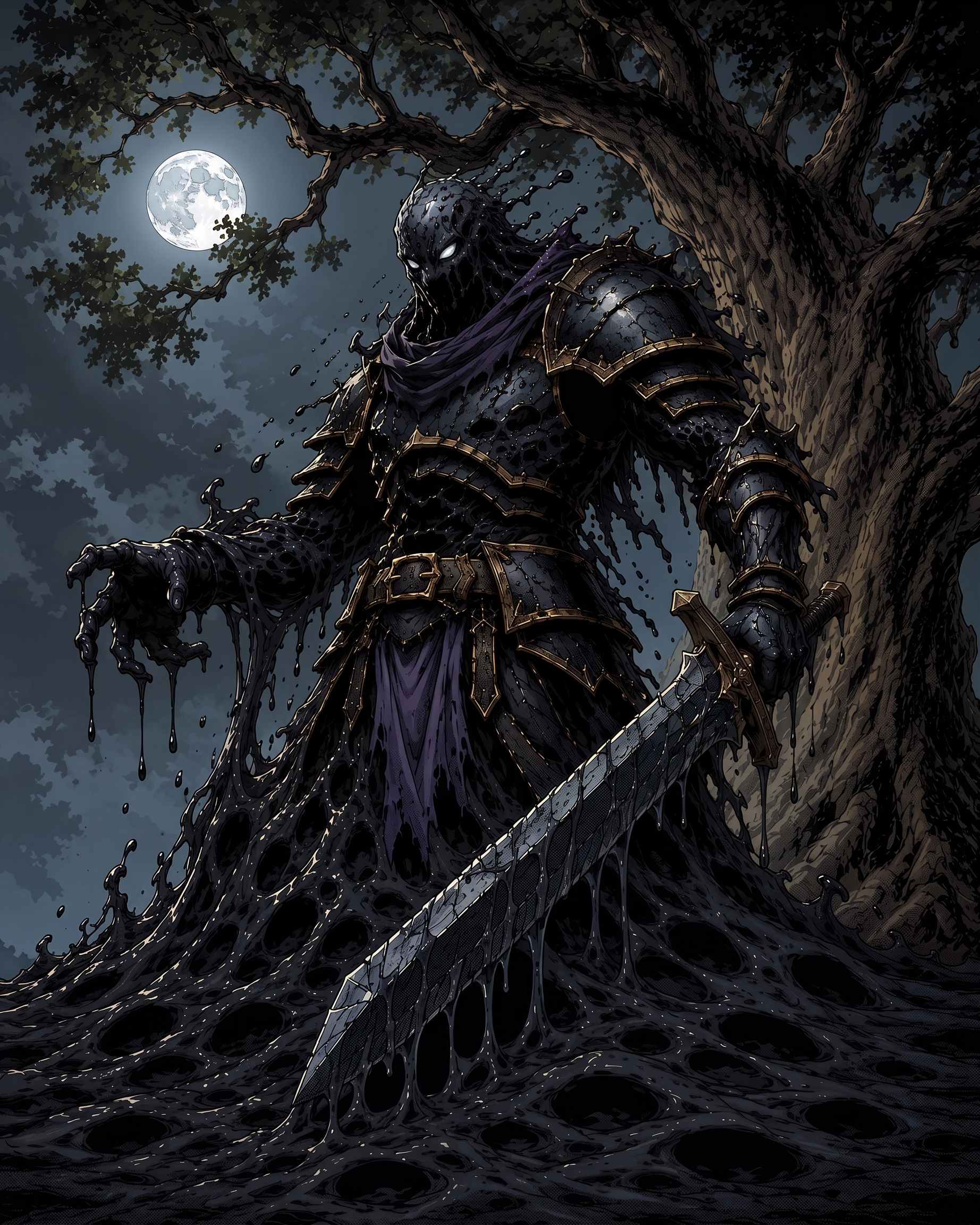
Thus was born Orax, Black Pudding of the Nameless City.
For years Orax schemed in the darkness beneath the city, determined to undermine Kiborus and eventually destroy him. His newfound intelligence allowed him to unlock powers that had lain dormant within his strange form. He learned to sap the strength and vitality of other creatures, weakening them before hunting them down. The servants of Kiborus quickly became his prey, and one by one they vanished into the sewers. Yet no matter how many minions he consumed, Orax never lost sight of his ultimate goal: the destruction of the vampire who had created him.
Two years after the experiment, Kiborus finally learned of the creature stalking his servants. He discovered the power Orax possessed and, more troubling still, the hatred the ooze bore toward him. By then many of his followers had already perished. The Dweller did not tolerate weakness, and Kiborus knew that his position within the Nameless City was beginning to slip. Orax had become a threat that could no longer be ignored. Gathering a band of his most loyal and powerful henchmen, the Cold Lord descended into the sewers to destroy his creation once and for all.
The existence of Orax, however, had already attracted the attention of another.
The Dweller had long been engaged in a subtle and far-reaching scheme to expand the power of her dark master, Vornoth. One by one she sought candidates worthy of becoming the Lords of Sin. Yet she struggled to find a suitable champion for one of the strangest and most elusive of the sins: Sloth. Orax seemed the perfect choice.
When Kiborus and his followers finally located the black pudding in the depths of the sewer system, they found that he was not alone. The white-robed Dweller herself stood beside the creature. With a slight wave of her hand, she dismissed the vampire and his forces. Though furious, Kiborus obeyed and slunk away.
The Dweller then offered Orax a bargain. She promised to fulfill his greatest desire. Kiborus would die, and he would die painfully.
The price was eternal service to the Dweller and to Vornoth himself. Orax agreed without hesitation.
The ooze and the enigmatic Dweller then retired into the depths of Frostspire. There, using the power of the Book of Seven, the Dweller enhanced Orax's natural abilities, strengthening his power to exhaust and weaken those who came near him. The Book also granted him the ability to assume human form, for the Dweller knew that he would need to rule a kingdom. Finally, she imbued him with the Dark Will so that he could command armies and lead the forces of darkness. Thus Orax, Lord of Sloth, was born.
Yet the Dweller betrayed him.
She still considered Kiborus too valuable a servant to sacrifice, and she knew that Orax's will was now bound to hers through the power of the Book of Seven. When she sent him at the head of a dark army to conquer Zeland he had no choice but to obey. The revenge he had been promised was denied him. Still, in the deepest recesses of his being, Orax never forgot.
Many misunderstand the nature of his sin. Orax is not slothful because he is lazy. Indeed, he can be patient, calculating, and relentless when pursuing his goals. Rather, he embodies a deeper and more terrible form of Sloth: spiritual surrender. Since the moment of his creation, Orax has existed in a state of resentment and stagnation. He does not strive to build, improve, or create. He clings to old grievances and allows them to define him. His victims feel their strength, ambition, and willpower drained away in his presence, mirroring the emptiness at the core of his own existence. Orax is the temptation to give up, to cease striving, to accept bitterness in place of purpose. He is not merely idle; he is the embodiment of despairing inertia.
Huge ooze (shapechanger), neutral evil
AC 18 Initiative -1Hit Points 260 (20d12+100)
Speed 20 ft., climb 20 ft. in ooze form
Skills Insight +7, Intimidate +5, Perception +6
Senses Blindsight 60 ft. in ooze form (blind beyond this radius in ooze form), passive Perception 16
Languages Dark Speech, Kingdom Common, Farlandish
Challenge 17 (XP 18 000 or 20,000 in lair; PB +6)
Shapechanger. The Lord of Sloth can use his action to polymorph into a human-like humanoid, or back into his true form, which is a black pudding. His statistics are the same in each form, although if an attack or ability is designated as a specific form, he can only use that attack or ability while in that form. Any equipment he is wearing or carrying is transformed. He reverts to his true form if he dies. In human form, the Lord of Sloth is stocky and strong. He generally carries and fights with a greatsword and crossbow, which somehow remain drenched in the acid of his ooze form.
Aura of exhaustion. At the start of each of the Lord of Sloth's turns, each creature within 20 feet of him must succeed on a DC 20 Constitution saving throw or gain a level of exhaustion. This effect cannot cause a creature's level of exhaustion to progress beyond level 3.
Amorphous. While in ooze form, the Lord of Sloth can move through a space as narrow as 1 inch without expending extra movement to do so.
Corrosive form. While in ooze form, a creature that touches the Lord of Sloth or hits him with a melee attack roll takes 13 (3d8) Acid damage. Nonmagical ammunition is destroyed immediately after hitting the Lord of Sloth and dealing any damage. Any nonmagical weapon takes a cumulative −1 penalty to attack rolls immediately after dealing damage to the Lord of Sloth and coming into contact with him. The weapon is destroyed if the penalty reaches −5. The penalty can be removed by casting the Mending spell on the weapon. In 1 minute, the Lord of Sloth can eat through 2 feet of nonmagical wood or metal.
Spider climb. While in ooze form, the Lord of Sloth can climb difficult surfaces, including along ceilings, without needing to make an ability check.
Multiattack. The Lord of Sloth makes two melee attacks, two ranged attacks, or a combination of the two.
Dissolving Pseudopod (ooze form). Melee Weapon Attack: +12, reach 10 ft., one target. Hit: 22 (3d10 + 6) bludgeoning damage plus 27 (4d10+6) acid damage. Nonmagical armor worn by the target takes a −1 penalty to the AC it offers. The armor is destroyed if the penalty reduces its AC to 10. The penalty can be removed by casting the Mending spell on the armor.
Acid projection (ooze form). Ranged Weapon Attack: +5 to hit, range 40/100 ft., one target.Hit: 27 (4d10+6) acid damage. In addition, nonmagical armor worn by the target is partly dissolved and takes a permanent and cumulative -1 penalty to the AC it offers. The armor is destroyed if the penalty reduces its AC to 10.
Greatsword (human form). Melee Weapon Attack: +12, reach 5 ft., one target. Hit: 13 (2d6+6) slashing damage plus 27 (4d10+6) acid damage.
Hand crossbow (human form). Ranged Weapon Attack: +5 to hit, range 30/120 ft., one target.Hit: 6 (1d6+3) piercing damage plus 27 (4d10+6) acid damage.
Legendary Action Uses: 3 (4 in Lair). Immediately after another creature's turn, the Lord of Sloth can expend a use to take one of the following actions. He regains all expended uses at the start of each of his turns.
Attack. The Lord of Sloth moves up to half his speed and makes a melee or ranged attack. He can't take this action again until the start of his next turn.
Heal self. The Lord of Sloth magically regains 27 (5d8 + 4) hit points. He can't take this action again until the start of his next turn.
Sleep. One creature within 90 feet of the Lord of Sloth must succeed on a DC 20 Constitution saving throw or fall unconscious until it takes damage or someone uses an action to shake or slap it awake. The target can save again at the end of each of its turns, ending the effect on a success. Once it has saved against this effect, it cannot be affected again for 3 rounds.
Aura of Sloth. The Lord of Sloth picks a point within 60 feet of him. The point emits an aura of sloth in a 15-foot radius. Any creature except the Lord of Sloth within the radius is affected as if it had failed a saving throw against the Slow spell. Only one of these auras can be in existence at a time. The aura cannot be moved once created. It can be dismissed by the Lord of Sloth as a bonus action, and it disappears if the Lord of Sloth uses a legendary action to create another aura of sloth.
The Lord of Sloth lairs in the Castle in Zel City and rarely leaves it. Those who live within half a mile of the Lord of Sloth's lair tend to be lazy and apathetic. Streams and bodies of water have a dark tint and taste acidic. His lair is guarded by various powerful oozes.