
Skip

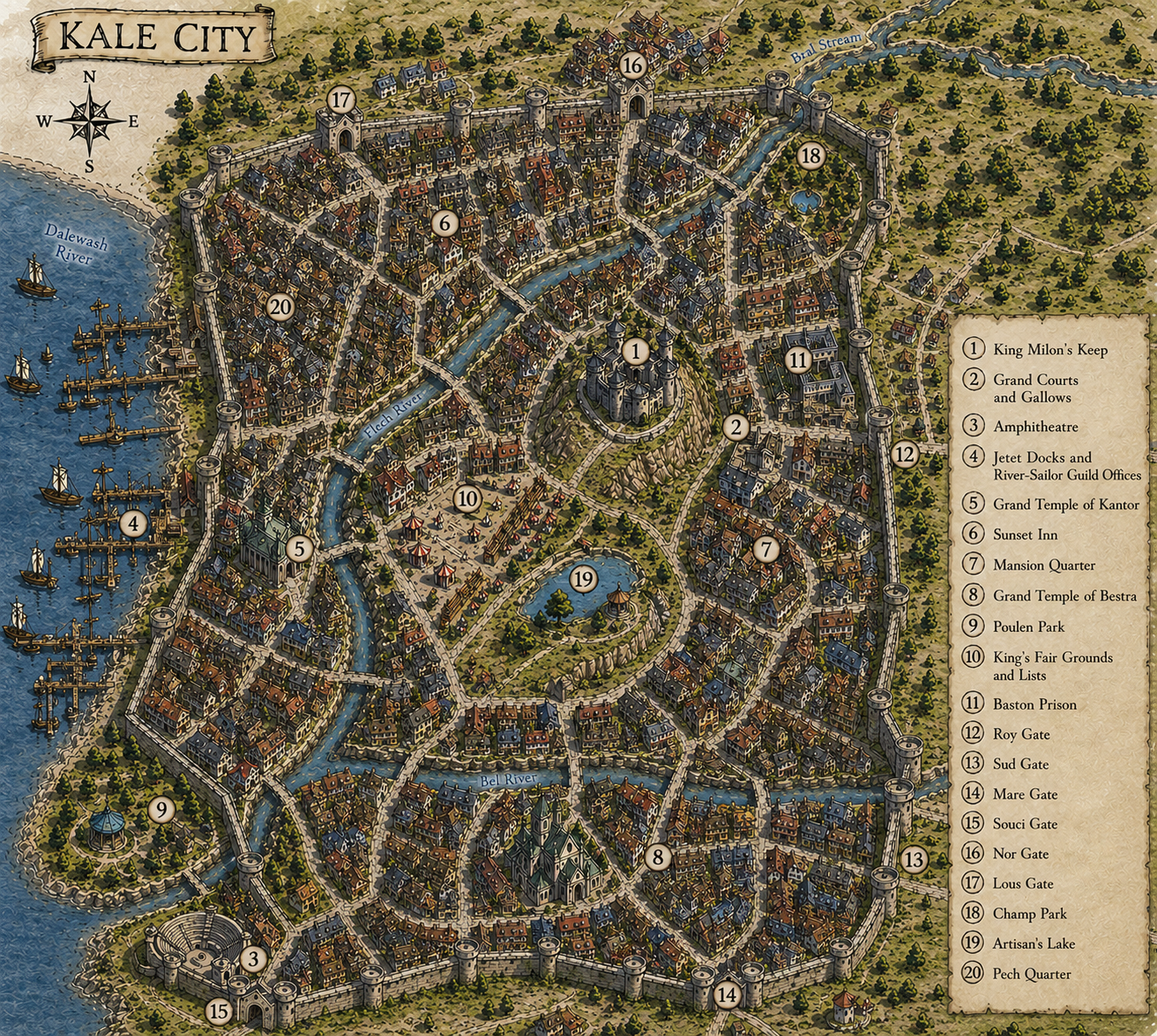
Kale City is the capital of the Kingdom of Kale and the youngest of the great human capitals of the West. It lacks the age, learning, and refinement of cities such as Dragonspur, and it suffered under the rule of the Lord of Pride during the Dark Occupation, but it has become one of the richest ports in the western kingdoms. Kale is a hard, crowded, energetic city where river merchants, knights, craftsmen, farmers, sailors, and thieves all struggle to make their fortunes beneath the walls of King Milon's Keep.
General Information
Areas of Interest
The City
Possible Adventures in Kale City
Important Dates
Who Rules: King Milon Dukalle, King of Kale, rules from Milon's Keep. He is a strong and active monarch who relies heavily upon his knights, royal judges, and personal officers to maintain control of the city.
Other Power Centers: Lord DeCourt is the most powerful noble in Kale outside the royal family. He dares not oppose Milon directly, but he works quietly to undercut the king's authority and to gather support among nobles who resent the Crown's alliances with the guilds.
Doolin, head of the Artisan's Guild, is one of the richest men in the city. He controls thousands of craftsmen, laborers, apprentices, and suppliers, and even the king must consider the guild's interests before imposing new taxes or regulations.
General Namus commands much of Kale's field army and is extremely popular among the citizenry. His victories during the Liberation and his habit of speaking plainly have made him a hero among soldiers and common men, though he has shown no desire to challenge Milon's rule.
Population: Kale City has between 20,000 and 25,000 inhabitants, though the number grows considerably during the great fairs and at harvest time. The population is mostly human, but a small community of wandering dwarves has settled near the workshops and foundries around Artisan's Lake. A few half-orcs also live in the city, almost all of them confined to the poverty of the Pech Quarter.
Major Products: Kale City is famous for Brandywine, port, and other strong spirits produced from the vineyards and orchards of the kingdom. It also exports wheat, fish, leather goods, saddles, tools, furniture, weapons, and finished craftwork.
The city is equally important as a port through which goods pass rather than originate. Cargo from northern Kale and the Selfhaven Archipelago is transferred between river vessels, sea-going ships, wagons, and warehouses, enriching merchants, guilds, and the Crown.
Armed Forces: King Milon maintains a standing force of approximately five hundred well-trained knights and professional soldiers. Most are stationed in Milon's Keep or at Baston Prison, though detachments guard the gates, courts, docks, and other important locations.
In time of trouble, another two thousand or more men can be called up from the city and surrounding lands. This number is smaller during planting and harvest, when farmers and laborers are reluctant to leave their fields. The guilds can also arm their members, though Milon watches such private forces carefully.
King Milon's Keep stands upon a steep hill near the center of Kale City, rising above the surrounding houses, markets, and waterways. Its towers can be seen from nearly every quarter, and the gold and black banners of House Dukalle fly constantly from its battlements. The keep is not especially beautiful, but it is very strong. Its curtain walls follow the edge of the rocky hill, while a fortified road slopes upward through two gates before reaching the inner ward.
The oldest portions of the keep date from the time when Kale was little more than a feudal stronghold surrounded by farms and muddy river villages. Later kings expanded it, and the Lord of Pride added several towers, a great audience hall, and a throne chamber intended to impress foreign ambassadors. Milon uses these additions but has removed most of their former master's statues, portraits, and other hateful decorations. The king and his household live within the inner keep, while the outer buildings contain barracks, armories, kitchens, stables, offices, and chambers for visiting nobles.
About three hundred of Milon's knights and household soldiers are normally stationed here. Visitors approaching the keep are questioned at the first gate, searched at the second, and watched closely thereafter. Even nobles are not permitted to carry weapons into the royal audience hall unless granted that privilege by the king.
The Grand Courts occupy a grim complex of stone buildings east of the royal hill. The highest royal court meets here, as do several lesser courts dealing with guild disputes, debts, property claims, theft, violence, and offenses against the Crown. Milon is known for swift judgment, and cases that might drag on for months elsewhere are often decided within a few days in Kale.
The courts are crowded from dawn until late afternoon with advocates, witnesses, prisoners, guild representatives, and citizens hoping to settle disputes. Justice is not always even, for wealthy men can afford skilled advocates and poor men usually cannot. Even so, bribery among the king's judges is dangerous. Milon has dismissed several magistrates and hanged one after discovering that he had sold verdicts to the Transporters Guild.
The gallows stand in a walled yard beside the courts. Executions are public and usually draw large crowds, especially when the condemned prisoner is a murderer, traitor, or notorious thief. Lesser criminals may be whipped, branded, fined, placed in the stocks, or sentenced to work on the city walls and roads.
The Amphitheatre lies just outside the southwestern wall near the Souci Gate. It is an old stone structure built into a low rise overlooking the Dalewash River, with enough seating for several thousand spectators. Plays, contests, public speeches, religious ceremonies, and military demonstrations are held here during the warmer months.
The people of Kale have little patience for long tragedies, obscure poetry, or the refined dramas favored in older cities. They prefer comedies, heroic tales, mock battles, wrestling matches, animal exhibitions, and performances involving loud music or dangerous stunts. Traveling companies that understand this can earn a great deal of money, while those that do not are often driven from the stage by thrown fruit and insults.
Blood sports were frequently held here during the Occupation, but Milon has outlawed fights to the death. Accidents still occur, particularly during staged battles and contests involving wild animals. Beneath the arena are old holding cells, storage chambers, and passages dating from several periods of construction, some of which have been sealed since the fall of the Lord of Pride.
The Jetet Docks extend along the western bank of Kale City where the Dalewash River meets the city's lesser waterways. Long piers jut into the river, and the water is usually crowded with barges, fishing boats, merchant vessels, and shallow-draft sailing ships. Cargo from northern Kale, the Selfhaven Archipelago, and the southern river lands passes through these docks.
The district is noisy at nearly every hour. Sailors shout from decks, porters carry crates along the piers, merchants argue over damaged goods, and guild clerks inspect manifests beneath canvas awnings. The air smells of fish, tar, wet rope, spices, river mud, and the spirits stored in the nearby warehouses.
The River-Sailor Guild maintains its main offices in a fortified stone building overlooking the largest pier. No commercial vessel may unload at Kale without the guild's permission, and every captain must pay docking fees, inspection fees, and a contribution toward maintenance of the river channels. Guild pilots guide larger vessels through the shallows and branching waterways, though many captains complain that these pilots are both unnecessary and expensive.
Smuggling is common despite frequent searches by the king's officers. Contraband is hidden beneath fish, inside wine casks, among bundles of leather, and sometimes beneath false decks. The guild officially condemns such practices, but some of its officers have grown very wealthy on salaries that should not permit it.
The Grand Temple of Kantor stands near the river west of the royal Fair Grounds. It is a massive stone building with a square bell tower, a broad stair, and heavy bronze doors carved with scenes of judgment, war, law, and kingship. Knights of Kale traditionally visit the temple before taking their oaths to the Crown.
The temple priests teach that strength must serve law rather than appetite. They bless soldiers, advise judges, keep records of noble marriages and oaths, and provide sanctuary to those who can reach the temple before being seized. This right of sanctuary is limited, however, and the priests will surrender murderers, traitors, and servants of the Dark Powers after an inquiry.
The current high priest is Father Armand Vaul, an austere old man who supported Milon during the liberation of Kale. He is one of the few men in the city who will openly rebuke the king, though he does so in private whenever possible. Beneath the temple are crypts containing former kings, royal knights, and several heroes who died during the struggle against the Lord of Pride.
The Sunset Inn is the most famous inn in Kale City and one of the largest in the western kingdoms. It stands in the northern quarter where several important streets converge near the Flech River. Its upper windows face west, and on clear evenings the setting sun shines across the rooftops and turns the river red and gold.
The inn contains several common rooms, private dining chambers, stables, baths, and more than fifty guest rooms. Merchants, minor nobles, guild officers, foreign captains, and successful adventurers all stay here. Prices are high, but the food is excellent, the beds are clean, and the inn's guards make theft more difficult than in most Kale lodgings.
The proprietor, Darien Sol, knows nearly every important merchant and caravan master who passes through the city. He is friendly without being foolish and helpful without giving anything away for free. Several guilds use the inn's private rooms for meetings, and foreign agents are sometimes found among the guests pretending to be wine merchants or dealers in cloth.
The Mansion Quarter lies southeast of the king's hill and contains the homes of Kale's wealthiest nobles, guild masters, merchants, and royal officers. High walls surround most estates, and armed servants guard their gates. The streets are wider and cleaner than elsewhere in the city, though they remain crowded with coaches, messengers, tradesmen, and household servants.
Lord DeCourt owns the largest private residence in the quarter, a fortified mansion with its own tower, chapel, gardens, and barracks. He entertains lavishly and frequently holds dinners for nobles who believe King Milon has granted too much influence to guildsmen and common soldiers. DeCourt is careful never to speak treason, but few doubt that he would gladly weaken the king if he could do so without risking his estates or his neck.
Doolin, head of the Artisan's Guild, also keeps a mansion here. His house is less grand than DeCourt's but is filled with fine furniture, carved stone, tapestries, clocks, glasswork, and other examples of the guild's craft. Old nobles quietly resent his presence in the quarter, especially since Doolin is wealthier than most of them.
The Grand Temple of Bestra stands south of the Bel River, its tall roof and green copper spires rising above the surrounding houses. The temple is known for healing, charity, midwifery, and care of the city's poor. Its priests also maintain several gardens where medicinal herbs are grown behind high stone walls.
The temple's main hall is bright and spacious, with painted windows showing the seasons, the harvest, childbirth, healing, and the renewal of the land. A large hospice adjoins the temple and treats injured laborers, sick children, travelers, and soldiers. Those who can pay are expected to do so, but the priests rarely turn away anyone in genuine need.
The high priestess, Mother Celise, has repeatedly criticized the guilds for unsafe workshops, polluted water, and the treatment of laborers injured on the docks. This has made her popular among the poor and unpopular among several powerful guild masters. King Milon respects her, though even he has sometimes found her demands difficult to satisfy.
Poulen Park occupies a wooded point of land outside the western wall near the river. Stone paths wind among old trees, low cliffs, and small gardens overlooking the Dalewash. The park is reached through a narrow gate in the city wall or by boat from the nearby docks.
The park was once reserved for the royal family, but Milon opened it to the public. Families come here on holy days, soldiers walk the paths with their sweethearts, and old men gather beneath the trees to argue about war and politics. Taverns and food sellers are not permitted within the park, which has done little to stop visitors from carrying in bottles of Brandywine.
A small pavilion stands at the western edge of the park. Musicians sometimes perform there, and public announcements are made from its steps. The wooded slopes below the main paths are less respectable after dark, and thieves, smugglers, and secret lovers have all found uses for them.
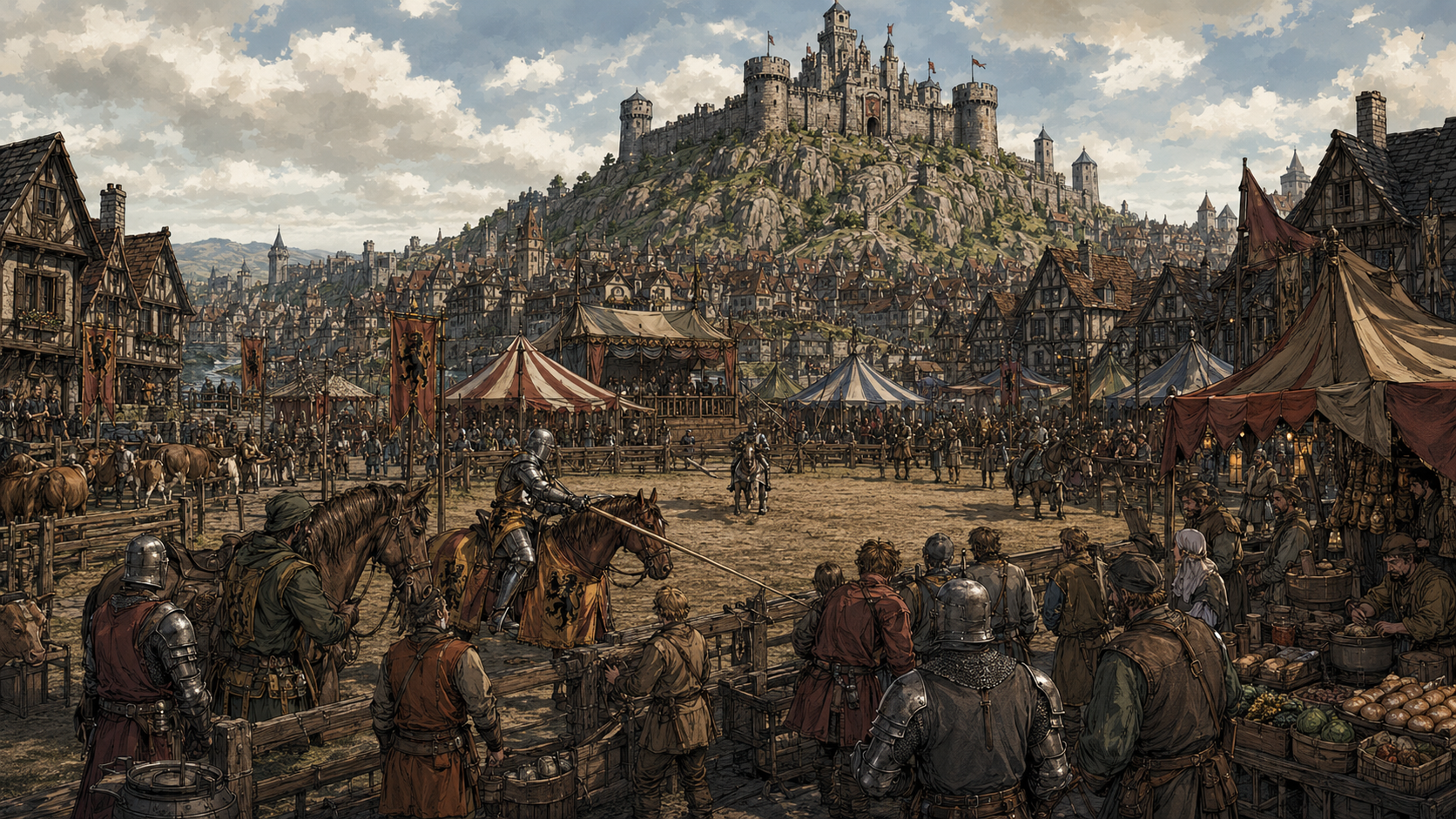
The King's Fair Grounds spread across the open land below Milon's Keep. Markets, livestock sales, festivals, military reviews, tournaments, and public celebrations are held here. When no major event is underway, the grounds still contain food stalls, performers, animal dealers, fortune-tellers, labor brokers, and merchants selling goods from carts and temporary booths.
The jousting lists occupy the eastern portion of the grounds. They include a long fenced course, viewing stands, stables, armories, and several sanded yards used for swordsmanship, archery, and mounted exercises. Milon's knights train here before the public, partly to encourage confidence in the Crown and partly to remind the citizens who keeps order in Kale.
The largest annual fair draws merchants from across the kingdom and from lands beyond it. During that week, the grounds become a temporary city of tents and wooden stalls. Guild rules are relaxed but not abolished, and visiting merchants must purchase fair permits before opening their booths.
Baston Prison is a broad, ugly fortress east of the Grand Courts. Its walls have no decoration, its windows are narrow, and its inner yards are divided by iron fences and covered passages. The prison holds dangerous criminals, political prisoners, captured bandits, and those awaiting judgment in the royal courts.
About two hundred of Milon's soldiers are stationed within the prison or in the adjoining barracks. Some serve as guards, while others form a reserve force that can quickly be sent to the courts, the Mansion Quarter, or the eastern gates. The prison governor, Sir Gaston Barre, is a severe but competent knight who considers escape a personal insult.
The oldest cells lie beneath the present structure and date from the original stronghold. During the occupation, these lower chambers were expanded into interrogation rooms, private dungeons, and places of execution. Milon ordered most of them sealed, but rumors persist that not every passage was found and that some prisoners were left behind when the servants of the Lord of Pride fled.
The Roy Gate stands in the eastern wall and opens onto the principal road toward the royal estates and the settled lands beyond Kale City, eventually proceeding on to Daven. It is a well-maintained gatehouse protected by two round towers, a portcullis, murder holes, and a pair of heavy wooden doors bound in iron. Nobles, royal messengers, and official processions commonly enter the city here.
The guards at the Roy Gate are chosen from the king's household troops and are better disciplined than those at most other gates. Wagons are inspected, weapons are declared, and travelers of suspicious appearance are questioned. Bribes are less likely to succeed here, though forged royal papers sometimes do.
The Sud Gate serves the southeastern road and much of the traffic from the farms and villages south of the city. Grain wagons begin gathering outside before dawn, and long lines form during the harvest season. Drovers also bring cattle, sheep, and pigs through this gate, making the nearby streets noisy and filthy.
The Transporters Guild keeps an office just inside the wall and collects fees from licensed wagoners. Independent drivers are watched carefully and often delayed on minor grounds until they pay for a temporary permit. Fights between guild wagoners and rural teamsters are common enough that a squad of city guards is stationed nearby during the busiest months.
The Mare Gate stands in the southern wall near the Bel River. It takes its name from the horse markets once held outside its towers, though the city has long since grown around the old market grounds. Horse dealers, messengers, cavalrymen, and travelers using the southern roads still favor this entrance.
Several large stables stand inside the gate, and nearly every one claims to offer the finest horses in Kale. Some are honest establishments, while others sell old animals after dyeing their coats, filing their teeth, or drugging them into temporary liveliness. The king's inspectors make occasional arrests, but the dishonest dealers always seem to return under new names.
The Souci Gate is located in the southwestern wall near the Amphitheatre. It is smaller than most of Kale's gates but handles a steady flow of spectators, performers, fishermen, and travelers coming from the river road. On performance days the road outside becomes lined with food sellers, gamblers, jugglers, and pickpockets.
The gate acquired a bad reputation during the Occupation, when condemned prisoners were marched through it to die in the Amphitheatre. Some citizens still refuse to pass beneath its arch after dark. Guards have reported hearing footsteps on the wall when no one is present, though they generally blame strong drink when questioned by their officers.
The Nor Gate is the largest gate in Kale City and the principal entrance from the north. The road beyond it carries wine, timber, grain, leather, and other goods from northern Kale. The gatehouse is protected by high towers and overlooks the Bral Stream, which flows near the outer defenses.
Merchants passing through the Nor Gate must declare their cargo and pay the appropriate tolls. Guild inspectors keep their own tables beside the royal collectors, so a traveler may be questioned and charged several times before entering the city. The resulting delays are a constant source of anger, but the trade passing through the gate is too profitable for either the Crown or the guilds to simplify matters.
The Lous Gate stands in the northwestern wall and opens onto a lesser road used by villagers, hunters, charcoal burners, and small caravans seeking to avoid the crowds at the Nor Gate. It is older and narrower than the city's other northern entrance. The gatehouse shows several periods of repair, and portions of its stonework still bear scars from the liberation of Kale.
The guards stationed here have a reputation for accepting small favors in exchange for overlooking minor violations. This makes the gate popular with smugglers who cannot afford the larger arrangements needed at the docks. King Milon's officers periodically replace the entire watch, but corruption gradually returns because the traffic is difficult to supervise and the surrounding ground offers many hiding places.
Champ Park lies in the northeastern part of the city near the wall. It is a broad green space containing lawns, groves, riding paths, and a small pond fed by the Bral Stream. The park was laid out during the Occupation as a place where nobles could display their horses, clothes, servants, and carriages.
Milon opened most of the grounds to the public but retained a fenced riding field for the use of the royal household and cavalry. Wealthy citizens still gather here to be seen, while apprentices and servants come to watch them. The park is quieter than the King's Fair Grounds and more fashionable than Poulen Park, though it becomes crowded whenever the weather is fair.
The trees near the northern wall have grown thick enough to conceal anyone leaving the main paths. Duels, secret meetings, and illicit exchanges sometimes take place there at dawn. The city watch patrols the park, but its officers rarely interfere with nobles unless blood has already been spilled.
Artisan's Lake lies southeast of the King's Fair Grounds and is fed by the Flech River and several smaller channels. It was once a marshy basin, but generations of craftsmen widened and deepened it to provide water for mills, tanneries, smithies, dyers, and other workshops. The Artisan's Guild now controls nearly every building along its shore.
Waterwheels turn along the northern channel, and barges carry fuel, timber, hides, ore, and finished goods between workshops. The lake is usually crowded with small boats, floating platforms, and rafts of lumber. A guild pavilion stands on a wooded island near its center, where Doolin and the senior masters hold private meetings.
The lake is not as clean as it appears from the king's hill. Dyes, ash, blood, tanning chemicals, and other waste enter the water despite royal regulations. The priests of Bestra have warned that the lake is becoming dangerous, but the guild insists that stricter rules would damage the city's prosperity.
The Pech Quarter occupies much of the western city between the river, the docks, and the poorer stretches of the Flech. It is the most crowded and impoverished part of Kale. Houses lean across narrow alleys, families sleep in cellars and lofts, and several streets turn into open sewers after heavy rain.
The city's poorest laborers live here, along with beggars, discharged soldiers, foreign sailors, half-orcs, and others unwelcome in better quarters. Any half-orcs remaining in Kale are required by law or custom to reside in Pech. Some have found work on the docks or in the tanneries, but many survive through casual labor, scavenging, smuggling, or crime.
Several small thieves' guilds operate in the quarter. None is powerful enough to challenge the king openly, and all fear Milon's swift justice, but they fight constantly over streets, taverns, gambling dens, and access to the sewers. A few guild officers and respectable merchants quietly employ these gangs when they need work performed without witnesses.
Rumors claim that dark folk left behind after the occupation still live beneath Pech. Sewer workers have found strange tracks, crude shrines, and doors blocked from the other side. The watch dismisses many of these stories, though patrols rarely enter the deeper tunnels without soldiers or priests accompanying them.

Kale City is the youngest capital city of the human kingdoms. It began as little more than a feudal stronghold overlooking a collection of river crossings, fishing villages, and farms. Its position gradually drew merchants and craftsmen, and the settlement grew around the keep until its walls enclosed a true city. Today Kale is one of the busiest ports in the West. Cargo from northern Kale and the Selfhaven Archipelago passes through the Jetet Docks, while grain, livestock, wine, and leather arrive by road. Goods move through the city in a nearly constant stream of wagons, carts, barges, pack animals, and sweating porters.
Only Dragonspur City clearly surpasses Kale in economic importance among the western capitals. Kale does not possess Dragonspur's scale, old institutions, or wide influence, and it cannot match the learning and art of older cities. Its wealth is newer and rougher, built on shipping, guild labor, strong drink, livestock, grain, and the needs of a kingdom that still thinks of itself as a frontier land.
The city more or less maintained its pre-conquest condition during the reign of the Lord of Pride. That ruler took smug pleasure in enlarging the walls, beautifying the keep, and making Kale appear as glorious as possible. He cared little for the welfare of its inhabitants, but he wanted the city to stand as evidence of his own greatness. While the pettiness of the Lord of Lust toward the Lord of Pride depressed the overall economy of the Kingdom of Kale, the city itself managed to maintain most of its economic livelihood.
This strange vanity spared Kale much of the destruction suffered elsewhere. Its workshops continued to operate, its docks remained active, and its walls were repaired rather than allowed to crumble. The cost was borne by slaves, prisoners, and heavily taxed citizens, many of whom died building monuments that Milon later tore down.
Since the city's liberation, King Milon's strong guiding hand has allowed its economic functions to grow. Roads have been repaired, river channels cleared, docks expanded, and royal patrols sent against bandits. Milon's justice is harsh, but merchants generally prefer harsh laws that are enforced to uncertain laws that can be purchased by every local noble.
Kale's geography is shaped by water. The Flech River cuts through the center of the city, while the Bel River flows through its southern quarter and smaller channels feed Artisan's Lake. Bridges connect the crowded districts, and boats often provide a faster means of travel than the streets. The Dalewash River forms the city's western boundary and carries most of its commercial traffic. The Jetet Docks spread along this shore, surrounded by warehouses, taverns, counting houses, cooperages, and the cramped streets of the Pech Quarter. At night the river reflects hundreds of lanterns, though the darker piers belong as much to smugglers and thieves as to honest sailors.
The city is enclosed by a strong wall strengthened by round towers and seven principal gates. Beyond the walls lie fields, orchards, scattered houses, mills, and roads crowded with travelers. Several important sites, including the Amphitheatre and Poulen Park, stand just outside the main defenses.
King Milon's Keep dominates the city from its central hill. The main market square, the royal Fair Grounds and Lists, and the Grand Public Courts surround it. The banners flying from the keep's parapets are visible from most quarters, providing a constant reminder that Kale is a royal city and that its king keeps watch over it.
The streets closest to the keep and the Mansion Quarter are paved and regularly cleaned. Elsewhere, paving is uneven or absent, and mud becomes a serious problem during wet weather. Wooden upper stories project over narrow streets, sometimes leaving only a strip of sky visible above. Fire is a constant danger. Most districts maintain public wells, ladders, hooks, and leather buckets, and guild regulations require workshops to keep sand and water nearby. These precautions are not always obeyed, particularly in Pech, where a single fire could consume several blocks before the watch could respond.
Large guilds dominate the economy of the city. The Artisan's Guild, the River-Sailor Guild, and the Transporters Guild are the most powerful of these bodies. A man cannot legally work or sell anything related to their trades without the express permission of the appropriate guild. Full membership is difficult to obtain and usually requires an apprenticeship, fees, sponsorship, and several years of service. Temporary permits to sell goods or provide services are easier to acquire, though they are rarely cheap. Foreign merchants often complain that they pay the guilds merely for permission to pay the Crown. The guilds protect standards, train apprentices, support injured members, and defend Kale's commercial interests. They also fix prices, exclude competitors, pressure royal officers, and ruin men who defy them. Milon understands that the city depends upon the guilds, but he has no intention of allowing them to become a second government.
Kale is wealthy, but much of that wealth is concentrated in a few hands. The Mansion Quarter displays fine houses, imported stone, gardens, and armed servants, while families in Pech crowd six or eight people into a single room. Guild masters and merchants speak proudly of the city's prosperity, but dockworkers and apprentices do not always share in it.
The city has fewer scholars, artists, and great schools than one would expect in a capital of its size. Its nobles employ musicians and painters, and the temples preserve libraries, but Kale has never become a major center of learning. Its people admire skill that produces something useful and are suspicious of learning that seems to produce only more words. This does not mean that Kale is dull. The Fair Grounds, Amphitheatre, taverns, parks, riverfront, and markets provide constant entertainment. Public arguments, wrestling matches, horse races, drinking contests, military parades, and guild festivals attract far more interest than lectures or formal poetry.
The Pech Quarter remains the city's greatest shame and its most dangerous district. The poorest residents and the city's personae non gratae are pushed into its alleys, where several small thieves' guilds compete beneath the watchful eye of the Crown. Milon's swift justice keeps them cautious, but it has not eliminated them. Stories of dark folk in the sewers are common in Pech. Some may be tales invented to frighten children or keep guards away from smugglers' tunnels. Others are supported by missing sewer workers, mutilated animals, and symbols found scratched into stones that predate the city's liberation.
Kale City is neither beautiful nor gentle, though parts of it can be impressive. It is a city of strong walls, crowded markets, proud knights, rich guilds, hard labor, and sudden opportunity. A clever man can become wealthy there, but he can just as easily end in Baston Prison, beneath the gallows, or floating facedown among the docks.
The Guildless Craftsman. A talented dwarven smith refuses to join the Artisan's Guild and begins selling weapons from a workshop near the Pech Quarter. His blades are better and cheaper than those of several guild masters, and Doolin orders the shop closed. When the smith disappears and his workshop burns, his family hires the adventurers to discover whether he was murdered, imprisoned, or forced into secret service.
Beneath Baston Prison. Prisoners in one wing of Baston begin vanishing from locked cells. Governor Barre suspects corruption among his guards, but the remaining prisoners speak of scratching sounds beneath the floors and pale hands reaching through cracks in the stone. The investigation leads into the sealed dungeons of the occupation, where something has survived without light for many years.
The Poisoned Lake. Workers around Artisan's Lake fall ill, fish wash ashore dead, and a sickly green film spreads across the southern water. The priests of Bestra blame industrial waste, while the guild insists that someone is poisoning the lake to damage Kale's economy. The truth may involve a careless guild master, a foreign rival, or a creature awakened in the mud beneath the workshops.
Lord DeCourt's Supper. The adventurers are invited to a dinner at Lord DeCourt's mansion, where they are quietly offered payment to uncover corruption among Milon's officers. The evidence they find is real, but DeCourt intends to use it to discredit the king rather than reform the city. Refusing him may make a powerful enemy, while helping him could weaken Kale at a dangerous moment.
The Last Statue of Pride. Laborers repairing a cellar beneath the royal Fair Grounds discover a buried statue dating from the Occupation. Those who see its face become arrogant, violent, and convinced that they deserve greater honor than they have received. The priests demand its destruction, but a wealthy collector has already offered a fortune to anyone who can remove it secretly from the city.
Smugglers at Lous Gate. A royal inspector disappears after reporting unusual traffic through the Lous Gate. His notes mention wagons entering empty and leaving heavier than before, though no cargo is recorded. The smugglers are not bringing goods into Kale, but carrying people and stolen relics out through an old passage beneath the wall.
The Souci Procession. On the anniversary of Kale's liberation, ghostly prisoners appear near the Souci Gate and march toward the Amphitheatre. Most vanish before reaching the arena, but one turns toward the crowd and names a living citizen as his murderer. The accused man is now a respected royal officer who claims never to have served the Lord of Pride.
The Missing Guild Barge. A barge carrying rare metal, finished weapons, and the Artisan's Guild payroll vanishes while traveling between the Jetet Docks and Artisan's Lake. No wreckage is found, and the river gates were watched throughout the night. Doolin offers a large reward for its recovery but conceals the fact that one locked chest aboard belonged personally to King Milon.
Blood beneath Pech. Several half-orc laborers disappear from the Pech Quarter, but the watch shows little interest until a knight's son vanishes as well. Tracks lead into the sewers, where rival thieves' guilds have agreed to a temporary truce. Something below the city is gathering blood for a ritual begun during the Occupation and never completed.
The False Brandywine. Merchants discover that barrels bearing the marks of several famous Kale vineyards contain cheap spirits mixed with a dangerous alchemical substance. The counterfeit wine has already been shipped to foreign courts, threatening both lives and the reputation of the kingdom. The trail leads through cooperages, guild warehouses, and a hidden distillery protected by men who know that exposure would ruin some of the richest families in Kale.
The General's Name. Anonymous broadsheets begin appearing throughout the city, calling upon General Namus to replace Milon as king. Namus publicly condemns them, but their author seems to know private details about his campaigns and household. The adventurers must determine whether the general is lying, being framed by DeCourt, or being used by an enemy who hopes to divide the kingdom without drawing a sword.
Murder at the Sunset Inn. A foreign envoy is found dead in a locked room at the Sunset Inn on the eve of negotiations with King Milon. The man's guards accuse Kale, the guilds blame foreign rivals, and Darien Sol insists that no one entered or left the chamber. Hidden among the envoy's belongings is a map of tunnels beneath Milon's Keep that should not exist.
The Champion of the Lists. An unknown knight wins every contest held at the King's Lists but refuses to remove his helm or name his family. His victories excite the crowds and embarrass several of Milon's household knights. When challengers begin dying from wounds that should have healed, suspicion falls upon the knight, though the true danger may be the weapon awarded to him after his first victory.
6560-Kale, the second son of King Orlock of Daven, cheated of an inheritance, goes off with his loyal followers and founds the Kingdom of Kale.
6562-Kale founds Kale City.
6602- A baron from the Kingdom of Kale attempts to found a colony in the Wilderness lands to the West of Kale. Kale receives word that the colony is initially founded successfully and is prospering.
6610-Lord Nicolas of Kale City begins funding buccaneers and raiders to capture Davonian merchants by land and sea. This is at the secret behest of King Girars.
6615-Kale and Daven become involved in a border dispute. A minor war ensues.
6617-All contact between Kale and her Western colony ceases. Kale is too involved in its losing conflict with Daven to investigate and the colony is entirely lost and is eventually forgotten.
6625-The conflict between Kale and Daven is resolved. Daven has expanded its Western border at the expense of Kale.
6701-The great Kale fire occurs, wherein the western part of kale City burns down.
6839-The rogue noble Lord Foulque mounts an attack on the Keep of King Charles in Kale City. The revolt is successful and the king is beheaded, although his family escapes. Lord Foulque declares himself king.
6983-Daven falls to the combined might of the Eastern Alliance. It is annexed as Western Orland. The Eastern Alliance forces Kelerak to cease trade with Kale; Kale suffers greatly.
7010-Abelard Von Basil, of the royal family of Daven, leads a successful revolt against the Orlandish invaders. With help from Kale and Kelerak, Orland is expelled and the Kingdom of Daven is refounded.
7168-The Eastern alliance, led by Farland, sends troops into Kale.
7169-Kale expels the troops of the Eastern Alliance in the Battle of the Bend.
7170-Farland invades Kale in force.
7172-Kale is defeated at the Battle of Fenmire, but escapes a massacre after one Captain Aurel sacrifices himself so that his men can successfully retreat.
7173-Kale is defeated at the Battle of Kale. Farland and the Eastern alliance besiege the city of Kale.
7175-Kale surrenders and is annexed as a province of Farland.
7179-Queen Sybille Halfelven of Kale, known as the diplomat, undergoes negotiations with Farland.
7195-Baranwe the tall becomes King of the Elves of Ardaranel.
7190-Farland agrees to withdraw from Kale, partially due to the threat growing to its East in the Wintervale. Kale agrees to pay yearly tribute.
7212-The Coughing Plague strikes in Kale City, causing much death.
7389-The city is assaulted by wyverns led by the hobgoblin Windrider Poz-Torga. The wyverns are killed after a pitched battle.
7401-The second Coughing Plague epidemic strikes Kale City. King Breton dies in the plague.
7591-An army of orcs led by the hags sisters Ferkor and Gestella invade Kale but are repulsed.
7792-The Dark Conquest begins. An organized force of orcs marches toward the city of Bale.
7793-The force, led by The Lord of Pride, attacks Bale but is repulsed. Later that year he takes the city.
8160-The city is liberated.