Skip

General Information
Maps
The City
Government and Politics
The People
The Boroughs
Churches of Dragonspur
Areas of Interest
History
Important Dates
Royal and Noble Families
Laws
Type: Metropolis
Location: Central Kelerak, on both banks of the Liferock River
Population: 40,000 in winter; up to 45,000 during the summer market season
Ruler: Formerly the Lord of Lust, now Lord Naglor Osbern
Advisors: Court High Mage Yedus Angrond, General Weston Ack-Elmor, and Captain Brian Hightower
Other Power Centers: Lord and Lady Lovelace; the Churches of Heshtail and Reeanan, led by High Potentate Burcan the White; the Craftsmen’s Guild, led by Sir Eric Ranulph; and the Dragonspur Thieves’ Guild, led by Corfin Ack-Sembar
Major Products: Textiles, preserved meats, leather, parchment, grains, barrels, pottery, metal goods, lotus, and other drugs
Armed Forces: In ordinary times, Dragonspur maintains about 300 armed watchmen. In the current time of strife, immediately after the Occupation and the Battle of the Dragonspur, the city is far more heavily militarized. In a true emergency, these forces could be supplemented by an uncertain number of local militia. Now, in 8169 F.R., the city has about 4,000 full-time soldiers. These are divided between the 2,500 soldiers of the Standing Battalion, under General Kurt Danthor, and the 1,500 Spur Elites, under General Weston Ack-Elmor and Captain Brian Hightower. The Standing Battalion camps outside the city and bears a black and green standard. The Spur Elites serve as the city guard.
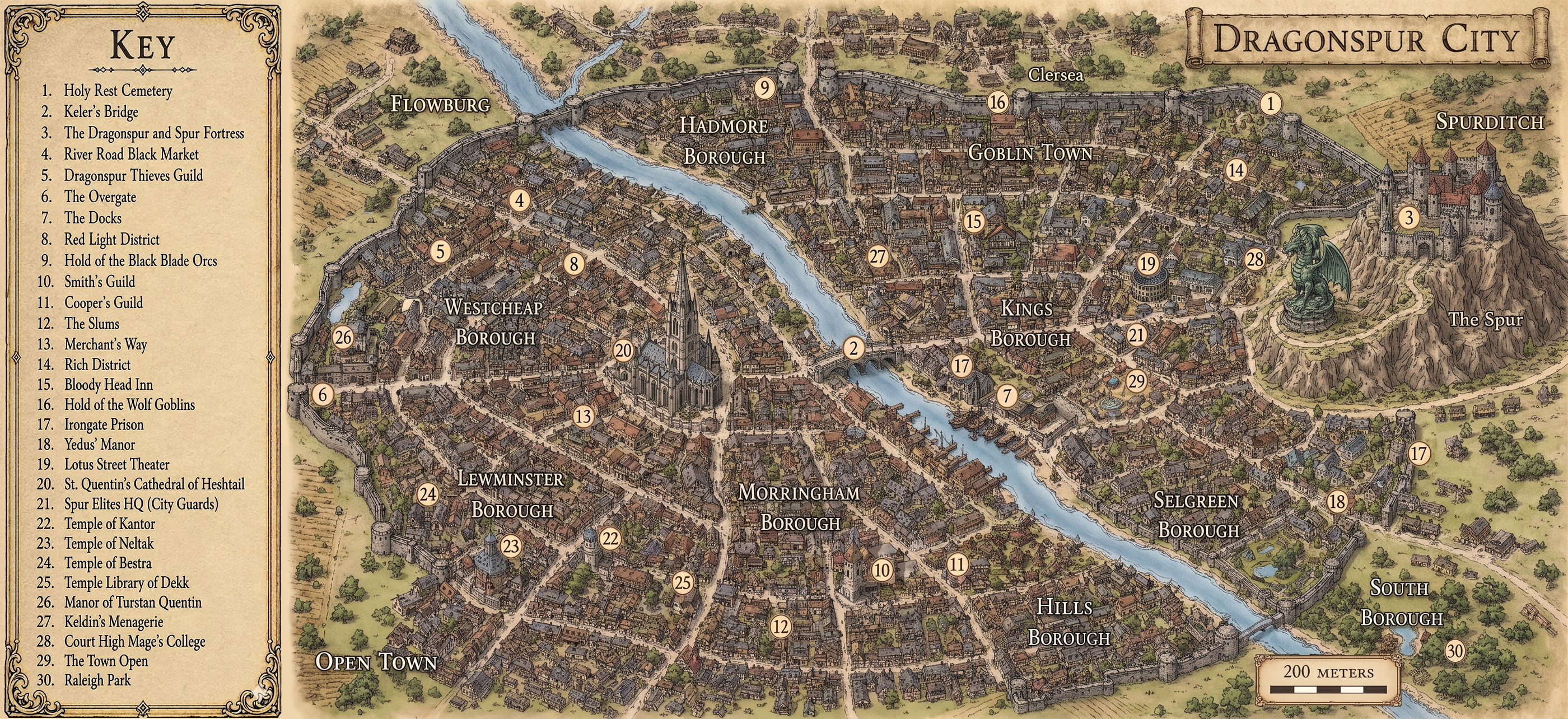
Large map of the City
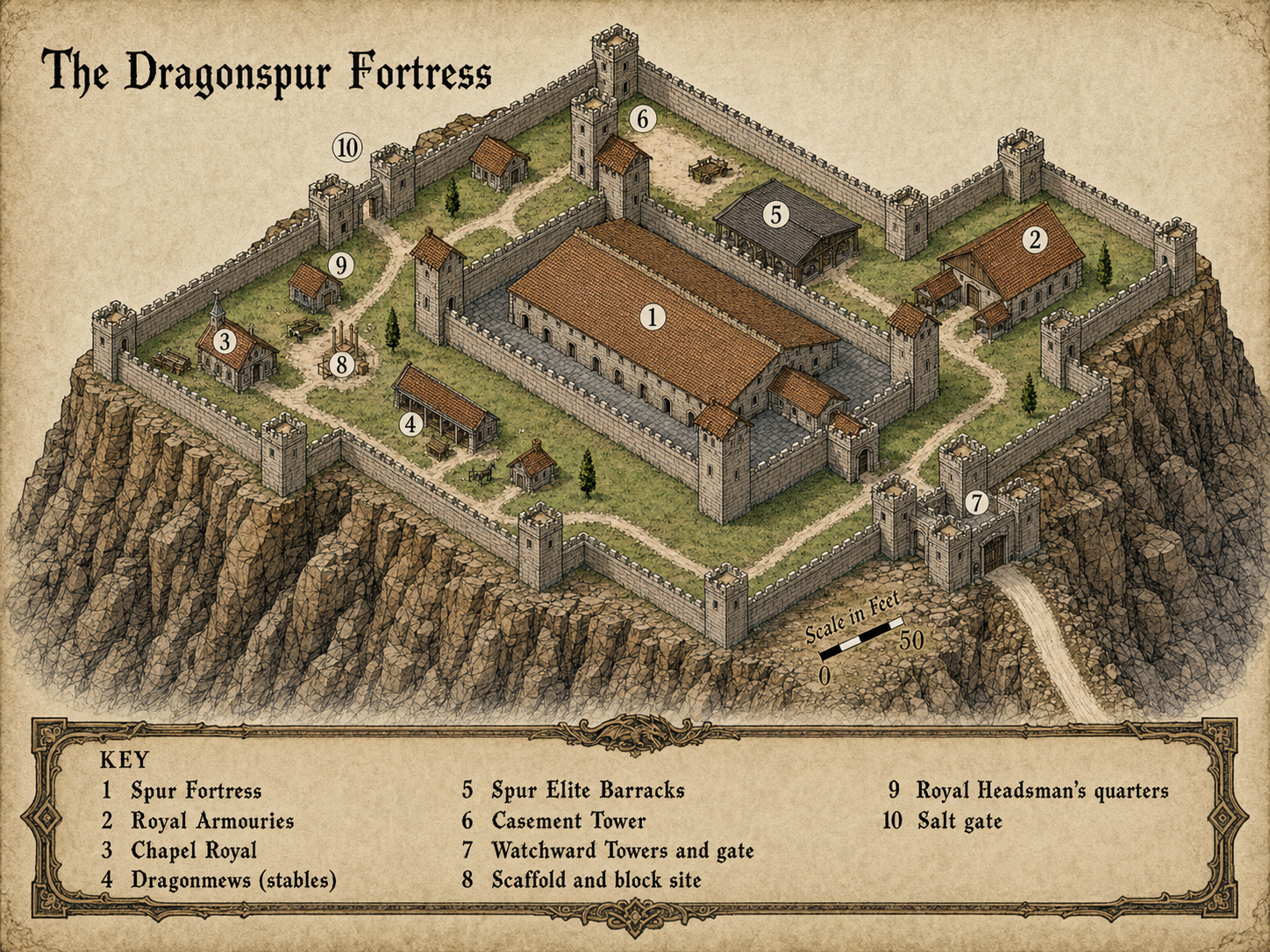
Fortress Complex itself
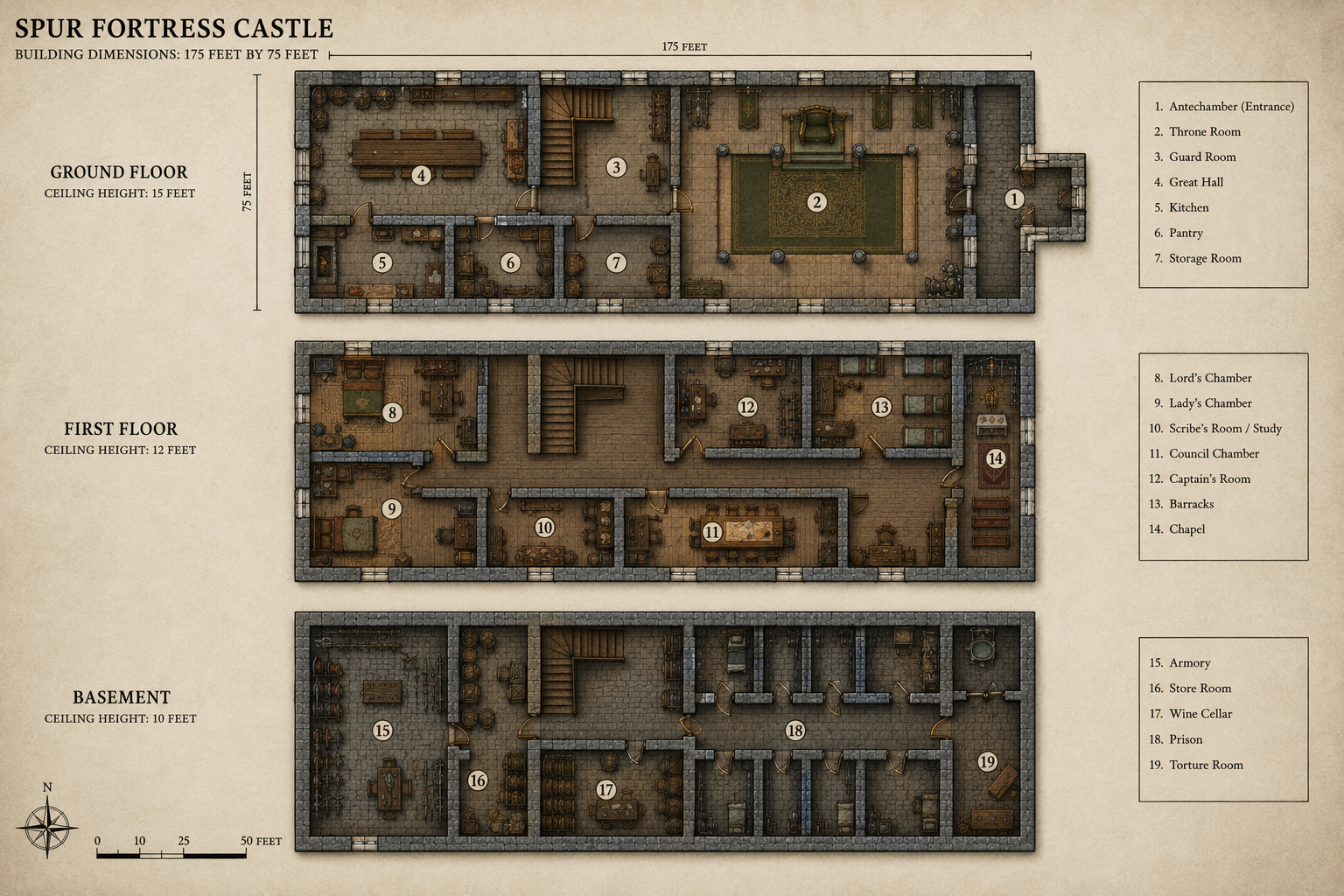
Map of the Interior of the Spur Castle
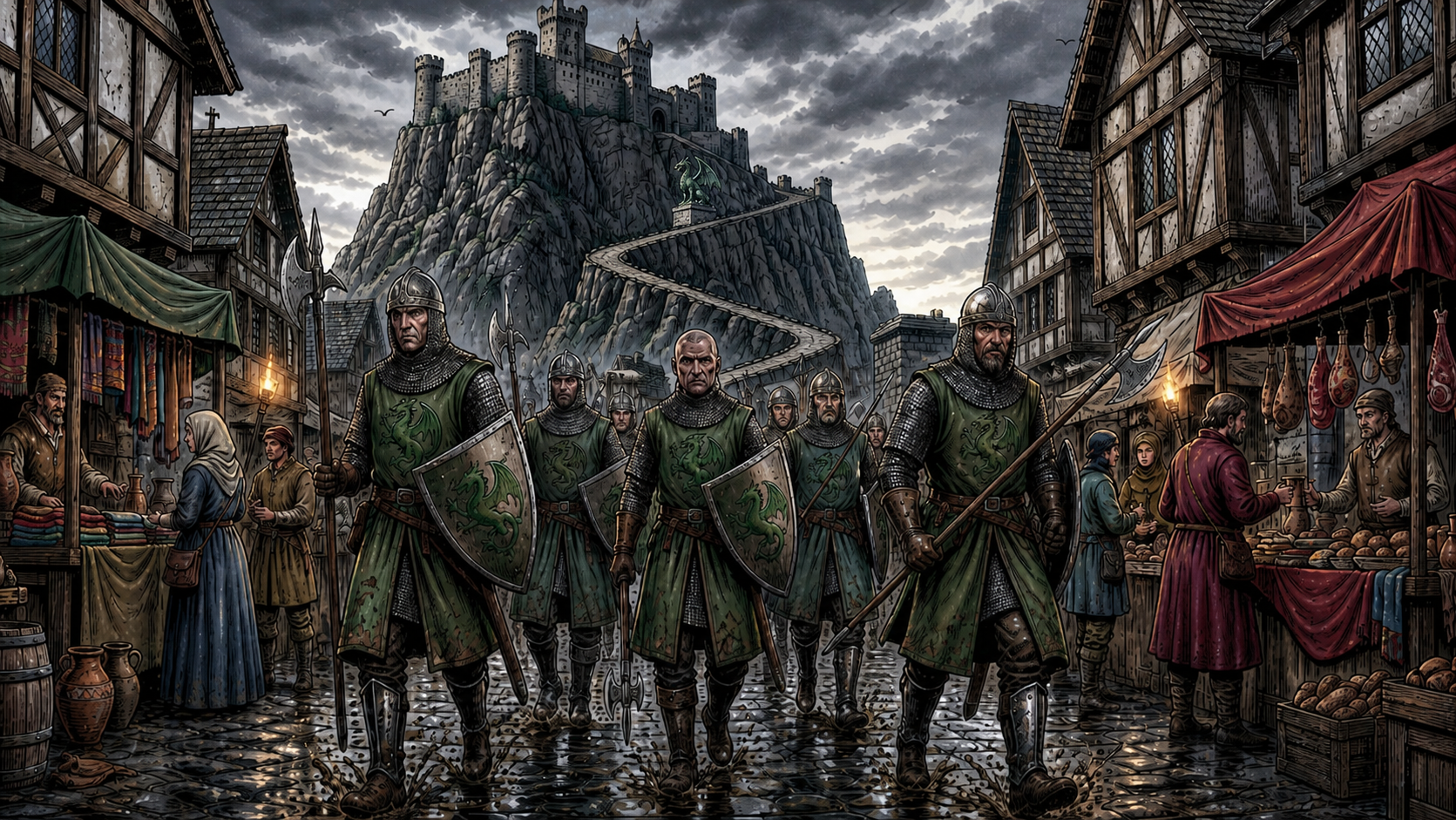
Dragonspur is the greatest city in western Farland and the old capital of the Kingdom of Kelerak. The pride of the West, or at least the pride of the once mighty Kingdom of Kelerak, the Spur was long a beacon for those wishing either a stable life, or a dangerous adventure. Kelerak has always been ruled by Kings, who governed from the Famous Green Throne, located in the Spur Fortress atop the Dragonspur proper. It is ancient, crowded, proud, filthy, wealthy, pious, corrupt, and almost impossible to kill. Kings have ruled from it, barbarians have sacked it, dragons have burned it, plagues have emptied its streets, dark lords have occupied it, and rebels have died beneath its walls. Still the bells ring, the river barges crowd the docks, the markets open at dawn, and the people of Dragonspur speak of their city as if it were older and more permanent than any ruler who claims to govern it.
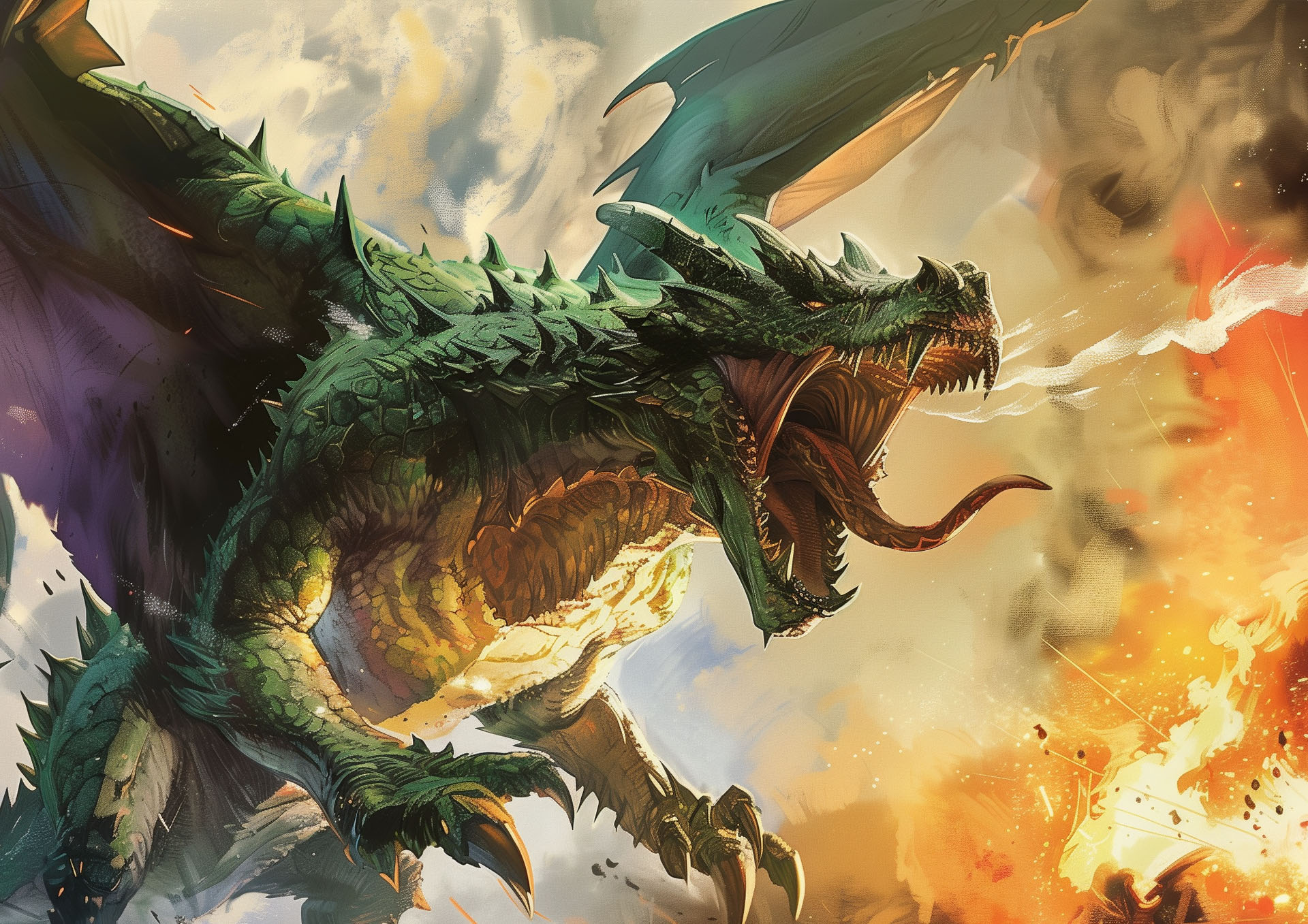
The city takes its name from the Dragonspur itself, a great rocky height rising over the Liferock River. Atop the spur stands the Spur Fortress, ancient seat of the kings of Kelerak and home of the famous Green Throne. Three-quarters of the way up the steep road to the fortress stands a huge statue of a dragon, wings spread wide over the city below. This image is one of the defining symbols of Kelerak.
Dragonspur is not a neat city. It is a layered city, built and rebuilt over centuries. Old noble houses stand beside counting-houses, churches, guildhalls, theatres, warehouses, slums, taverns, barracks, prisons, and black-market dens. The Liferock River divides the city but also gives it life. Trade, crime, gossip, grain, fish, timber, soldiers, pilgrims, refugees, and adventurers all move along the river and across Keler’s Bridge.
Although the city was recently liberated from the forces of the Lord of Lust, it does not feel merely like a wounded battlefield. Dragonspur has survived too much for that. Its people are wary, suspicious, and conservative, but also practical. They complain, haggle, pray, drink, scheme, rebuild, and get on with life. To outsiders, this can seem callous. To citizens of the Spur, it is simply how one survives in a city that has seen nearly two thousand years of catastrophe.
Dragonspur is ruled by Lord Naglor Osbern, a resistance leader who helped free the city from the occupation. His authority is real but not absolute. The city is too old, too rich, and too divided to be ruled by command alone.
Naglor is advised by Court High Mage Yedus Angrond, General Weston Ack-Elmor, and Captain Brian Hightower. The Spur Elites remain loyal to Osbern and serve as both military force and city guard. However, rumors persist that Lord Turstan Quentin, a young, ambitious, and wealthy nobleman, seeks greater power. Some believe that General Kurt Danthor and the Standing Battalion favor Quentin over Osbern.
Lord and Lady Lovelace speak for much of the old nobility. They are powerful, fashionable, condescending, and deeply invested in preserving aristocratic privilege. They look down on merchants and guildsmen, whom they dismiss as “day workers.” This contempt has placed them at odds with Sir Eric Ranulph, head of the Craftsmen’s Guild and one of the richest men in the city. Ranulph was born the son of a merchant, not a noble, though his wealth has earned him a knighthood.
The Churches of Heshtail and Reeanan, led by High Potentate Burcan the White, remain among the city’s most stabilizing forces. Their clerics provide healing, charity, and battlefield medicine, and they generally support Lord Osbern’s rule.
The Thieves’ Guild, now led by Corfin Ack-Sembar, recently suffered a serious setback but remains dangerous. Its influence touches smuggling, burglary, fencing, blackmail, lotus distribution, and the hidden economy of Westcheap and River Road.
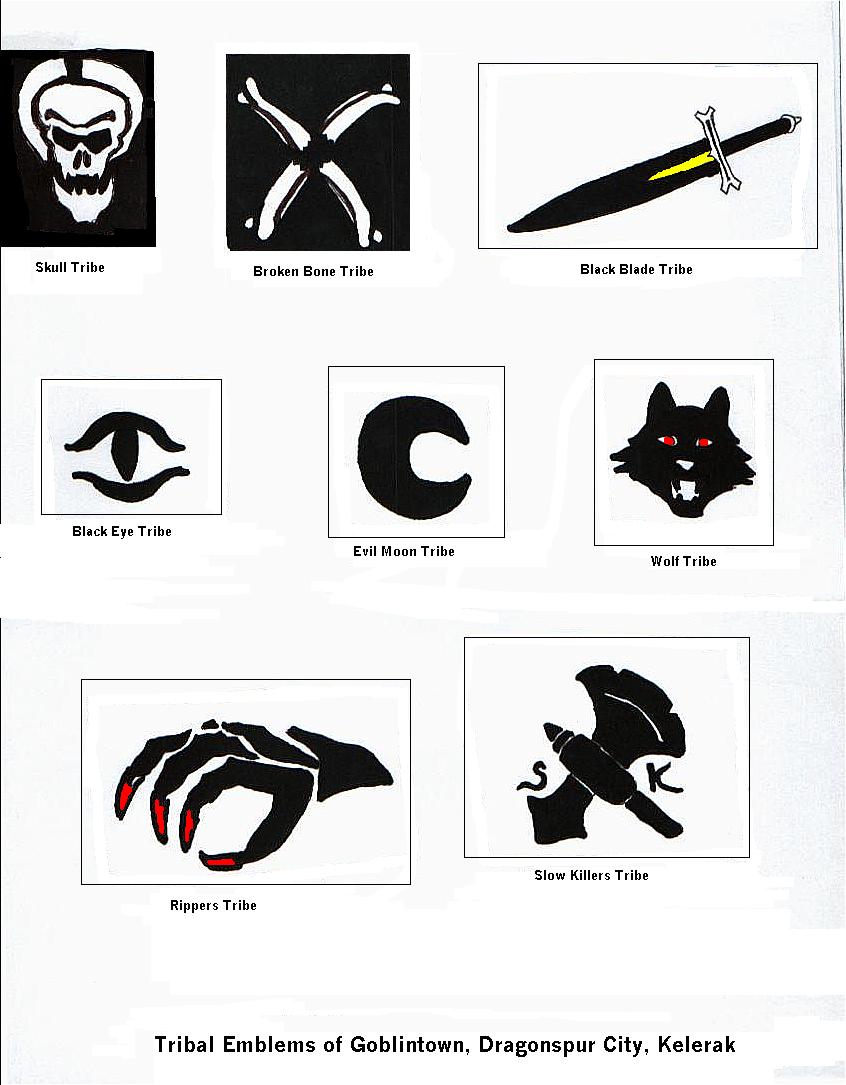
The people of Dragonspur are mostly human, with many half-orcs among them. The city also contains approximately 4,000 humanoids and other undesirables left over from the Occupation, concentrated in the segregated northern district known as Goblin Town and organized into tribes.
Most citizens are proud of Dragonspur but do not romanticize it. They know its mud, smoke, taxes, tolls, prisons, riots, plagues, fires, and corrupt officials as well as its temples, parks, kings, markets, and monuments. Their patriotism is local, stubborn, and practical. A citizen of Dragonspur may curse the city all morning and threaten violence against anyone from outside who does the same by noon.
Beneath this practical resilience, the city remains in shock. Dragonspur has been liberated, but not truly settled. No one has yet imposed a completely stable order on the city or the former kingdom, and many citizens resist change, distrust outsiders, and long for a return to the ancestral greatness of Kelerak.
The city itself is made up of eight boroughs, not including the newer Open Town and the brand-new Goblin Town. The oldest boroughs lie east of the Liferock River. Kings Borough was founded by Keler himself and still remains the richest area of the city. Selgreen Borough is another very old borough, founded second; it is also one of the city's wealthier areas. Founded third was Hadmore Borough, named after a famous lord who lived during the time of Keler's heirs. Much of Hadmore is taken up by dispossessed dark folk, who have claimed almost the entire borough, leaving only a few blocks adjacent to the river for the human residents. This area has come to be called Goblin Town. Most human residents steer clear of Goblin Town, and the dark folk stay out of the human areas. They do raid under cover of night into the adjacent city, and Lord Naglor Osbern is doing what he can to clear them out. South Borough, east of the river, was founded much later as a natural outgrowth of the city; this borough lies adjacent to the beautiful Raleigh Park and is sought after as a residence by those who work in the city center.
Lewminster was the first borough founded west of the river, and it was founded very quickly after Hadmore. This area is known for its famous temples and churches, and the spire of St. Quentin's, the most well-known church in this borough, can be seen from all over the city. A famous poem about the churches of the Spur, called "Silver and Tin," is known to every child in Kelerak. The remaining boroughs were founded consecutively, as the population of the city swelled after Baron Stephen Lanfranc took the city back from the barbarians who had sacked it. Westcheap is one of the seedier boroughs of the city; it is home to the "sin economy" of the burg, encouraged by the Lord of Lust, and houses the city's thriving black market, thieves' guild, and sex trade. The southern end of this borough is more reputable and contains many honest merchants' shops. The Morringham Borough, south of Lewminster, also holds many churches and temples but also had a notable pottery trade. Hillsborough, named for the small Herluin Hill that sits on its east side, is one of the city's main economic districts. It contains flourishing cobbler, smith, and cooper trades (although they are still recovering from the ravages of the Lord of Lust). South of Morringham is the poorest and newest part of the city, Open Town. Open Town grew up after the fall of the city to the Lord of Lust as citizens made poor by the Deadly Lord's economic policies spilled out of the city center in search of cheap housing. Crime is rampant in Open Town.
1. Holy Rest Cemetery. The largest cemetery in Dragonspur, containing generations of commoners, nobles, soldiers, priests, plague victims, and heroes of Kelerak.
2. Keler’s Bridge. The great bridge over the Liferock River and one of the city’s defining landmarks. It carries merchants, soldiers, pilgrims, beggars, carts, livestock, and river-smell from one half of Dragonspur to the other.
3. The Dragonspur. The rocky height from which the city takes its name. The Spur Fortress crowns its pinnacle. Three-quarters of the way up the steep road stands the huge Dragon Statue, wings spread wide over the city.
4. River Road Black Market. A notorious district where lotus and other drugs, whores, contraband, stolen goods, and illegal weapons can be found.
5. Dragonspur Thieves’ Guild. The hidden center of the city’s organized criminal world, now led by Corfin Ack-Sembar.
6. The Overgate. One of the principal entrances into the city. A toll-tax is charged to enter.
7. The Docks. Crowded, noisy, and essential to the city’s wealth. Warehouses, fishmongers, sailors, bargemen, smugglers, laborers, and taverns crowd this riverfront district.
8. Red Light District. A district of brothels, drink-houses, gambling rooms, music halls, and private entertainments.
9. Hold of the Black Blade Orcs. One of the strongest orcish enclaves in Goblin Town.
10. Smiths’ Guild. The guildhall and organizational center of Dragonspur’s smiths and metalworkers.
11. Coopers’ Guild. The center of the city’s barrel-making trade, vital to shipping, brewing, food storage, and river commerce.
12. The Slums. Overcrowded, dirty, dangerous districts where the poor live in cramped houses, cellar rooms, and leaning tenements.
13. Merchant’s Way. The principal commercial street of Dragonspur. Nearly every sort of good available in the West can be found here, except weapons and armor, which are more tightly controlled by guild and law.
14. Rich Section. A wealthy district of noble houses, town manors, gardens, private guards, and old family names.
15. Bloody Head Inn. A famous inn known to soldiers, adventurers, travelers, and locals alike.
16. Hold of the Wolf Goblins. A major goblin tribal enclave within Goblin Town.
17. Irongate Prison. The principal prison of Dragonspur, feared for its heavy doors, old stones, and harsh sentences.
18. Manor Home of Yedus Angrond. The residence of the Court High Mage.
19. Lotus Street Theater. A well-known theater and performance house, located in one of the city’s more colorful districts.
20. Temple of Heshtail. One of the city’s major temples, devoted to Heshtail the Merciful.
21. Headquarters of the Spur Elites. The command center of Dragonspur’s guard and internal military force.
22. Temple of Kantor. A major temple dedicated to the god of holy war.
23. Temple of Neltak. A prominent temple serving the faithful of Neltak, god of Law and Justice.
24. Temple of Bestra. One of the city’s old religious institutions, shrine to the goddess of fertility, be it crops or mothers.
25. Temple-Library of Dekk. A center of scholarship, record-keeping, theology, and historical study. Many of the city’s old dates and chronicles are preserved here.
26. Manor Home of Turstan Quentin. The residence of Lord Turstan Quentin, a wealthy and ambitious nobleman rumored to oppose Lord Osbern’s rule.
27. Keldin’s Menagerie. A famous zoo and museum, visited by citizens, scholars, travelers, and the merely curious.
28. Court High Mage’s College. A newly founded magical college, it is also colloquially called the Battle Mage’s College. One must officially join the Dragonspur Army to study here.
29. The Town Open. A large public square used for primarily for bi-weekly markets but also for festivals, troop drills, speeches, proclamations, and executions.
30. Raleigh Park. A large and beautiful public park, especially valued by citizens seeking air, space, and greenery away from the crowded streets.
In 6028 F.R., the wizard Keler led a large group of people from the East into the land that would become Kelerak, meaning “the offspring of Keler.” In 6029 F.R., while wandering the new land, Keler saw a mighty green dragon perched on a rocky spur above a fertile river valley. Taking this as a sign from Dekk, he founded his capital there. Eastern settlers came in great numbers, drawn by Keler’s fame, his magic, and his promises of treasure in the new kingdom. Some of the native peoples, remnants of older fallen chiefdoms, joined the growing realm. Others resisted.
In 6030 F.R., King Keler led the Kingdom Wars against those indigenous peoples who would not submit. He was quickly successful. Many native peoples were absorbed into Kelerak, while others fled north. This founding remains a source of pride in Dragonspur, but also a darker truth beneath the city’s heroic legends: the capital was born from omen, ambition, settlement, and conquest alike.
Keler disappeared in 6060 F.R., retreating to his fortified manor north of Lake of the Sky and was never seen again. Since then, Dragonspur has passed through the hands of many royal dynasties. It has been the center of wars with Daven and Orland, suffered barbarian invasion, foreign occupation, plague, fire, rebellion, and conquest by the forces of the Lord of Lust.
Among its greatest disasters were the barbarian sack of 6201 F.R., the Spur Fire of 7200 F.R., the Great Coughing or Coffin Plague of 7305 F.R., the invasion by the Lord of Lust in 7795 F.R., the second Spur Fire of 7801 F.R., and the failed Great Rebellion of 7954 F.R. The city was finally liberated in 8161 F.R. through the efforts of the elf Valanduil, Bartarius the barbarian, and the resistance fighters of Naglor Osbern. In 8165 F.R., the Winged One, son of the Lord of Lust, attempted to retake Dragonspur but was defeated.
These events have shaped the city’s character. Dragonspur is proud, class-conscious, religious, suspicious of strangers, and obsessed with its own past. The citizens remember that their city once held more than 100,000 souls. Many still believe that if Kelerak is ever restored, Dragonspur must again be its heart.
6028 F.R. Keler leads settlers from the East into the land that will become Kelerak.
6029 F.R. Keler sees a mighty green dragon perched on a spur of rock in a fertile river valley and founds his capital there.
6030 F.R. Keler leads the Kingdom Wars against native peoples who refuse to submit.
6040 F.R. Daven and Kelerak invade the forgotten kingdom to the southeast.
6060 F.R. Keler retreats to his fortified manor north of Lake of the Sky and is never seen again. King Rohan of the Cadre of the Wise succeeds him.
6070 F.R. Keler’s nephew, Theobald Keler, slays King Rohan and begins the Spur Wars.
6076 F.R. Theobald Keler comes to power.
6201 F.R. Northern barbarians sack Dragonspur and slay King Peter Keler, supposedly ending the line of Keler.
6210 F.R. Baron Stephen Lanfranc retakes Dragonspur, names himself king, rebuilds the city, and raises the famous Wall.
6500 F.R. General Leofwyne Anglarond rebels and seizes southern Kelerak. King Harold Braceford eventually defeats him, though Leofwyne later receives a barony.
6800 F.R. King William Richard falls in battle against the northern barbarian tribes.
7029 F.R. Daven and Kelerak invade Orland but are repulsed at the Battle of Greenhill, beginning the Decadion War.
7039 F.R. The elves put a stop to the Decadion War between Kelerak, Daven, and Orland by using the Stone of Silence to frustrate the armies of all sides. King Simon Humphrey is forced to submit after his huge army is easily defeated by a small elven force wielding the artifact.
7110 F.R. King Herluin Half-Elven, the Peace-Keeper, comes to power.
7143 F.R. The Eastern Alliance invades Kelerak and occupies Dragonspur City. Under King Quentin, Kelerak is forced to pay tribute.
7200 F.R. The Spur Fire destroys a third of the city.
7305 F.R. The Great Coughing, or Coffin, Plague strikes Dragonspur.
7792 F.R. Rumors of the Dark Times reach Dragonspur. Word comes that Kale is being invaded by orcs from the East and South. King John Ranulf sends aid.
7795 F.R. Dragonspur is invaded by the forces of the Lord of Lust. The Ancient Wall is breached by demon minions of Brathelathor and the breath of the blue dragon Skywing.
7800 F.R. The internment camp of Lotus is established south of Dragonspur.
7801 F.R. The second Spur Fire devastates the city. Rumor claims the Lord of Lust herself started it.
7954 F.R. The Great Rebellion occurs. Led by Osbern Payn, citizens attack the Spur Fortress, but the rebellion is put down.
8161 F.R. The Liberation. Dragonspur is freed through the efforts of Valanduil, Bartarius, Naglor Osbern, and the resistance.
8165 F.R. The Winged One, son of the Lord of Lust, attacks Dragonspur in an attempt to retake it but is defeated.
8170F.R. The army of the Lord of Envy, led by General Angus Neebrok, attacks the Spur but is narrowly defeated.
Dragonspur has seen fourteen royal families in its long history: Keler, Matild, Richard, Fulk, Lanfranc, Braceford, Brian, Marchel, Elton, Quentin, Baldwin, Payn, Anselm, and Ranulf.
Prominent noble families include Osbern, Rose, Agath, Angrond, White, Lovelace, and others, as well as descendants and branches of the former royal houses.
Dragonspur obeys the ancient laws originally laid down by Keler, along with later additions. Punishments are severe, and imprisonment or labor may sometimes be substituted with indentured servitude.
| Crime | Punishment |
|---|---|
| Treason | Death |
| High Murder | Death |
| Low Murder | Payment of weregild or 20 years in prison |
| Attempted Murder | 10 years hard labor |
| Piracy | Death |
| Rape | 2–5 years hard labor |
| Kidnapping | 5–10 years hard labor |
| Arson | 10–20 years hard labor |
| Counterfeiting | 10 years hard labor |
| Bribery | 100–5,000 sp fine |
| Fraud | 100–4,000 sp fine |
| Assault | 5–1,000 sp fine or 1 year labor |
| Theft | 2 years imprisonment |
| Grand Theft | Death |
| Theft of Mount | Death |
| Fencing Stolen Goods | 1–5 years hard labor |
| Enslaving | 1–5 years hard labor and 100–1,000 sp fine |
| Blackmail | 10 years imprisonment |
| Extortion | 10 years hard labor |
| Conspiracy | Related prison term |
| Ensorcering | 1–5 years hard labor |
| Public Endangerment | 10 years labor |
| Resisting Arrest | 1–3 years labor |
| Unlawful Entry | 50–1,000 sp fine or 1 year imprisonment |
| Debt | 1–5 years imprisonment |
| Practicing Banned Religion | 50–1,000 sp fine or 5 years labor |
| Practicing Black Magic | 50–1,000 sp fine or 5 years labor |