Wyvernia, Kelerak
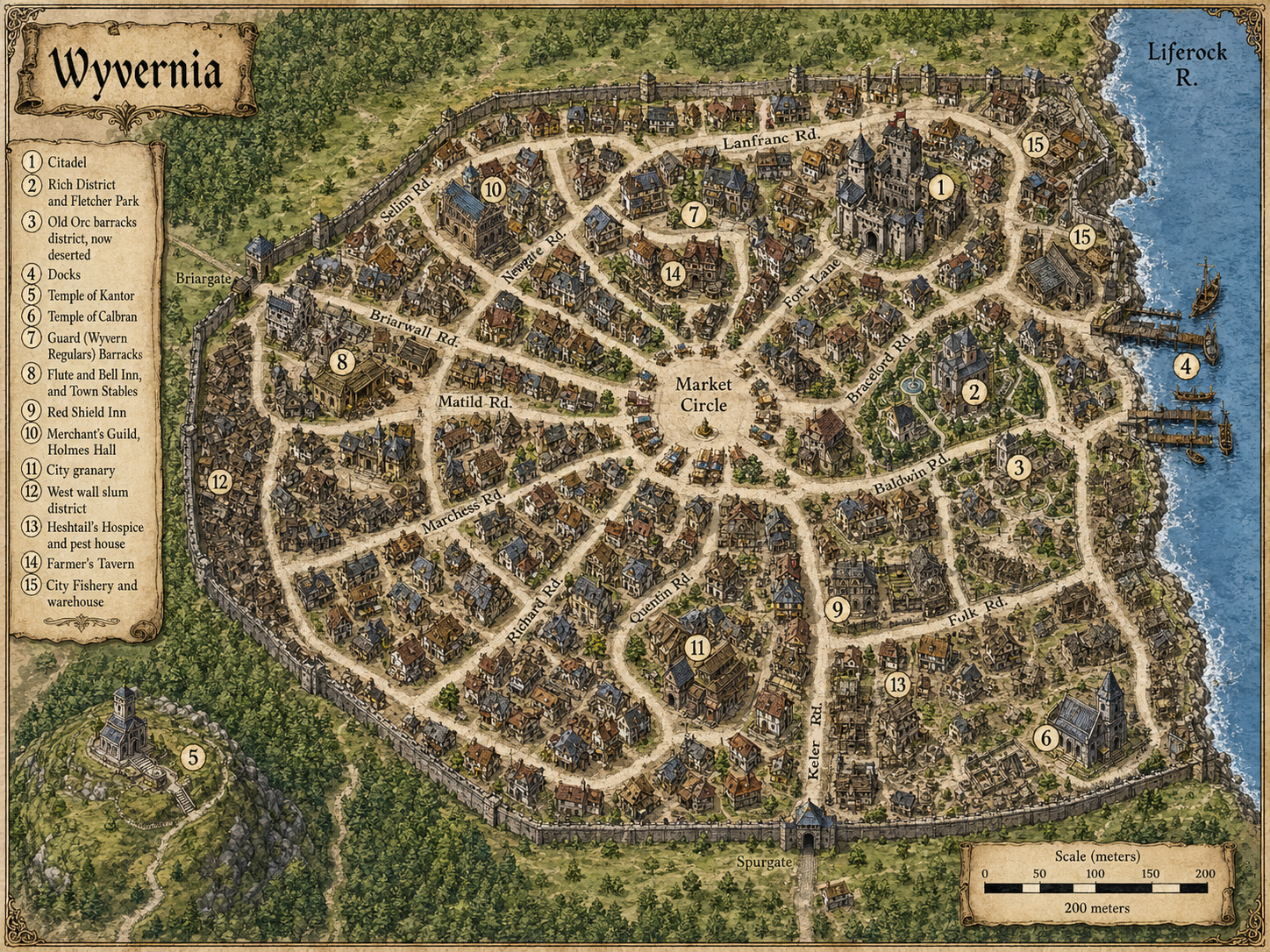
Table of Contents
General Information
Power Centers
The City
Locations of Interest
General Information
Type: Large city
Region: Eastern Kelerak
Location: North of Dragonspur City, on the western bank of the Liferock River
Population: 18,000-20,000
Full-time Guards: 250
Conscriptable Individuals: approximately 3,700
Government: Feudal barony, currently under disputed post-coup control
Ruler: Lord Damion Felmund
Former Ruler: Lord Drake Rose, deceased
Military Force: The Wyvern Regulars
Major Products: Silverwork, reed baskets, maple syrup, grain, bread, and fish
Current Condition: Economically strained, politically uncertain, and threatened by hostile forces blocking trade routes
Power Centers
Lord Damion Felmund, current ruler of Wyvernia, seized control of the city in a bloodless coup after the sudden death of Lord Drake Rose.
Lord Russell Starsul, an ambitious nobleman, frequently opposes Lord Felmund and may be positioning himself as a more legitimate alternative.
Bishop Hector Ack-Thelmund, bishop of the most powerful temple in Wyvernia, must be consulted before any major civic decision can be made safely.
The City
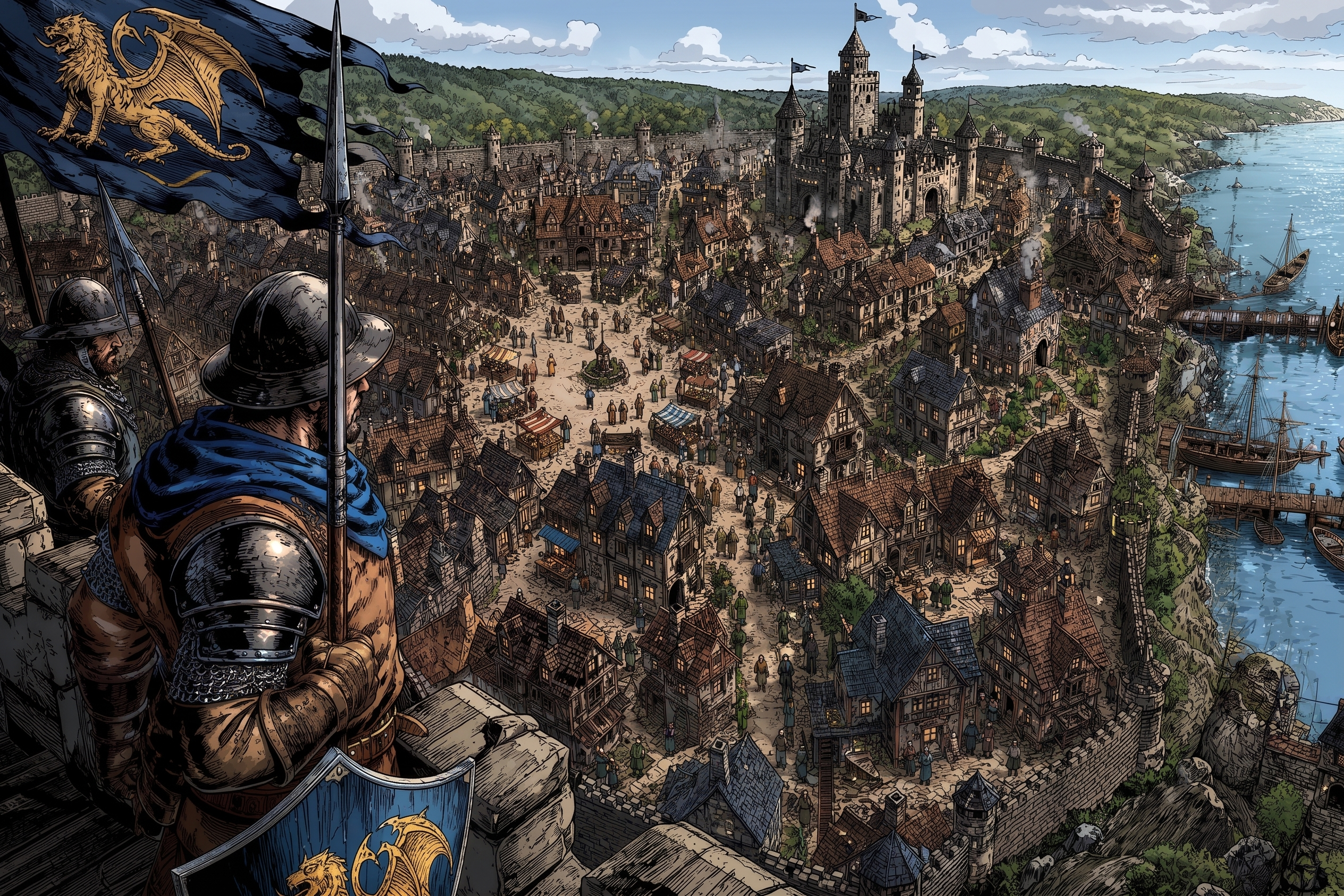
Wyvernia is a large, fortified city in eastern Kelerak, standing north of Dragonspur City on the western bank of the Liferock River. It is a city of stone walls, river mist, silverwork, old military pride, and uneasy politics. For much of its history, Wyvernia was a loyal feudal holding of the Green Throne in Dragonspur, guarding river traffic and the northern approaches to the kingdom.
The city is nearly a thousand years old. Its name comes from the plague of wyvern attacks that troubled its first settlers. Those early Wyvernians built towers, signal fires, strong walls, and disciplined pike formations to survive. The wyverns are now mostly gone from the region, but the city has never forgotten them. Their image appears on old shields, soldiers' badges, noble seals, tavern signs, and weathered carvings above the gates.
Wyvernia was long famous for its infantry, especially its pikemen. An old saying runs: "Give me a Wyvernian pikeman, and I will break any charge." That reputation has faded, but not disappeared. The city still has strong walls, disciplined regulars, and a population used to hardship. Its soldiers favor pikes, spears, shields, crossbows, and formation fighting over cavalry charges or flamboyant swordplay.
The city’s decline began under Lord Drake Rose. Though Wyvernia had once been a close ally of Dragonspur, Rose was corrupt, self-interested, and unreliable. He paid lip service to the Spur but repeatedly failed to provide soldiers, supplies, or money when called upon. After his sudden death, Lord Damion Felmund seized control of the city in a bloodless coup. Since then, Wyvernia’s allegiance has remained uncertain.
Felmund presents himself as the man who saved the city from collapse. His supporters argue that Rose had weakened Wyvernia and dishonored its obligations. His enemies call Felmund an opportunist who waited until the city was desperate enough to accept a usurper. For now, he holds the Citadel, the treasury, and the obedience of the Wyvern Regulars. Whether he holds the loyalty of the city is another matter.
The city’s politics are unstable. Lord Russell Starsul, an ambitious nobleman with ties to several old families, frequently opposes Felmund. Starsul argues that Wyvernia must restore honorable relations with the newly liberated Dragonspur. Whether this comes from principle or ambition is unclear. Meanwhile, Bishop Hector Ack-Thelmund remains one of the most influential men in the city. As bishop of Wyvernia’s most powerful temple, he controls moral legitimacy, temple resources, poor relief, and the trust of many common citizens.
Economically, Wyvernia is under severe strain. The city is known for its silversmiths, whose work includes chalices, buckles, reliquaries, officer’s badges, cloak clasps, pommels, and trade goods marked with the city’s wyvern stamp. It also once exported reed baskets made from the reeds of the Liferock River, maple syrup from the surrounding woodlands, bread, grain, and preserved fish. Now trade routes are blocked by hostile forces. River traffic is dangerous. Caravans require guards. Farmers come to market armed, late, or not at all.
The city itself is arranged around Market Circle, with broad roads radiating outward toward the walls, the Citadel, the docks, and the richer districts. The eastern side descends toward the Liferock River, where docks, fisheries, warehouses, and laborers dominate daily life. The western wall shelters poorer districts and crowded tenements. The north contains wealthier homes, civic buildings, and military quarters. The southeast still bears scars from occupation and violence, especially in the abandoned old orc barracks district.
Wyvernia is not a doomed city, but it is a city balanced on a knife-edge. Its walls are strong. Its people are stubborn. Its soldiers still remember their old discipline. But the city must decide where its loyalty lies, who has the right to rule, and how much hardship its people can endure before pride gives way to hunger.
Locations of Interest
1. The Citadel
The Citadel is the seat of the Baron of Wyvernia and the current residence of Lord Damion Felmund. It rises in the eastern part of the city, close to the Liferock but protected by layers of streets, walls, and loyal soldiers. Its old towers were built to watch both the river and the skies, a reminder of the city’s wyvern-haunted founding.
The Citadel contains the lord’s hall, council chamber, armory, treasury vaults, prison cells, records rooms, and the private apartments of the ruling household. Drake Rose’s old banners have been removed, but not every trace of him is gone. Servants still whisper about sealed rooms, missing ledgers, and the night Rose died.
Felmund keeps the Citadel orderly and heavily guarded. He understands that whoever holds it can claim Wyvernia.
2. Rich District and Fletcher Park
The Rich District is home to Wyvernia’s nobles, wealthy merchants, senior guildsmen, officers, and old families. Its houses are stone-built, slate-roofed, and guarded by walls, gates, and private retainers. The streets are cleaner here, the wells better kept, and the patrols more regular.
Fletcher Park is the district’s green jewel. It contains ornamental trees, walking paths, memorial stones, archery lawns, and a small field where young nobles practice bowmanship. The park’s name recalls Wyvernia’s old military dependence on archers and fletchers during the years when wyverns still menaced the city.
Lord Russell Starsul’s allies are especially strong in this district.
3. Old Orc Barracks District, Now Deserted
This district is one of Wyvernia’s open wounds. During darker years, orc soldiers and their overseers used this area as a barracks, mustering ground, and holding quarter. The buildings remain, but most are abandoned, vandalized, or half-collapsed. Old walls still bear crude marks, smoke stains, weapon gouges, and iron fixtures no decent citizen wants to explain.
Officially, the district is deserted. In practice, it attracts scavengers, smugglers, desperate squatters, criminals, and worse things that prefer empty buildings. Some Wyvernians want the entire district burned and rebuilt. Others argue that the city cannot afford to waste stone, lumber, and defensible ground.
Few patrols enter deeply after dark.
4. Docks
Wyvernia’s docks are the city’s river throat. Barges, fishing boats, reed skiffs, ferries, and merchant vessels once crowded this stretch of the Liferock. Now there are fewer sails, more guards, and too many idle hands.
The docks smell of fish, wet rope, tar, mud, smoke, and desperation. Dockworkers unload grain, timber, river reeds, casks, tools, salt fish, and whatever goods still make it through the hostile roads and dangerous waters. River captains have become a political class of their own, since anyone who controls river traffic controls a piece of the city’s survival.
Those who want to move goods, fugitives, rumors, bodies, or contraband through Wyvernia eventually deal with the docks.
5. Temple of Kantor
The Temple of Kantor stands outside the main walls on a wooded hill, reached by a road winding through the trees. Its position is symbolic as well as practical: Kantor’s temple watches over the city from beyond the noise of markets and politics.
This is the most powerful temple in Wyvernia and the seat of Bishop Hector Ack-Thelmund. The temple complex includes the main sanctuary, clerical residences, guest quarters, a scriptory, gardens, and fortified storehouses used for food relief during crises.
Citizens come here for blessings, judgments, oaths, counsel, and burial rites. Nobles come here because they must. Lord Felmund cannot rule securely without the bishop’s cooperation.
6. Temple of Calbran
The Temple of Calbran stands in the southeastern part of the city, near the poorer river districts and not far from the abandoned orc barracks. It serves artisans, laborers, soldiers, boatmen, widows, and common families who need a temple closer to the grit of daily life.
The temple is less politically powerful than Kantor’s, but it may be more beloved by ordinary folk. Its clergy are practical, direct, and used to hardship. They bless river crews, comfort families of dead soldiers, assist the poor, and help the sick when Heshtail’s Hospice is overwhelmed.
As food prices rise and fear spreads through the poorer districts, the Temple of Calbran has become increasingly important.
7. Guard Barracks: The Wyvern Regulars
The main barracks of the Wyvern Regulars house the city’s full-time guard. The complex includes drill yards, officers’ quarters, armories, stables, mess halls, and punishment cells. Its walls are decorated with old pikes, wyvern skull motifs, and battle honors from campaigns fought in service to the Green Throne.
The Regulars patrol the gates, walls, Market Circle, docks, and noble districts. They are also responsible for suppressing riots, escorting grain shipments, and keeping the old orc barracks district contained.
Morale is complicated. Many Regulars despised Lord Rose. Some respect Felmund for restoring discipline and pay. Others dislike the coup but fear disorder more. If Felmund and Starsul ever come to open conflict, the senior captains of the Regulars may decide the city’s future.
8. Flute and Bell Inn, and Town Stables
The Flute and Bell is a respectable inn near the western-central roads, close enough to Briargate to serve travelers but far enough from the slums to attract merchants, minor officials, and wealthier visitors. It is known for clean rooms, decent music, hot stews, and strict rules against brawling.
The attached town stables are among the best in Wyvernia. Couriers, caravan guards, and rural gentry often stop here first. Because of this, the Flute and Bell is one of the better places to hear reliable road news, though the innkeeper understands the value of silence.
9. Red Shield Inn
The Red Shield Inn stands in the southern part of the city, near roads leading toward Spurgate and the poorer neighborhoods. It is rougher than the Flute and Bell, but not lawless. Soldiers, caravan guards, laborers, minor adventurers, and off-duty Regulars drink here.
The inn’s sign shows a red shield marked by an old pike head. Veterans claim the name comes from a battle in which Wyvernian infantry held a road against impossible odds. Whether that story is true hardly matters; the Regulars like it.
The Red Shield is a good place to hire guards, find trouble, or hear what common soldiers really think of Lord Felmund.
10. Merchant’s Guild, Holmes Hall
Holmes Hall is the headquarters of the Merchant’s Guild and one of the most important secular buildings in Wyvernia. It contains counting rooms, contract chambers, guild offices, arbitration halls, private vaults, and meeting rooms where more politics happens than anyone admits.
The guild is anxious. Blocked roads and unsafe river traffic threaten every major house in the city. Some guildmasters blame Felmund for uncertainty. Others blame Rose’s years of weakness. Some want Dragonspur’s protection, but only if it comes with favorable trade guarantees.
Holmes Hall is outwardly neutral. In reality, it is a battlefield of ledgers, favors, bribes, and carefully worded promises.
11. City Granary
The city granary is one of Wyvernia’s most strategically important sites. In good years, it stores enough grain to stabilize prices and feed the city during short disruptions. In the current crisis, every sack matters.
Felmund has placed the granary under close guard, which has made him look responsible to some and tyrannical to others. Rumors claim grain is being diverted to the Citadel, hidden by merchants, or reserved for soldiers. The truth may be less dramatic but no less dangerous: there may simply not be enough if the roads remain closed.
A riot at the granary could break the city faster than an army at the gates.
12. West Wall Slum District
The west wall slums are crowded, poor, and old. Families live in patched timber houses, leaning tenements, cellar rooms, and converted workshops built against the inner wall. The streets are narrow, muddy, and poorly lit. Children run errands for coins. Beggars sleep under awnings. Gangs and informal neighborhood bosses provide the order the city does not.
The slums are not simply dens of crime. They are also home to laborers, widows, refugees, discharged soldiers, reed workers, failed apprentices, and families ruined by war or trade collapse. The people here know every crack in the wall and every weakness in the city’s conscience.
Felmund’s rule will be judged here by bread prices, not proclamations.
13. Heshtail’s Hospice and Pest House
Heshtail’s Hospice serves the sick, dying, injured, and abandoned. The pest house attached to it is grim but necessary, used to isolate plague victims, river-fever cases, and those suffering from unknown contagions brought by travelers or refugees.
The hospice is one of the few places in Wyvernia where rank matters less than need, though wealth still has a way of improving one’s bedding. Its healers are overworked, underfunded, and increasingly worried. Malnutrition, crowding, and fear have made the city more vulnerable to disease.
The pest house has a dark reputation. Some say those taken inside do not always come out because they die. Others say some do not come out because they are not allowed to.
14. Farmer’s Tavern
Farmer’s Tavern sits near the city’s central market roads and serves the rural folk who bring goods into Wyvernia. It opens early, serves strong ale, and keeps food simple: bread, cheese, onions, stew, smoked fish, and whatever farmers have traded that morning.
This tavern is where the countryside speaks. Farmers discuss unsafe roads, burned fields, missing livestock, strange tracks, taxes, and which lord’s men are taking more than they should. The mood has darkened lately. Too many farmers arrive armed. Too many arrive late. Some do not arrive at all.
Anyone seeking news beyond the walls should start here.
15. City Fishery and Warehouse
The city fishery and warehouse district occupies the northern and eastern riverfront. Fish are cleaned, salted, smoked, packed, taxed, and shipped from here. Warehouses store river reeds, barrels, nets, tools, rope, grain, and goods awaiting safer passage.
The district is loud during the day and suspicious at night. Guild factors, fishmongers, warehouse guards, boat crews, smugglers, and inspectors all compete for space and profit. With trade disrupted, the warehouses have become more important and more dangerous. A locked warehouse may hold food, silver, contraband, weapons, or nothing but rats and bad air.
The fishery helps keep Wyvernia fed when the roads fail. That makes it essential, and worth fighting over.


