East-of-Sky
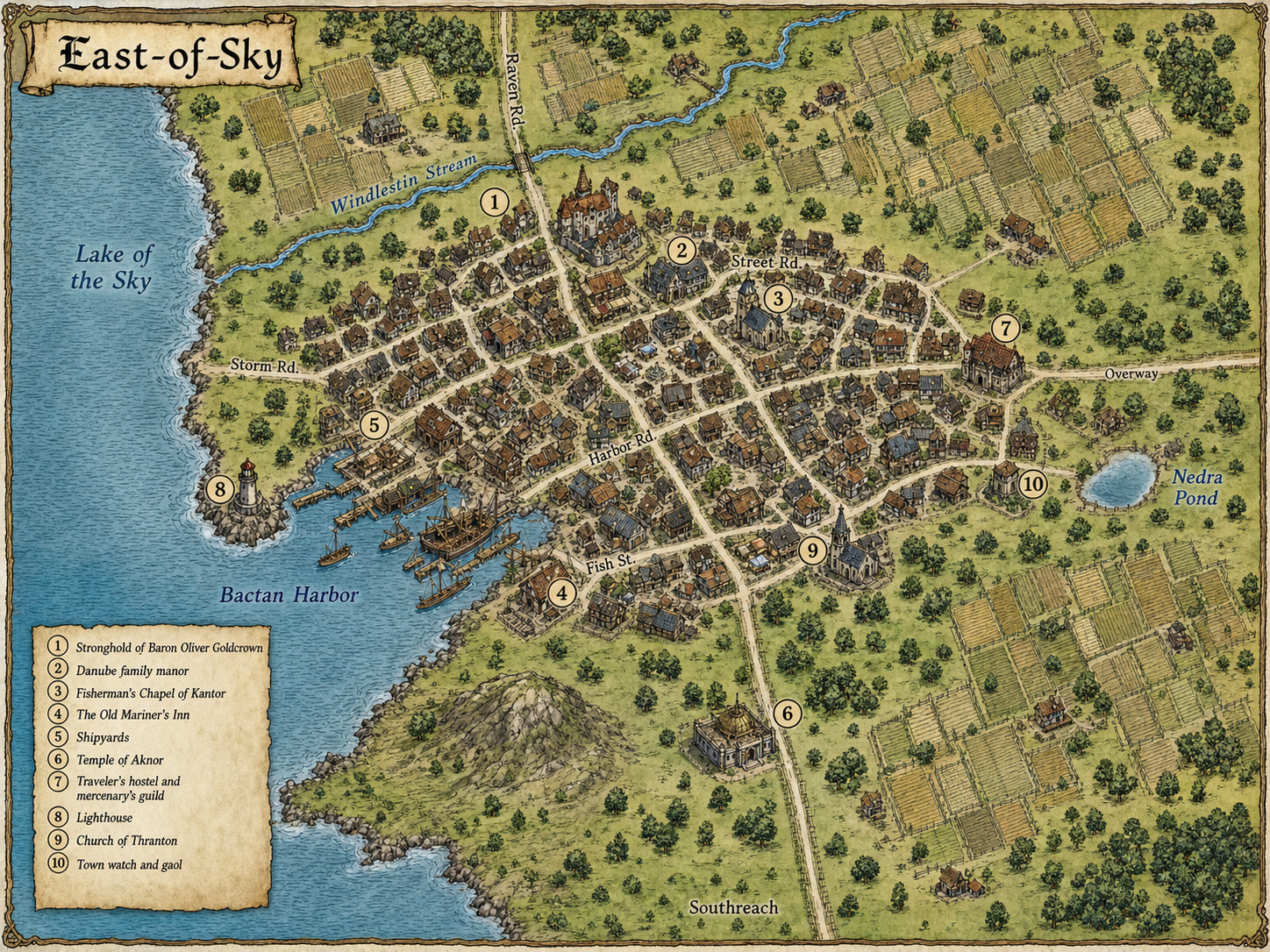
Small city in eastern Kelerak, set on the eastern bank of the Lake of the Sky.
Population: Approximately 9,000 people.
Who Rules: Baron Oliver Goldcrown, the rightful lord of the city, recently freed from the dungeons of the usurper Lord George Danube.
Power Centers: Jacob Ack-Simore, a wizard loyal to Baron Oliver; and High Priest Felix Ack-Heathcliff of Kantor, who nominally supports Oliver but often works against what he sees as the Baron's excessive caution.
Major Products: Fish, fishing barges, sailboats, nets, line, hooks, cured lake fish, tarred rope, ship timber, and other goods connected to the fishing trade.
Armed Forces: East-of-Sky has 250 full-time guards, with roughly 550 conscriptable citizens available in time of crisis.
Overview
East-of-Sky is a venerable fishing city on the eastern bank of the Lake of the Sky. For nearly five centuries, its fortunes have risen and fallen with the lake. Its markets smell of salt, smoke, tar, wet rope, fish oil, and old wood. Its people are bargemen, net-makers, fishwives, sail-menders, boatwrights, chandlers, shrine-keepers, guards, mercenaries, and merchants who understand that water can make a city rich, but it can also bring an enemy straight to the docks.
The city began as a fish market supplying Dragonspur City, but its position on the Lake of the Sky soon made it more than a provincial trading post. Boats from many communities along the lake came to East-of-Sky to buy, sell, repair, hire crews, hear news, and settle disputes. As wealth grew, so did political influence. In better days, the Barons of East-of-Sky were among the nobles most likely to be heard by the Green Throne. Money, ships, and food give even a small city a loud voice.
Those better days are gone, or at least suspended. In 8170 F.R., East-of-Sky is a city recovering from occupation, betrayal, and civil uncertainty. Its rightful ruler, Baron Oliver Goldcrown, has only recently been restored after being imprisoned by Lord George Danube, a puppet ruler placed in power through the schemes of Lilith, the demon-spy of Brathelathor, the Lord of Lust. The old order has returned in name, but the wounds are fresh. Danube loyalists still have friends. Informers still fear exposure. Fishermen still speak too softly when certain names are mentioned.
Worse still, East-of-Sky's trade routes are blocked by hostile forces. Fish can be caught, but not always sold. Boats can be built, but not always delivered. Merchants who once moved freely around the lake now hire guards, sail in convoys, or stay home. Hunger has not yet come to East-of-Sky, but anxiety has. The city has survived orcs, Hoths, demons, and a false lord. Now it waits to see whether it can survive the next army crossing the water.
Government and Power
Baron Oliver Goldcrown is the lawful lord of East-of-Sky. His restoration was welcomed by most of the city, especially those who suffered under George Danube's rule. Oliver is legitimate, personally brave, and more honorable than many nobles who survived the Dark Occupation. Those virtues, however, do not automatically make him secure. He has inherited a city with blocked trade, divided loyalties, depleted confidence, and the threat of invasion from the west.
Oliver's strongest open supporter is Jacob Ack-Simore, a wizard of considerable learning and influence. Jacob believes that the city needs lawful stability before it can recover. He advises Oliver on magical threats, political intelligence, and the lingering works of Lilith and her agents. Some citizens trust Jacob; others fear that any wizard near power is one bad secret away from becoming the next tyrant's tool.
The most difficult power in the city is High Priest Felix Ack-Heathcliff of Kantor. Felix does not oppose Oliver because he favors Danube. He opposes him because he thinks Oliver is too conservative, too careful, and too slow to seize the moment. Felix argues that East-of-Sky must act boldly: reopen the lake routes, punish known collaborators, strengthen the docks, arm more crews, and prepare for the coming assaults. In public he blesses the Baron. In private he presses captains, guildsmen, and lakefolk to force Oliver's hand.
This gives East-of-Sky three competing centers of authority. Oliver holds the title. Jacob protects the restoration. Felix commands the conscience of much of the waterfront. If they remain aligned, the city may endure. If they break apart, Afej the Black may not need to conquer East-of-Sky. He may only need to wait.
History
East-of-Sky was founded roughly 500 years ago as a market for fish bound for Dragonspur City. Its early prosperity came from geography. The Lake of the Sky connected scattered communities more easily than any road, and East-of-Sky sat in the right place to profit from that movement. Barges came heavy with fish, timber, grain, lake salt, and passengers. Out went cured fish, boats, nets, iron fittings, rope, and news.
As the city grew, so did the importance of its rulers. The Barons of East-of-Sky developed a reputation as practical nobles: less grand than the lords of old blood, perhaps, but richer than many of them and useful to nearly all. They supplied food, boats, and lake access. In Kelerak, those things matter.
During the Dark Occupation, East-of-Sky suffered greatly under its Orc Hoths. The worst of them was Zebet, the last Hoth of the city, whose long war with the Hoth of Jacob's Rock drained men, ships, coin, and hope. The conflict was wasteful even by the standards of orcish rule. Lake trade was disrupted, captains were pressed into service, shipyards were turned toward military use, and whole families vanished into prisons, labor gangs, or worse.
Brathelathor, the Lord of Lust, watched the city through Lilith, a demon-spy whose beauty, cruelty, and patience made her more dangerous than an army. After the Liberation of Kelerak, Lilith did not simply flee. Instead, she arranged for Lord George Danube to rule as her puppet and had Baron Oliver Goldcrown imprisoned in his own city. For a time, East-of-Sky was free in name only. The orcish Hoths were gone, but corruption remained behind, wearing human faces.
Oliver's rescue by a band of heroes ended Danube's open rule, but not all of his influence. His family manor still stands. His former agents still know where records were hidden, who took bribes, who betrayed neighbors, and who profited under the occupation. East-of-Sky has changed rulers, but the city has not yet finished deciding what justice requires.
The City Today
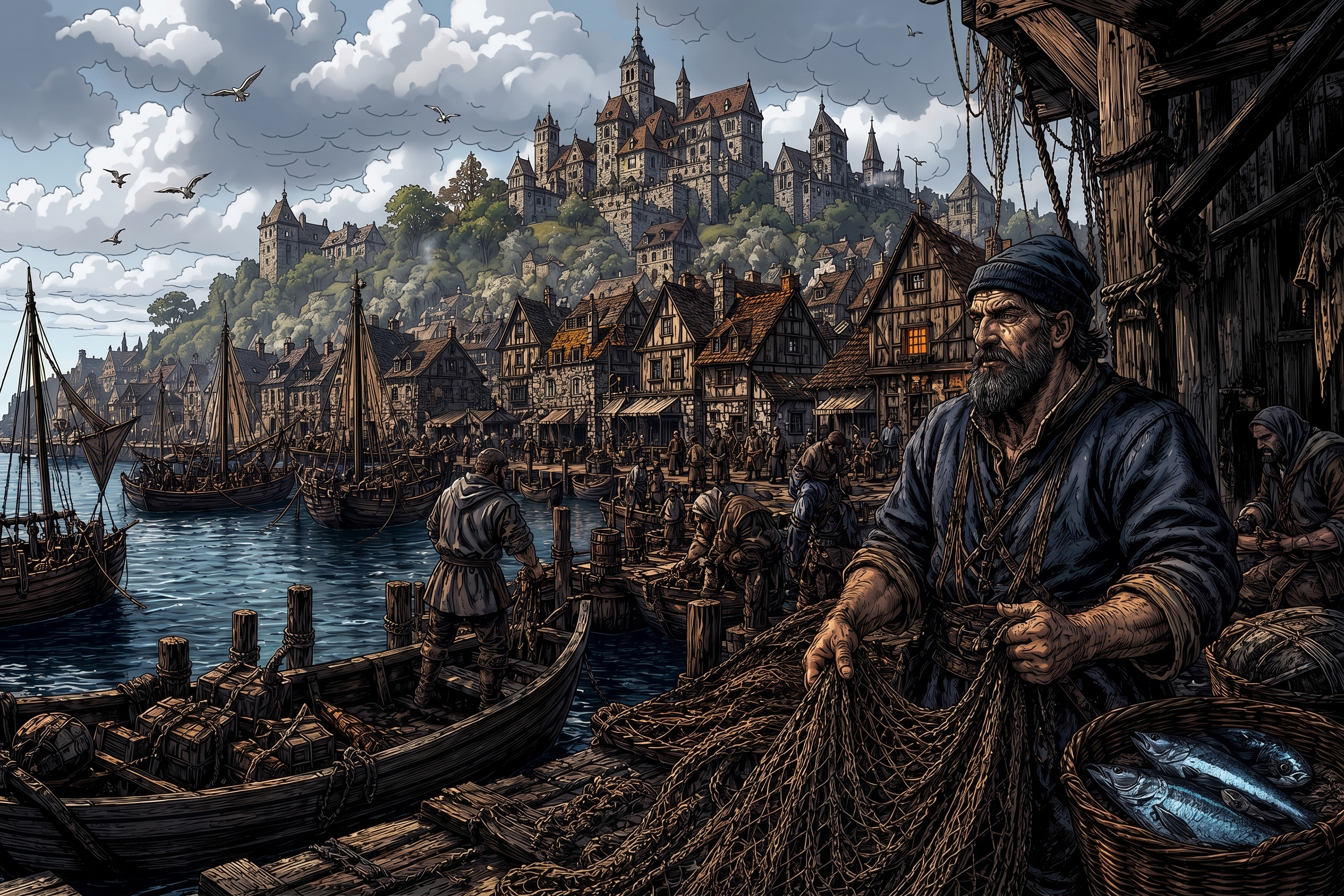
East-of-Sky is busy, tense, and watchful. The docks still creak under barrels of fish and coils of rope. The shipyards still ring with mallets and saws. The lighthouse still burns at night. The inns still hold sailors, refugees, mercenaries, and merchants waiting for safer roads. But beneath the ordinary life of the city lies a hard truth: East-of-Sky is economically wounded.
The blocked trade routes are doing what war often does better than swords. They are turning prosperity into scarcity. Fish spoils if it cannot move. Boats sit unfinished if buyers cannot come. Net-makers, coopers, sail-menders, and chandlers all depend on a lake economy that has been cut and strangled. Every week the routes remain blocked, the city grows poorer and angrier.
Yet East-of-Sky is not broken. Its people have the stubbornness of lakefolk. They have survived bad weather, bad lords, orcish rule, and demonic intrigue. They know how to mend what tears. They also know how to throw a body into deep water and let the lake take what the law cannot.
Armed Forces and Defenses
East-of-Sky maintains 250 full-time guards, a strong number for a city of its size. This reflects not comfort, but necessity. The city must police its markets, patrol its walls, guard its docks, watch for Danube loyalists, protect the shipyards, and prepare for attack from across the lake. The town watch is better trained than many small-city forces, though its loyalty has been tested by recent events.
In time of crisis, roughly 550 citizens can be conscripted. Many of these are sailors, dockhands, fishers, shipwrights, and mercenaries accustomed to hard labor and rough company. They may lack polish, but they are not delicate. A spear line of East-of-Sky dockmen is an ugly thing to push through, especially when every third man has a gaff hook, boarding axe, or gutting knife tucked somewhere close.
The city's greatest vulnerability is the lake itself. East-of-Sky lives by water, but so may an invader. The forces of Afej the Black gathering near West-of-Sky threaten to turn the Lake of the Sky from a trade route into an invasion road. If East-of-Sky loses control of its docks and shipyards, the city may fall quickly. If it holds them, it can bleed an invader white before he reaches the inner streets.
Places of Interest
1. Stronghold of Baron Oliver Goldcrown
The Baron's stronghold rises over the city as both fortress and symbol. It is not merely Oliver's residence; it is the seat of lawful rule in East-of-Sky. During Danube's usurpation, parts of the stronghold were used to house collaborators, seize records, and control the city administration. Since Oliver's restoration, the place has been cleaned, repaired, and guarded heavily. Still, some corridors feel colder than they should, and not every hidden room has been found.
2. Danube Family Manor
The Danube manor is one of the most hated houses in East-of-Sky. Once a proud noble residence, it now stands as a reminder of betrayal. Some citizens want it confiscated, stripped, and turned into a public hall or orphanage. Others argue that due process must be observed, even for traitors. The manor's servants know more than they say, and the family records may contain names that many powerful citizens would rather keep buried.
3. Fisherman's Chapel of Kantor
This waterfront chapel is older than many grander buildings in the city. Fishers pray here before dawn, widows light candles for those taken by the lake, and captains leave offerings before dangerous crossings. High Priest Felix Ack-Heathcliff often preaches here when he wants to speak directly to the lakefolk. His sermons are nominally religious, but recently they have carried a sharper edge: courage, action, justice, and preparation for war.
4. The Old Mariner's Inn
The Old Mariner's Inn is a weathered, crowded inn favored by captains, pilots, veteran sailors, smugglers, and anyone who prefers stories to comfort. Its beams are black with age and smoke, and its walls are hung with broken oars, lake maps, faded flags, and teeth from things no one agrees on. News travels through the Old Mariner faster than through the Baron's offices.
5. Shipyards
The shipyards are the industrial heart of East-of-Sky. Barges, fishing boats, patrol craft, and lake sailboats are built and repaired here. Even under occupation, the yards remained valuable, though often forced into the service of the Hoths. Today they are guarded day and night. Oliver needs them for defense, Felix wants them turned more aggressively toward war production, and merchants want them restored to trade as quickly as possible.
6. Temple of Aknor
The Temple of Aknor serves craftsmen, shipwrights, smiths, builders, and laborers whose work keeps East-of-Sky alive. Its priests bless tools, keels, beams, anchors, and new workshops. During the city's recovery, the temple has become a center of rebuilding. Its clergy have little patience for political speeches; they judge rulers by whether walls stand, boats float, and workers are paid.
7. Traveler's Hostel and Mercenary Guild
This large, practical building serves travelers, caravan guards, sell-swords, lake escorts, and hired blades waiting for work. In peaceful years it was a useful institution. In 8170 F.R., it is essential and dangerous. With trade routes blocked and invasion feared, mercenaries are everywhere. Some are loyal professionals. Some are deserters. Some are spies. The guildmasters try to keep order because if they fail, Oliver's guard will do it for them.
8. Lighthouse
The lighthouse of East-of-Sky stands near the lakefront, guiding boats through fog, storm, and night. Its flame is one of the city's most beloved symbols. During the rule of Danube, many whispered that the light was used to signal Lilith's agents and favored ships. Whether true or not, Oliver has replaced the keepers and stationed guards nearby. If Afej attacks by water, the lighthouse will become either a shield for the city or the first prize of the invader.
9. Church of Thranton
The Church of Thranton is smaller than the Fisherman's Chapel and less politically loud, but it remains an important spiritual center. As god of storms, Thranton will always have importance to lake-folk. His priests minister to families, merchants, and those who want steadiness in a city full of factional noise. Many citizens who distrust Felix's agitation but still want guidance have begun attending services here. Because of that, the church may become more politically important than its clergy intend.
10. Town Watch and Gaol
The watch house and gaol are busy, grim, and overcrowded. The cells hold thieves, smugglers, collaborators awaiting judgment, violent drunks, suspected spies, and the occasional fool who thought East-of-Sky's recent troubles made it weak. The watch is loyal to Oliver in theory, but some older guards served under Danube and have not forgotten where certain favors came from. Alanors, scribes, and jailers now spend as much time sorting the past as policing the present.
People of Note
Baron Oliver Goldcrown: The rightful lord of East-of-Sky, recently restored after imprisonment by George Danube. Oliver is honorable and legitimate, but his caution frustrates those who believe the city needs swift and ruthless action.
Jacob Ack-Simore: A wizard and supporter of Baron Oliver. Jacob is intelligent, controlled, and deeply concerned about lingering demonic influence in the city. He knows that Lilith's schemes may not have ended with Danube's fall.
High Priest Felix Ack-Heathcliff: Priest of Kantor and the most influential religious voice among the lakefolk. Felix supports Oliver's legitimacy, but he thinks the Baron is moving too slowly against collaborators and external threats.
Lord George Danube: The former puppet ruler of East-of-Sky, placed in power through the schemes of Lilith. Even if imprisoned, dead, or disgraced, Danube's influence lingers through records, allies, debts, blackmail, and fear.
Lilith: Demon-spy of Brathelathor, the Lord of Lust. Her direct presence may be gone, but few wise people believe she spent years in East-of-Sky without leaving traps behind.
Zebet: The last Orc Hoth of East-of-Sky, remembered for his ruinous war against the Hoth of Jacob's Rock. His rule left scars in the shipyards, the guard, and the memories of older citizens. His death was celebrated.
Current Tensions
- The Goldcrown Restoration: Oliver is rightful, but not yet fully secure. A restored seat is not the same as a healed city.
- The Danube Question: How much punishment is justice, and how much becomes revenge? Many citizens are not interested in the distinction.
- Felix and the Waterfront: Felix Ack-Heathcliff is becoming the voice of the impatient lakefolk. If Oliver ignores him, the docks may turn against the stronghold.
- Blocked Trade: Every day the routes remain closed, merchants lose money, workers lose wages, and tempers worsen.
- Afej the Black: The threat from West-of-Sky is no rumor. East-of-Sky is preparing for invasion, whether its leaders admit it openly or not.
- Lilith's Remnants: Danube was a puppet. The hand that moved him may have left other strings tied around the city.
Rumors and Local Sayings
- "The lake feeds us, drowns us, and brings our enemies when the wind is wrong."
- "Goldcrown has the right, but Felix has the docks."
- "The Danubes lost the city. That does not mean they lost their keys."
- "If the lighthouse burns blue, pray first and ask questions later."
- "A fish rots from the head, but a city rots from the records room."
- "The Old Mariner hears every secret before the Baron does."
Adventure Hooks
- The Danube Ledger: A hidden account book from Danube Manor names collaborators, paid informers, and citizens who secretly served Lilith. Half the city wants it found; the other half wants it burned.
- The Black Sails: A fishing crew returns with news of strange vessels moving out from West-of-Sky under cover of fog. Oliver wants confirmation before acting. Felix wants the fleet armed immediately.
- The Lighthouse Signal: On moonless nights, someone is using the lighthouse to send coded messages across the Lake of the Sky.
- Rot in the Shipyards: Newly repaired patrol boats fail under stress. Sabotage, cursed timber, bribed workers, or demonic residue may be to blame.
- The Prisoner Below: A forgotten prisoner from Danube's rule is discovered in a sealed lower cell of the gaol. He knows something about Lilith, but his mind is badly damaged.
- Felix's Ultimatum: High Priest Felix threatens to organize the lake captains without Oliver's permission unless the Baron takes stronger action against Afej's forces.
- The Hoth's Spoils: Treasure seized by Zebet during the occupation may still be hidden beneath the old military stores near the docks.


