
Skip

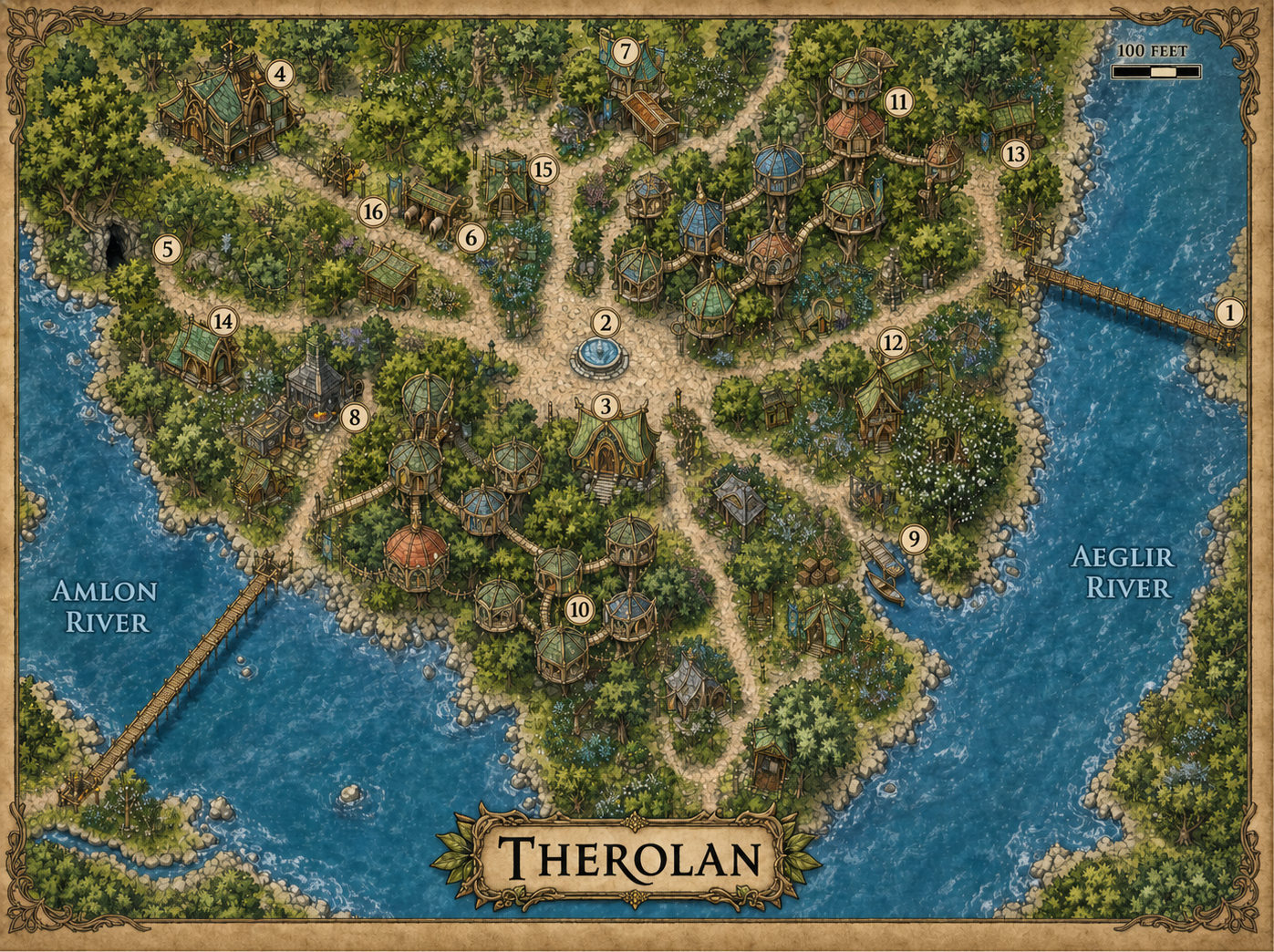
Therolan is an ancient elven village of the Belendale, built upon a wooded tongue of land between the Amlon and Aeglir Rivers. Its bowers, treetop fletches, gardens, and winding paths give it an air of quiet beauty, but the village is also a well-defended frontier settlement whose inhabitants keep a close watch upon the kingdom of Kale to the south. Therolan is governed by the heads of its five Houses, whose people are known for their boats, textiles, wine, music, and skill with the bow.
General Information
The Houses of Therolan
Defenses of Therolan
Life in Therolan
Points of Interest
Possible Adventures in Therolan
Who rules: Therolan is governed by a council consisting of the heads of its five Houses. The council is headed by Windeltha of House Thalandwire, although she has little authority over the daily lives of the villagers. The council meets chiefly to discuss matters involving the defense of Therolan, relations with other elven settlements, and events beyond the borders of the Belendale.
Population: 593 elves. Almost every inhabitant belongs to one of the five Houses of Therolan, although a small number of rangers, hunters, artists, and other solitary elves live near the village without formally joining a House.
Major Products: Boats, textiles, game, and wine. Therolan is particularly known for its light river craft, which are narrow, swift, and well suited to the wooded waterways of the Belendale. Its woven cloth is also prized for its durability and for the green, blue, brown, and silver dyes favored by the elves. Therolan produces many fine goods, but it is not a major center of trade, and most of its inhabitants have little interest in accumulating coin. Merchants are more likely to accept useful materials, well-made tools, rare books, or promises of service than outsiders might expect.
Armed Forces: Therolan has ten full-time guards led by Belost of House Thalandwire and Padavorn the ranger, a low-ranking Shadow Walker. These guards spend most of their time secretly watching the approaches to the village and the entrance to the Bower of House Thalandwire, since there is little crime within Therolan itself. In times of trouble, forty very capable elves can be called up as a militia. House Thalandwire also keeps two trained griffins, which serve as guardians, messengers, and steeds.
Therolan is an ancient village of the elves of the Belendale. It stands on a wooded tongue of land between the Amlon River and the Aeglir River, where the two waterways draw close before continuing southward. The rivers protect much of the village, while thick forest and carefully concealed defenses guard the remaining approaches.
The elves of Therolan have long watched the peoples of the kingdom of Kale to the south. They do not consider the folk of Kale enemies, but neither do they trust them entirely. News from the south is carefully gathered, discussed by the council, and passed onward to other settlements of the Belendale when it is judged important.
Therolan is not a large village, but it is a particularly difficult one to attack. Its position between the rivers, its skilled defenders, and its hidden traps make even reaching the settlement dangerous for an unwelcome visitor. An enemy who enters the woods surrounding Therolan may never know that he has been observed until the first arrow is loosed.
Almost all the inhabitants of Therolan belong to one of five Houses: Thalandwire, Aldaval, Taltaur, Wertanthir, and Tifwing. These Houses are more than families in the human sense. Each includes several bloodlines, dependents, sworn companions, and elves who have been accepted into the House through marriage, adoption, or long service.
The Houses are loosely ranked by prestige. This rank depends chiefly upon the age of the House and upon how many of its elders have spent time in the Summervale and seen the Great Swan. House Thalandwire is presently regarded as the foremost House of Therolan, but this distinction grants it few formal privileges.
The elves seldom speak openly of these differences, and few feel personally denigrated by the rank of their House. Rivalries exist, particularly in matters of art, horsemanship, archery, and public service, but they are usually expressed through competition rather than hostility. A poem, a finely made bow, or a daring ride through the forest may improve the reputation of a House more effectively than wealth ever could.
The two bridges leading into Therolan are narrow wooden crossings that appear almost too slight to bear the weight of a traveler. They are soundly built, but deliberately difficult for outsiders to cross quickly. A non-elf attempting to cross one must succeed at a DC 12 Dexterity check or fall into the river below.
This crossing becomes much more difficult when arrows are being fired from the treetop guard platforms on the village side of the rivers. The guardians know every plank, rope, and support of the bridges, and they can quickly cut or collapse sections if an enemy attempts to force a passage. Small boats are also kept hidden beneath the trees so that defenders can move along either river without using the bridges.
Several log deadfall traps guard the landward approaches to Therolan. These traps have been hidden with all the skill of the elves and are very difficult to detect. Some can crush a group of intruders beneath heavy timber, while others block the road and leave attackers trapped in a narrow killing ground.
The guards of Therolan do not stand openly at gates or challenge every traveler from the road. They watch from the branches, from concealed platforms, and from narrow paths hidden behind screens of leaves. Most visitors are observed for some time before they realize they have entered the defended lands of the village.
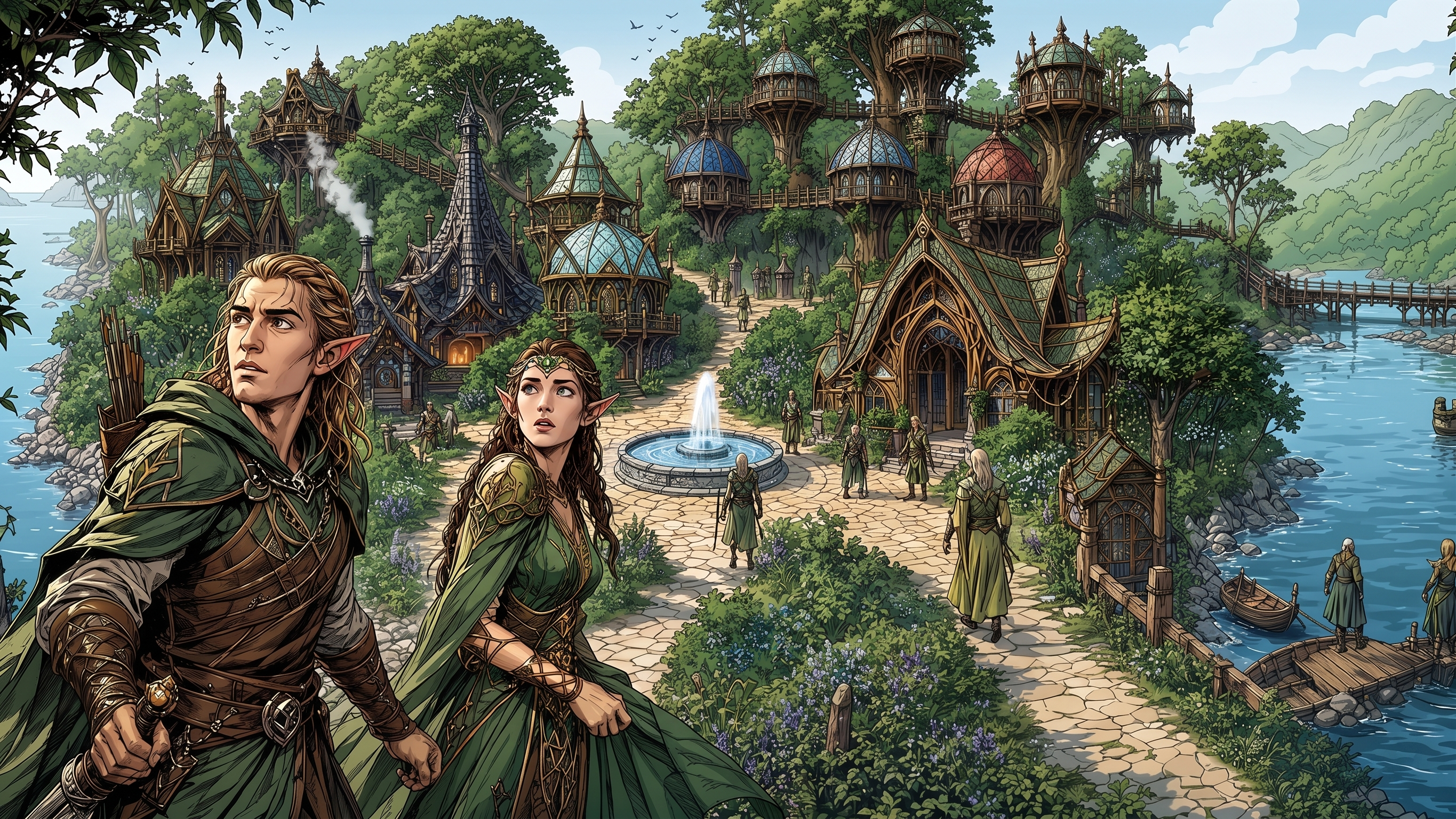
The buildings of Therolan are chiefly bowers and fletches. Bowers are created by carefully planting trees and tending them over many years until their trunks and branches interlace to form walls and a watertight roof. Most are shaped much like longhouses, with leafy screens dividing the interior into two or three rooms.
A fletch is a house built among the branches of a living tree. Some are small family dwellings, while others consist of several chambers connected by wooden walks and rope bridges. Two large fletch compounds rise near the center and southern end of the village, their towers and platforms woven through several enormous trees.
There are also a few buildings made from worked timber and stone. The compound of House Thalandwire is the most notable example, since only the front portion of the house is a living tree-bower. The deeper rooms are constructed from carved wood, stone foundations, and old beams decorated with scenes from the history of the House.
The atmosphere in Therolan would be described by a non-elf as magical, although most of the effect is produced by patient attention to the beauty of the village. Flowers are planted so that some part of Therolan is in bloom throughout most of the year. Paths curve around old trees rather than cutting them down, and even practical structures are carved, painted, or grown into pleasing shapes.
Music can be heard through much of the village. An elf practicing a flute beside the river may be answered by a singer in one of the fletches, while children learn old verses as they work in the gardens. At night, shaded lamps hang from branches and bridges, casting green, gold, and blue light across the paths.
The elves of Therolan are merry folk, but their cheer should not be mistaken for carelessness. They understand that theirs is a frontier village. Even during a feast, some elves remain at the guard posts, and songs about beauty and love are often followed by songs remembering the wars and losses of the past.
This guard post stands above the eastern bridge across the Aeglir River. It is hidden among the upper branches of several large trees and commands a clear view of the bridge, the riverbank, and the road beyond. From below, it appears to be little more than a tangle of leaves and branches.
Two or three guards are usually stationed here, armed with longbows and signal horns. Ropes attached to the bridge allow the guards to loosen planks or pull away part of the crossing. A covered platform also contains spare arrows, coils of rope, and enough dried food for several days.
The Town Glade is the open heart of Therolan. A low stone fountain stands at its center, fed by a clear spring drawn through channels beneath the village. The surrounding stones have been worn smooth by centuries of footsteps, dancing, markets, and public gatherings.
Most village celebrations are held here, as are announcements made by the council. Traders may display their goods along the edge of the glade, although loud bargaining is considered rude. In the evening, musicians often gather near the fountain, and villagers sit beneath the trees to listen.
This graceful bower serves as Therolan's chief place of worship. Here the elf god Tal-Allustiel is revered. Its high roof is formed from living branches, and the entrance is framed by pale wood carved with swans, stars, leaves, and flowing water. The interior is quiet and cool, even during the hottest days of summer.
The elves come here for marriages, blessings, memorials, and the observance of holy days. There is no large altar. Instead, a shallow basin of clear water rests beneath an opening in the roof, where moonlight falls upon it during the night.
The Bower of House Thalandwire stands in the northwestern portion of Therolan. It is one of the oldest and largest dwellings in the village, and its steep roof and carved wooden front make it more imposing than most elven bowers. Several smaller gardens and private paths surround the compound.
Windeltha resides here, and the council usually meets in its main hall. The House keeps records of Therolan's dealings with Kale, reports brought by rangers, and letters received from the Summervale. The entrance is watched more closely than any other place in the village, although the guards are rarely seen.
A rocky hollow near the western riverbank serves as the lair of the two griffins kept by House Thalandwire. The cave is larger than it first appears and extends beneath the roots of several ancient trees. Its floor is covered with dry leaves, rushes, bones, and pieces of leather tack.
The griffins are trained to tolerate the elves of Therolan, but they are not tame animals. Outsiders are forbidden from approaching the cave without an escort. When danger threatens, the griffins can be released within moments and guided by riders from House Thalandwire.
The stables of Therolan are low, open structures built around a shaded yard. The elves keep swift forest horses here, most of them smaller and more agile than the warhorses used by human knights. They are accustomed to narrow trails, shallow streams, and sudden movement through thick woods.
The stable hands also maintain tack for the griffins and several light wagons used within the Belendale. Visitors may board their animals here, although a horse that has been badly treated will usually be taken from its owner until the council decides what should be done.
The Bower of House Aldaval stands near the northern edge of the village. Its chambers have been grown around several closely planted trees, producing a tall and somewhat irregular structure. The House is known for its hunters, boatwrights, and elves who range along the two rivers.
Maps of the Amlon and Aeglir hang in its common chamber, marked with landing places, dangerous currents, and old paths through the surrounding woods. Members of House Aldaval often provide guides for those traveling deeper into the Belendale, though only travelers they consider trustworthy receive such aid.
Therolan's smithy is built partly from stone to contain its heat and lessen the danger of fire. Its tall chimney rises above the nearby bowers, and the sound of hammering can often be heard from the western paths. The forge burns charcoal made in carefully managed forest pits beyond the village.
The smith produces tools, arrowheads, knives, buckles, and fittings for boats and fletches. Heavy armor and large weapons are made only rarely, since the elves of Therolan favor speed and freedom of movement. Even ordinary objects from the smithy are usually decorated with leaves, birds, waves, or geometric patterns.
A narrow boat launch lies on the bank of the Aeglir River. Several light craft are usually drawn onto the shore or tied beneath a small shelter, while paddles and poles are stored in racks nearby. Crates of wine, woven cloth, and provisions are sometimes stacked here before being carried downriver.
The launch is watched from the trees and from the nearby paths. No boat is permitted to leave Therolan after nightfall without the approval of a guard captain or member of the council. The elves know that the rivers provide access to the village as well as protection from its enemies.
The Fletch of House Wertanthir occupies a cluster of immense trees near the southern riverbank. Its chambers are connected by curved bridges and platforms, some of which hang high over the water. Colored glass and painted wooden panels catch the morning light and scatter it through the leaves.
House Wertanthir is strongly associated with weaving, music, and the making of wine. The lower chambers contain workrooms and storage areas, while the upper fletches are used as dwellings. During festivals, musicians from the House play from several platforms at once, allowing their music to carry across the river.
The Fletch of House Tifwing rises above the northeastern part of Therolan. It is the highest dwelling compound in the village and consists of several towers joined by long wooden bridges. From its upper platforms, an observer can see far along the Aeglir River and across the surrounding forest.
Many of Therolan's scouts and archers belong to House Tifwing. The House maintains a signal platform near the highest chamber, where colored lanterns, flags, and smoke can be used to communicate with distant watchers. Its lower rooms contain bows, climbing gear, and supplies prepared for sudden patrols.
The Bower of House Taltaur stands east of the Town Glade among thick gardens and flowering shrubs. It has a broad, welcoming entrance and several covered porches where members of the House gather to talk, eat, and work. Travelers who have been formally accepted as guests of Therolan are often lodged here.
House Taltaur is known for its gardeners, healers, and keepers of old stories. Its private garden contains medicinal plants gathered from many parts of the Belendale. Some are harmless and pleasant-smelling, while others can cause sleep, paralysis, fever, or death when prepared incorrectly.
This small building near the eastern riverbank serves as Therolan's general store and common storehouse. It stocks rope, lamp oil, blankets, preserved food, tools, arrows, fishing gear, and other ordinary goods. Most of its wares are made within the village or brought from other elven settlements.
The store also receives goods from merchants allowed to enter Therolan. Human-made objects are examined carefully before being offered for sale, and items judged ugly, wasteful, or poorly made may be refused regardless of their value. The storekeeper keeps little coin on hand and prefers barter for larger purchases.
The militia meeting house is a sturdy bower near the western side of the village. Its main chamber is large enough to hold Therolan's forty militia members, along with the full-time guards and several representatives of the council. Maps, patrol routes, and plans for defending the bridges are kept in locked cabinets.
A concealed storeroom contains bows, arrows, shields, leather armor, and supplies for a prolonged defense. The militia gathers here for regular training, though much of its practice takes place in the forest. When the meeting house bell is rung three times, every able militia member is expected to report at once.
The Hall of Poetry and Art is a slender bower near the northern path. Its walls are formed from pale, smooth-barked trees, and its doors are carved with lines from famous elven poems. Paintings, woven scenes, sculptures, and decorated weapons are displayed within its several chambers.
The Hall is also used for recitations, musical performances, and contests between the Houses. Some works remain on display for centuries, while others are shown for only a single evening. The elves consider the destruction of a work kept in the Hall to be a serious crime, nearly equal to the burning of a history or the desecration of a grave.
This section of the western path appears to pass between an ordinary fence and a cluster of old trees. In fact, the road lies within the killing ground of one of Therolan's largest deadfall traps. Heavy logs are suspended among the branches and concealed by leaves, while hidden ropes allow the guards to release them from several protected positions.
The trap can either crush those beneath it or block the path behind them, depending upon which ropes are cut. Archers watch the area from nearby trees and can fire upon intruders trapped between the fallen timber. Villagers know where to step and which markers to watch for, but an outsider is unlikely to notice anything unusual.
The Empty Griffin Cave. One of House Thalandwire's griffins fails to return from a patrol, and the second becomes agitated and refuses all attempts to saddle it. Tracks suggest that the missing creature landed willingly in a clearing beyond the Amlon River, but the elves who went to investigate have also disappeared.
The Fallen Bridge. A section of the eastern bridge collapses beneath a party of visiting merchants, killing one and nearly drowning several others. The guards insist that the bridge was deliberately weakened, but only elves of Therolan should have known where its supports could be cut without the damage being noticed.
A Song That Should Be Forgotten. An old poem is discovered behind a wall in the Hall of Poetry and Art. Several elves claim that the work was hidden because its verses reveal a shameful event in the history of one of the five Houses, while others insist that the poem is a coded warning concerning an enemy that has returned to the Belendale.
The Silent Watch. A treetop guard post fails to answer its scheduled signal, and the elves sent to investigate find the platform empty. There is no blood, no sign of struggle, and no indication that the guards climbed down. Their bows remain in place, but every arrow has been removed from its quiver.
Wine on the Aeglir. Several boats carrying Therolan wine disappear while traveling south along the Aeglir River. The council fears human bandits, but Padavorn believes the attacks are being made by someone who knows the elves' sailing routes and signal customs. The missing cargo may be less important than the messages that were hidden among the casks.
The House Without a Voice. The head of one of Therolan's Houses is struck by a strange affliction on the morning of an important council meeting. She remains conscious and appears otherwise unharmed, but she cannot speak, write, or communicate through signs. Her condition leaves the council divided just as troubling news arrives from the borders of Kale.
The Trap in the Road. One of the great deadfalls is triggered during the night, though no bodies or tracks are found beneath it. The noise draws the militia away from the village, and the guards soon realize that the trap may have been deliberately sprung to leave another approach unprotected.
The Guest of House Taltaur. A wounded human ranger is found near the southern forest and brought to the Bower of House Taltaur. He claims that soldiers from Kale are searching for Therolan, but his story changes each time he tells it. Some elves wish to send him away, while others suspect that the danger he describes is real.