Saint Quentin's Church, Dragonspur
St. Quentin's Church is one of the oldest and most famous temples of Heshtail in Dragonspur City. It is the chief seat of the Church of Heshtail in the free lands of Kelerak, the residence of the High Potentate, and a destination for pilgrims who come to venerate the relics of Saint Quentin.
Table of Contents
General Information
Areas of Interest
The Blessed Crypts
The Gardens and Outbuildings
General Information
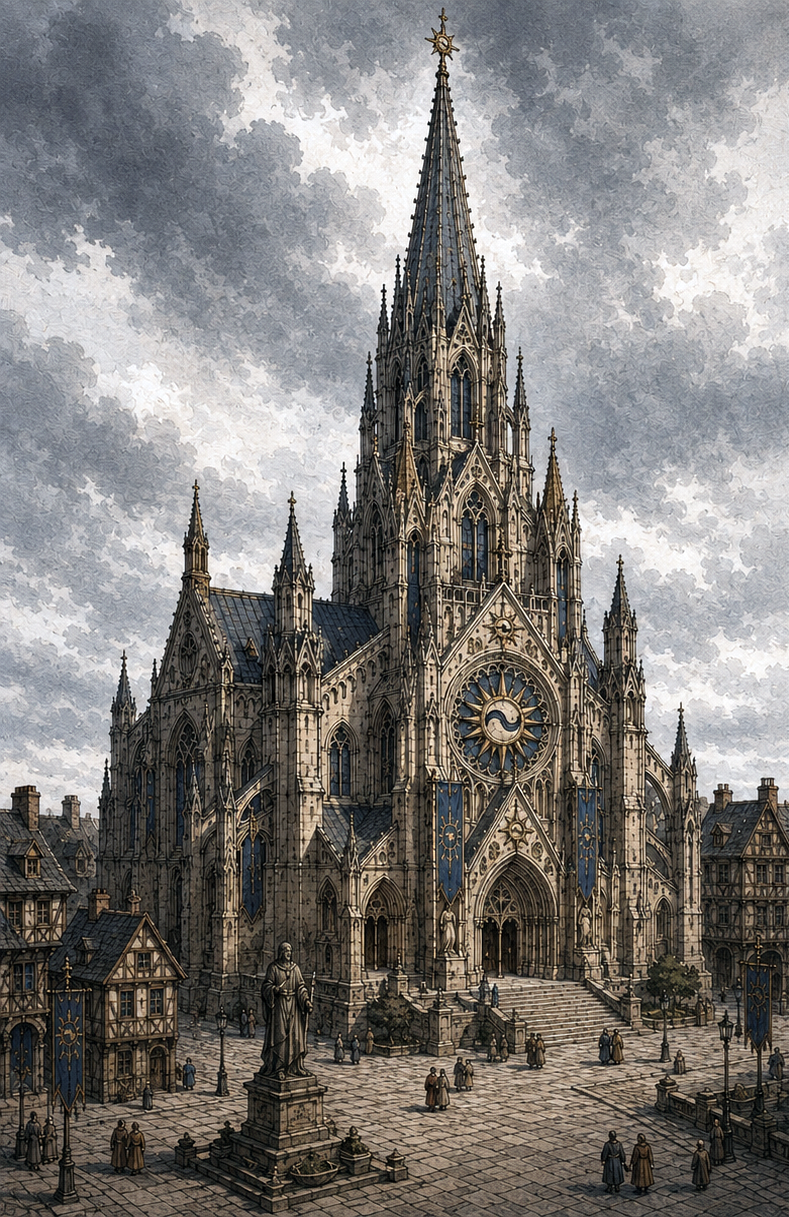
St. Quentin's Church, a temple to Heshtail, is one of the most famous buildings in all of Dragonspur City. The church has stood for nearly a millennium, surviving wars, invasions, fires, and the long years of the Dark Occupation. It remains the most important temple of Heshtail in the city and perhaps in all of the western side of the continent of Farland.
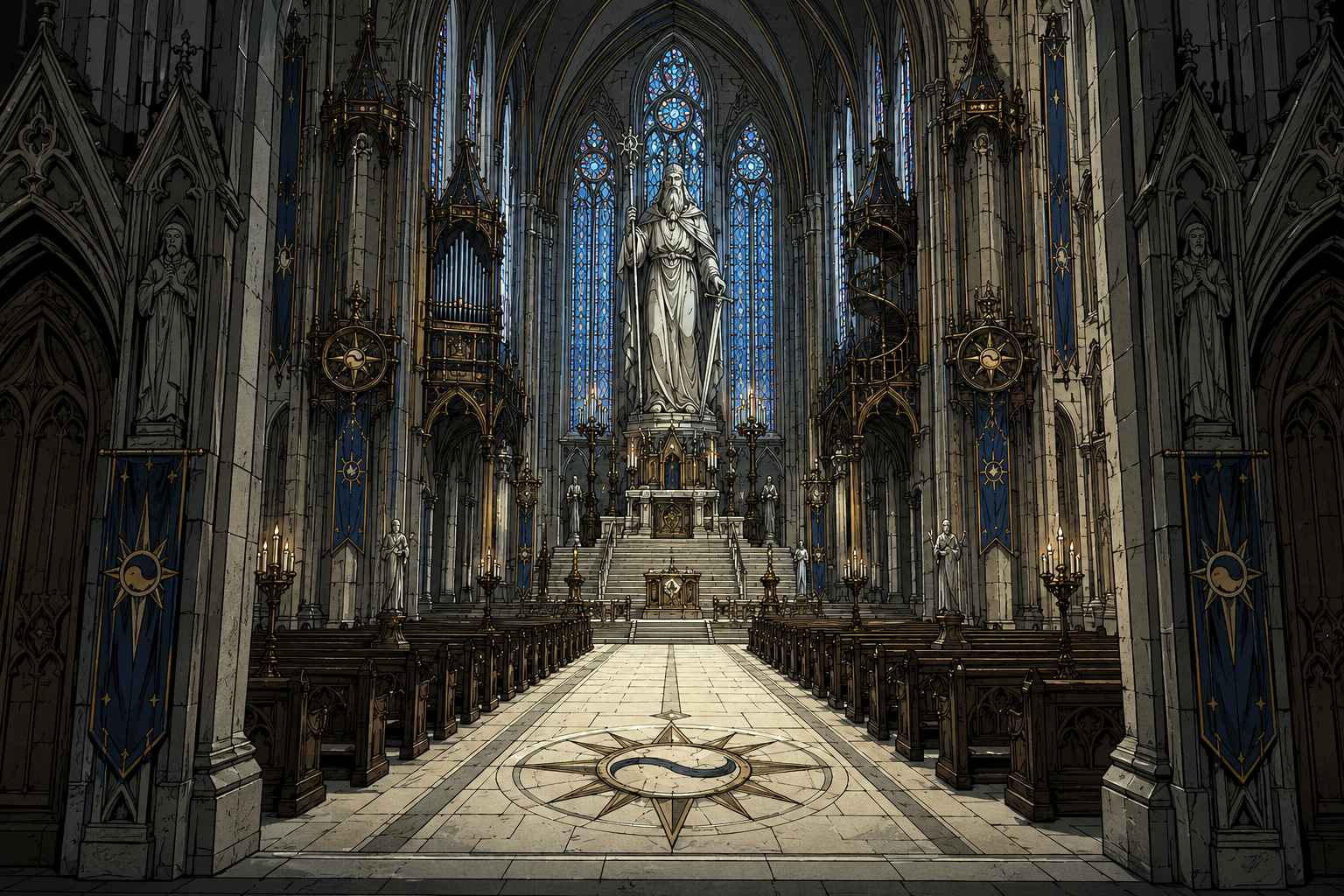
The building itself is roughly shaped like the holy symbol of the Merciful One. Its tall central nave forms the body of the church, while the sanctuary, chapels, aisles, and adjoining chambers suggest the staff and sword carried by Heshtail. The church is built of pale stone darkened by age, with a great arched porch facing the city and a high spire rising above the northern end. Passing through the main doors, a visitor enters the long nave. Rows of carved wooden benches stand on either side of the broad central aisle, while statues, tombs, side chapels, and banners fill the spaces beneath the high stone arches. A great device of Heshtail is set into the floor near the entrance, and smaller versions of the holy symbol appear upon doors, lamps, pillars, and hanging cloths throughout the church.
The eye is immediately drawn to the eastern wall, where enormous stained glass windows rise almost to the vaults. The windows show Heshtail as judge, healer, and protector, surrounded by saints and servants of the church. Much of the original glass was broken during the Occupation, but the surviving pieces were carefully gathered and incorporated into the restored windows. Beneath the windows stands a huge statue of Heshtail, resplendent with staff and sword raised. The two instruments represent the mercy and strength of the church, as well as its two great orders, the Faithful and the Militant. The statue is ancient and bears several marks left by soldiers and dark folk who tried unsuccessfully to pull it down during the Occupation.
The holy high altar stands at the foot of the statue upon a broad series of stone steps, like a supplicant prostrate at the feet of the god. The pulpit and sacred organ flank the sanctuary, while spiral stairs rise behind it toward the belfry and the upper chambers of the spire. From the highest platform, one is afforded one of the finest views in Dragonspur City, barring perhaps that from the towers of the Spur Fortress. From there one may wander through the rest of the cathedral, taking in amid the hushed ambience the exquisite statuary of the saints or the venerated sepulchers of the famous. The church once possessed a considerable collection of paintings, jeweled icons, golden reliquaries, and illuminated manuscripts. Most movable objects of value were stolen during the Occupation, though a few were hidden by the clergy or carried away by faithful families. This lack is quickly being remedied through rich donations, and new works now stand beside the older pieces that survived.
St. Quentin's resisted complete destruction during the Dark Occupation, seemingly of its own power. Fires went out without reason, stones refused to crack beneath hammers, and more than one servant of the Dweller died after entering the sanctuary with the intention of defiling it. The priesthood does not claim that the church is indestructible, but none who serve here doubt that Heshtail watches over it.
Areas of Interest
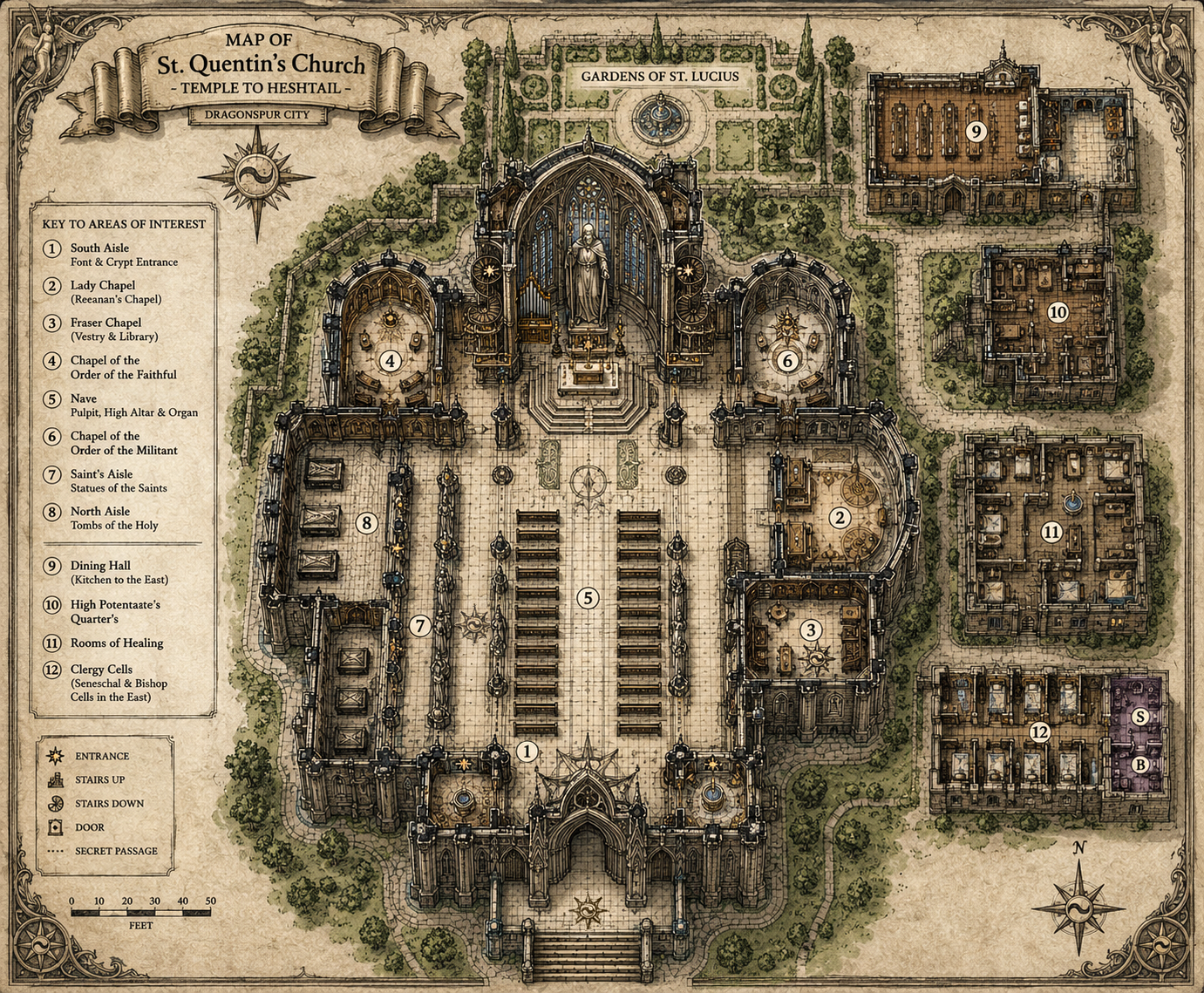
1. South Aisle
The South Aisle runs along the souther part of the nave, on both sides of the main entrance, and contains the church's principal baptismal fonts. The fonts are carved from single block sof pale stone and are said to have been brought from the first temple of Heshtail raised upon this site. Generations of children from Dragonspur's noble and common families alike have been blessed in their waters.
A heavy stone trap door near the southwestern font opens onto the stairs leading into the blessed crypts. The door is ordinarily kept locked, and entrance is permitted only to clergy, mourners, pilgrims with special permission, and those conducting church business among the dead.
2. Lady Chapel
The Lady Chapel is dedicated to the handmaiden of Heshtail, the great goddess Reeanan. It is smaller and quieter than the great nave, with a rounded sanctuary, a modest altar, and several images of the goddess watching over mothers, children, travelers, and those in distress.
The chapel is used for private prayer, marriages, blessings before childbirth, and services held for women who died protecting others. A paladin of Reeanan traditionally commands the temple guard, strengthening the old connection between this chapel and the defense of St. Quentin's.
3. Fraser Chapel
Fraser Chapel serves as both vestry and library. The clergy robe here before important services, and cabinets along the walls contain vestments, candles, sacred vessels, incense, and other objects needed for worship.
The chapel's library contains histories of the church, copies of sermons, records of miracles, rolls of the dead, and accounts of the deeds of Saints Quentin and Lucius. The most valuable books are kept in locked cases, since several manuscripts disappeared during the confusion following the city's liberation.
4. Chapel of the Order of the Faithful
This chapel is reserved for the Order of the Faithful. Its decorations show Heshtail with his staff extended over the sick, the poor, and the penitent, while carvings around the altar depict priests teaching children, feeding prisoners, and burying the dead.
Daily services are held here before dawn. Members of the Faithful also gather in the chapel to settle questions concerning doctrine, temple discipline, charitable work, and the distribution of church funds.
5. The Nave
The nave is the heart of St. Quentin's and the place where the largest public services are held. Its high roof is supported by massive pillars, and the long rows of benches can seat several hundred worshipers. Far more stand in the aisles during major holy days and ceremonies conducted by the High Potentate.
The pulpit stands near the eastern end, close enough to the sanctuary that a speaker can be seen throughout the church. The sacred organ rises nearby, its pipes framed by carved stone and dark wood. The instrument suffered serious damage during the Occupation, but it has been rebuilt, and its sound can be heard well beyond the church grounds when all the pipes are in use.
The holy high altar stands before the statue of Heshtail. Important relics are displayed upon it during festivals, and the High Potentate conducts the greatest ceremonies from the upper steps. The space beneath the statue is never entirely dark, for lamps are kept burning there at all hours.
6. Chapel of the Order of the Militant
The eastern chapel is dedicated to the Order of the Militant. Its altar is plain and heavy, and the surrounding walls bear the names of paladins, soldiers, and militant priests who died defending the faithful.
Weapons carried by several famous champions hang behind the altar, though most are ceremonial or too damaged for further use. Members of the Militant pray here before departing on dangerous duties, and the bodies of fallen temple guards are brought here before burial.
7. Saint's Aisle
Saint's Aisle contains statues of the recognized saints of Heshtail. Some are life-sized, while others are small figures set into niches between the pillars. Candles and written petitions frequently gather at their feet.
Saint Quentin occupies the place of greatest honor, but Saint Lucius, Saint Fraser, and several lesser figures are also represented. A few empty niches remain for saints whose names or images were deliberately destroyed during the Occupation and have not yet been recovered.
8. North Aisle
The North Aisle contains the tombs of bishops, Potentates, paladins, and other honored servants of the church. The oldest sepulchers are simple stone chests, while later tombs bear carved figures of the dead lying with hands folded in prayer.
Not every person buried here was wealthy or powerful. Several common temple servants rest among the great because they died protecting relics, hiding fugitives, or refusing to betray the church during the Occupation.
9. Dining Hall and Kitchen
The dining hall stands in a separate building behind the church and is used by the resident clergy, temple guards, healers, and visiting church officials. Long tables fill the main room, and meals are plain except upon feast days.
The kitchen lies immediately to the east and contains large ovens, preparation tables, storerooms, and a well-stocked pantry. Food is also prepared here for the poor, particularly during winter and for the troubled districts of the city.
10. High Potentate's Quarters
The High Potentate's residence is comfortable but not especially luxurious. It contains private chambers, offices, meeting rooms, a small chapel, and enough guest rooms to house visiting Potentates or important representatives of the church.
Much of the business of the free districts is conducted here. Reports arrive from temples across Kelerak, disputes are heard, appointments are considered, and decisions are made concerning money, soldiers, missions, and the rebuilding of churches damaged under the Lords of Sin.
11. Rooms of Healing
The Rooms of Healing are maintained by the Order of the Faithful. They contain clean wards, private chambers, stores of herbs, and several small rooms where priests perform difficult treatments away from the noise of the common halls.
The poor are treated without charge when space and supplies permit. Soldiers, pilgrims, and members of the clergy are also brought here, and difficult cases sometimes attract healers from other temples in Dragonspur.
12. Clergy Cells
The clergy cells are small private rooms arranged around narrow corridors. Most contain little more than a bed, writing table, chest, lamp, and small image of Heshtail, though senior clergy are permitted somewhat larger chambers.
The rooms at the eastern end belong to the Seneschal and Bishop. The Seneschal oversees the practical needs of the church and its household, while the Bishop is responsible for much of its worship, teaching, and ordinary discipline.
The Blessed Crypts
Deep beneath the spire and the body of the church lie the blessed crypts. They can be reached through the stone trap door in the South Aisle, followed by a long stair that descends well below the streets of Dragonspur. The passages are extensive, and portions of them are older than the present church.
The crypts contain the graves of many famous figures, including King Stephen Lanfranc, who reconquered Dragonspur after the Great Barbarian Invasion of 6201. Bishops, saints, knights, royal servants, and defenders of the city lie in chambers nearby, though only a fraction of the dead have marked tombs.
The most sacred objects kept at St. Quentin's are the mace of Saint Quentin and fragments of the saint's bones. These relics are normally secured within the lower crypts and brought into the church only during important holy days. Pilgrims come from every part of Farland to kneel before them, and some travel for months to do so.
Many stories are told about the crypts. Lights have been seen moving behind sealed doors, bells have sounded in chambers where no bells hang, and armed invaders have become lost in passages that should have led directly back to the stairs. The clergy acknowledge these stories but rarely discuss them with outsiders.
The Gardens and Outbuildings
Behind the church lie the Gardens of Saint Lucius. Trimmed hedges, narrow paths, old trees, and a central fountain surround small plots used for herbs and flowers. The gardens provide a quiet place for prayer, and the clergy often bring recovering patients here when the weather is fair.
The grounds are flanked by the dining hall, kitchen, High Potentate's residence, Rooms of Healing, and clergy quarters. Covered walks and paved paths connect the buildings, allowing the clergy to move between them without crossing the public streets.
The church maintains a substantial contingent of temple guards, memebers of the Order of the Militant, led by a paladin of Reeanan. They watch the gates, patrol the grounds, escort important relics, and protect pilgrims during major festivals. These soldiers will reinforce the forces of the Green Throne whenever the city is threatened.
St. Quentin's remains an impressive and imposing structure, but its importance extends beyond its stones and relics. It survived the worst years of Dragonspur's history and gave the faithful a place to gather after the city was freed. Its priesthood believes it will continue to serve as a beacon of Heshtail's mercy and strength for another thousand years, and few who have stood beneath its great eastern windows would readily disagree.