The Nameless City
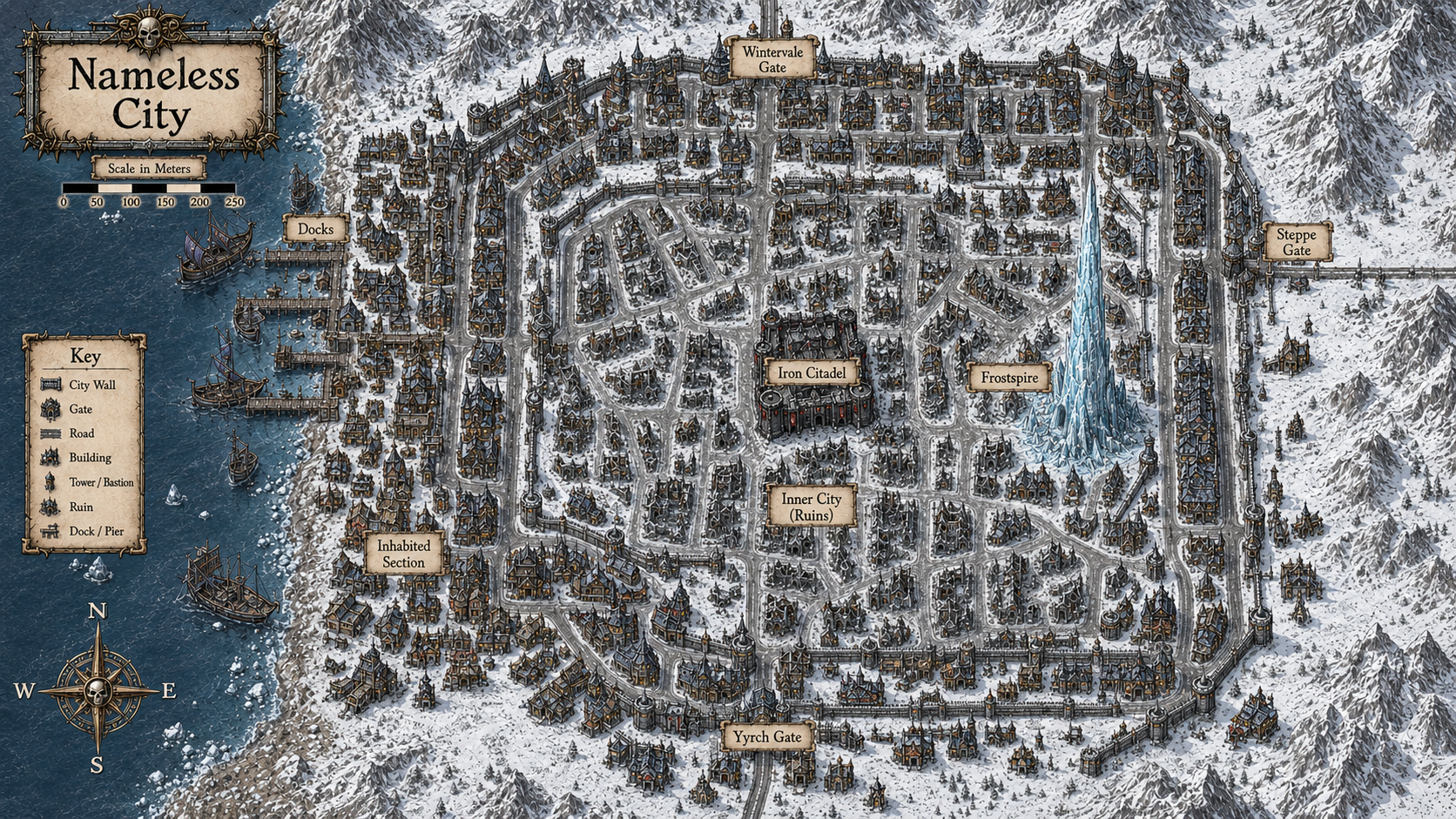
The Nameless City is the frozen capital of the Wintervale and the dreadful abode of the Dweller. It stands on a bitter northern harbor, hemmed in by mountains, black water, ice, and the malice of its mistress. Its present name is not its first name. Long ago it was Talas, fortress-city of the rebel Elves of Al-Dustriel. Later, when orcs and monsters came to infest its halls, they called it Gorgwath. Now even those names are dangerous. Among the free peoples of Farland it is called only the Nameless City.
The city is one of the most accursed places in the world, not because it began in squalor, but because it began in greatness. It was founded by the mightiest of the Elven houses after she who would become the Dweller turned them against their own people. Its fall was not merely military. It was spiritual, racial, and historical. The Nameless City is what remains when splendor rebels against the light and is punished, corrupted, sacked, occupied, and finally frozen into a monument of death.
Table of Contents
General Information About the City
Ancient History
The City Today
Locations of Interest
The Frostspire
Kiborus, the Cold Master
Irzuk Orcs, Inhabitants of the City
Adventuring in the Nameless City
General Information About the City
The city is ruled in name by Kiborus, the Cold Master, who serves as chancellor, governor, jailer, taxmaster, and executioner. In truth, all power belongs to the Dweller in the Wintervale, who broods within the Frostspire and whose will is the only law that ultimately matters. Kiborus rules because she permits him to rule; should she withdraw that favor, he would last no longer than a candle in the northern wind.
The other powers of the city exist under the authority of the Cold Master and against one another. Hoth Dorak, an oluk orc of grim discipline and brutal habits, serves as captain of the docks and oversees security, tribute, prisoners, slaves, and military transport in and out of the harbor. Hai Urg, another dour oluk, controls the eastern Steppe Gate and the overland roads that lead into the white wastes and the subject lands beyond. Captain Khalid Hammerhand commands the Black Fleet, the black-sailed attack ships that prowl the icy harbor and serve as the navy of the Wintervale. Master Yen Keng, the Cold Master's wizard, leads a cabal of dark mages drawn from Yrrkune, Budum-Ishi, and other conquered places. Lord Rand, a tiefling merchant-prince and head of the importers' guild, manages the city's trade, smuggling, bribes, slave contracts, and quiet arrangements with those foolish enough to do business with the Wintervale. Yellsh, a goblin of remarkable cunning and spectacular cowardice, rules the assassins' guild from hidden warrens in the southeastern ruins.
About 20,000 living souls dwell in the city itself. Roughly three quarters of them are orcish, most of these being Irzuk, the red-skinned orcs of the Vale. The rest are goblins, hobgoblins, oluks, tieflings, corrupt men, dark mages, corpse-handlers, smugglers, spies, foreign envoys, and a scattering of other dark folk. This number does not include the undead. No accurate count of the dead exists, and no sane person would attempt one.
The Nameless City exports nothing except war, terror, and death. It imports weapons, grain, timber, iron, slaves, prisoners, spell components, poisons, vellum, corpse-wax, black salt, and whatever else the armies and necromancers of the Wintervale require. It produces little of value, but it consumes endlessly.
The city's armed forces are considerable. Hoth Dorak can muster several thousand orcs quickly, and he keeps roughly one thousand oluks ready at all times as dock-guard, wall-guard, and city enforcers. The Cold Master maintains a separate household force of highly trained oluk shock troops, along with a disciplined legion of hobgoblins who answer only to him. Khalid Hammerhand's Black Fleet controls the harbor and the cold sea approaches. Worst of all, the wandering dead of the city can be called to war by Kiborus or by the Dweller herself. These dead are not mere shambling corpses. Many are the broken spirits of the old inhabitants, and many more are the shades of those murdered here since the city's fall.
Ancient History
Before it was nameless, the city was Talas. It was founded by House Al-Dustriel, greatest of the Elven houses, after she who would become the Dweller seduced that proud line into rebellion against its own people. Whether she worked through pride, grievance, enchantment, or promises of dominion, the result was the same: Al-Dustriel removed into the east, allied itself with orcs and monsters, and raised a mighty fortress-city beyond the lands of the free peoples.
Talas was no crude citadel. It was an Elven city, and therefore beautiful even in treachery. Its towers, walls, halls, and harbors were raised with the skill of a high people, but their purpose had become corrupt. The rebel Elves made Talas the eastern seat of their power, and the orcs who gathered around them gave the city another name: Gorgwath.
In time, the loyal Elves defeated Al-Dustriel, stormed Talas, and broke the rebel house. Those of Al-Dustriel who escaped fled deep underground, where in darkness and exile they became the Dulim, known to many as the Drow. Talas itself was sacked and ruined. The Elves did not restore it. They left it broken, a warning against pride and betrayal.
But evil places do not remain empty. Orcs and other dark folk returned to the shattered city, nesting in its outer districts and harbor. Over the ages, Talas faded from common memory, and Gorgwath became a name used by orcs, necromancers, and servants of old evils. At last the Dweller reinhabited and claimed the city fully, raising the Frostspire within its ruins, freezing it in endless winter, and making the dead city her seat in the north. Since then, it has been the Nameless City: not rebuilt, not redeemed, but occupied by the descendants of its corruption and ruled by the ancient evil that first turned its founders from the light.
The City Today
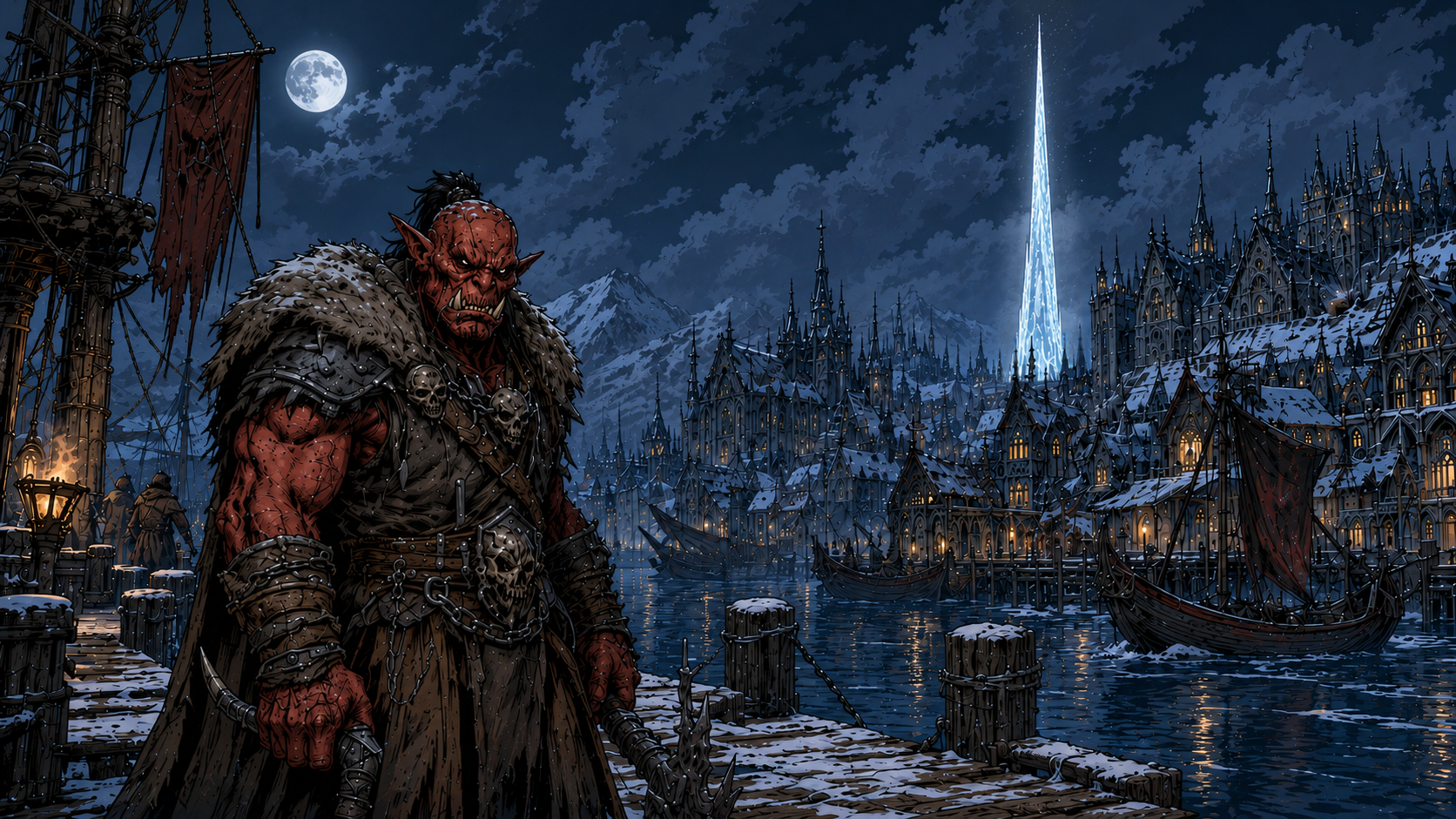
The Nameless City is a necropolis with an occupied rim. The western harbor, docks, outer roads, and certain districts near the gates are inhabited and brutally active. Orcs haul cargo through sleet. Goblins pick through ruins. Hobgoblins drill in frozen courtyards. Foreign merchants keep their heads down and their guards close. Slaves drag sledges through streets glazed in blue ice. Prisoners from the south and east are brought through the gates and seldom leave by them.
The old Elven bones of Talas remain visible beneath the ruin. A traveler who knows what to look for can still see the difference between the city's first makers and its present occupants. The arches are too graceful for orc-work. The street plan is too deliberate. Some lintels still bear defaced Elven designs beneath layers of soot, ice, and old blood. The orcs have hammered iron spikes into marble, stretched hides across broken windows, built crude stockades in noble courtyards, and painted the signs of their tribes over the symbols of Al-Dustriel, but they did not make the city. They only infest it.
The inner city is different. There the buildings are mostly ruined, the roads are choked with snow, and the dead walk. Even the Irzuk avoid those streets unless ordered in force. The old inhabitants of Talas still linger there, along with the victims of the Wintervale's long dominion. Some are pale shapes seen at windows. Some are frozen corpses that rise when warm blood passes near them. Some are voices under the ice. Some have no form at all, only hatred, cold, and hunger.
The living residents understand the city's unwritten geography. The harbor is dangerous but usable. The inhabited section is violent but governed. The gates are watched. The Iron Citadel is feared. The Frostspire is avoided. The inner ruins are entered only by fools, prisoners, necromancers, or those sent there as punishment. At night, even the orcs bar their doors and bank their fires low. The city belongs to the dead after moonrise.
Intrigue poisons every district. The Irzuk hate the southern orcs who come north in search of plunder and status, even though the Irzuk themselves trace their distant origin to Gorug in the south. The distinction is not really geographic anymore. It is tribal, cultural, and bitterly self-serving. The Irzuk consider themselves orcs of the Wintervale now: harder, colder, more useful, and closer to the Dweller's power. The oluks despise both groups and treat them as barely disciplined animals. Khalid Hammerhand schemes against Hoth Dorak, Hoth Dorak schemes against Lord Rand, Lord Rand pays Yellsh to murder rivals, Yellsh sells the same secrets twice, and Master Yen Keng records it all for Kiborus. The Cold Master encourages this back-biting. Divided servants are easier to rule, and in the Nameless City ambition is another shackle.
Locations of Interest
The Docks
The docks are the busiest part of the city and perhaps the only place that resembles ordinary urban life, if ordinary life included slave pens, black-sailed warships, corpse-barges, and armed oluks on every pier. The harbor is dark, cold, and often filmed with ice, though the main channels are kept open by laborers, firepots, alchemy, and darker arts. Ships from the Black Fleet lie at anchor beside merchant vessels from wicked ports and tribute barges from conquered lands. Nothing enters or leaves without Hoth Dorak's knowledge, and very little does so without his profit.
The Inhabited Section
The inhabited section lies chiefly near the western harbor and along the safer outer streets. This district is a hard sprawl of repaired ruins, timber additions, smoky halls, barracks, counting houses, shrines to dark powers, butcheries, ale dens, and low markets. The Irzuk dominate the district, though goblins, hobgoblins, oluks, tieflings, and foreign agents all maintain enclaves. The streets stink of tallow, wet fur, iron, old blood, and the sharp animal musk of the red-skinned orcs.
The Wintervale Gate
The northern gate opens toward the deeper Wintervale and the road to the Dweller's subject lands of Cadocia in the north. It is heavily fortified and guarded by troops who have no interest in conversation, bribery, or mercy. Prison columns, military detachments, and messengers of Kiborus pass through this gate under banners stiff with frost. Those who enter by the Wintervale Gate usually arrive under orders. Those who leave by it are usually marching to war.
The Steppe Gate
The eastern Steppe Gate is controlled by Hai Urg. It watches the road into the eastern wastes, where the cold plains stretch outward beneath the mountains. Once the unnatural glacial plane ends, the fertile lands of Yyrkune open beyond it, with their rich eastern cultures. Caravans, raiding parties, scouts, and tribute trains pass through this gate, but always under armed inspection. Hai Urg's soldiers are famous for their suspicion. They assume treachery first and ask questions only after the bodies have cooled.
The Yyrch Gate
The southern gate, often called the Yyrch Gate, opens toward the hard roads that lead to the orcish lands and the grim traffic of the south. It is less strategically important than the Steppe Gate and less orderly than the Wintervale Gate, but it is no less dangerous. Southern orcs gather here, and brawls between them and the Irzuk are common. The gate district is a place of taverns, fighting pits, animal pens, cheap barracks, and informers.
The Iron Citadel
The Iron Citadel is the seat of Kiborus' practical government. It is a black, angular fortress of iron-bound stone, old Elven masonry, newer cruelty, and red-lit windows. From here the Cold Master administers the city, commands his private troops, receives reports, interrogates prisoners, and issues decrees in the name of the Dweller. The citadel is also a prison, archive, armory, court, treasury, and torture house. Its gates are guarded by oluks who speak little and remember faces.
The Inner City Ruins
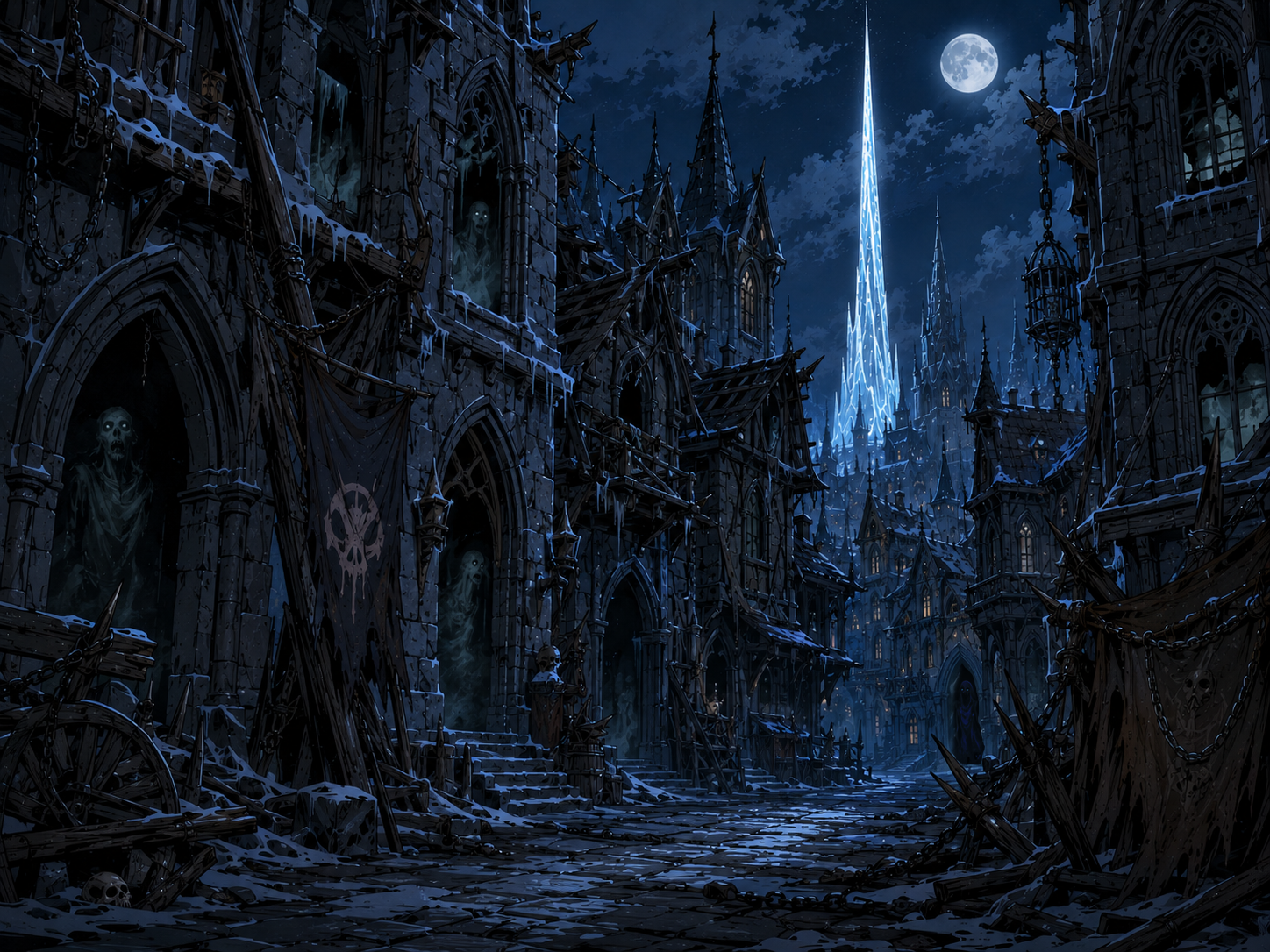
The inner city is the dead heart of the Nameless City. These ruins are the oldest remains of Talas, and in places the fallen beauty of Al-Dustriel can still be seen beneath frost and desecration. Roofless halls gape at the sky. Towers stand hollow. Frozen fountains hold black ice. In some places the ruins look merely abandoned; in others they seem to be watching. The living avoid the district because the dead are thick there. The spirits of rebel Elves, slaughtered soldiers, murdered prisoners, and later victims of the Wintervale wander its avenues, bound by grief, hatred, or the will of the Dweller. Kiborus can command many of them, but not all. That fact troubles him more than he admits.
The Frostspire
The Frostspire dominates the city. It rises from the eastern inner districts like a spear of translucent ice driven into the world by a god's hand. By day it catches the weak northern light and shines with a pale blue radiance. By night it glows beneath the moon, throwing cold reflections across the harbor and the ruined streets. No building in the city can compete with it. Even the mountains seem to withdraw from it.
The spire is hundreds of feet high, smooth, featureless, and unnaturally pure. It is not ordinary ice. Fire does not melt it. Steel does not scar it. Siege engines failed against it during the Battle of Sorrow, and the greatest efforts of the Leagued Armies could not bring it down. The structure seems less built than manifested, as if the hatred of the Dweller took physical form and froze there forever.
There is only one visible entrance: a great dark opening in the western base of the tower. It has no door, no portcullis, and no visible guard. It needs none. The opening resembles a toothless mouth, and those who stand before it hear the wind moving inside the spire like slow breathing. Bitter cold pours from it without ceasing. Snow gathers around the entrance even when the rest of the street has been cleared. Animals will not approach it. Orcs sent too near grow silent and obedient. Prisoners dragged inside usually stop screaming before they vanish from sight.
From the Frostspire emanates the permanent winter that lies over the city. Snow falls even when the sky is clear. Ice forms on stone, wood, rope, mail, and skin. The harbor freezes in patterns that no natural tide could make. Breath hangs in the air longer than it should. Wounds ache. Old griefs return. The city is cold because the Dweller is cold, and her tower is the heart of that cold.
Within the Frostspire, the Dweller waits. She rarely never her abode and has no need to. Her attention is turned westward, toward the freed kingdoms, the surviving Lords of Sin, and all those who had any part in breaking the old dominion of evil over Farland. She is patient, ancient, and implacable. The Cold Master governs the city, but the Frostspire is the reason the city exists.
Kiborus, the Cold Master
Kiborus, called the Cold Master, is the vampiric chancellor of the Nameless City and the terrible steward of the Dweller's earthly power. To call him mayor is technically accurate and morally absurd. He does not lead a city in any civilized sense. He manages a fortress-necropolis, a military harbor, a prison, a market of dark necessities, and a nest of killers whose only shared loyalty is fear.
Kiborus is feared because he is not merely cruel. Many rulers in the service of darkness are cruel. Kiborus is worse: cold, methodical, patient, and almost never wasteful. He spends lives carefully, as another ruler might spend coin. He understands that terror loses value when used stupidly, and so he makes examples only when the lesson will be remembered. His decrees are clear. His punishments are public. His private vengeance is much more imaginative.
The Cold Master maintains power by division. He allows Hoth Dorak, Hai Urg, Khalid Hammerhand, Lord Rand, Yellsh, and Master Yen Keng to scheme against one another because their rivalry strengthens him. Any faction that grows too bold is exposed, humiliated, reduced, or quietly fed to the dead. Any servant who proves too competent is rewarded just enough to become hated by everyone else. Kiborus has turned the politics of the city into a frozen machine, and every ambitious villain in the Nameless City is one more gear inside it.
Yet Kiborus is not independent. His authority comes from the Dweller, and he knows it. He never speaks of her lightly, never presumes upon her favor, and never forgets that he rules in the shadow of the Frostspire. His terror of her is not the terror of a coward. It is the rational fear of one monster who has seen a greater monster clearly.
Irzuk Orcs, Inhabitants of the City
The Irzuk are the red-skinned orcs of the Vale, a strange and hardy breed of dark folk that came originally from the spawning pits of Gorug. In ancient origin, then, they are southern orcs. But that origin now matters less than their present condition. The Irzuk no longer dwell in Gorug or among the southern tribes. They live almost entirely in the Nameless City and have become creatures of the Wintervale: cold-hardened, city-bound, and shaped by generations of service to the Dweller and her chancellor.
They are easily recognized by their red hides, heavy jaws, large noses, and deep-set eyes. Their sense of smell is extraordinarily keen, and Irzuk trackers can follow blood, fear-sweat, warm metal, lamp oil, and even certain spell components through snow and crowded streets. This gift makes them excellent hunters, jailers, scouts, and dock enforcers.
Unlike many orcish breeds, the Irzuk tolerate cold remarkably well. They can work in sleet, sleep in poor shelter, and march across ice with little complaint. This hardiness made them useful to the Cold Master, and usefulness is the only virtue the Nameless City rewards. Over time the Irzuk became the dominant living population of the city, especially in the harbor, outer districts, warehouses, barracks, and markets.
The Irzuk are more industrious than common orcs, though not as disciplined or technically capable as the oluks. They build, haul, repair, butcher, smuggle, hunt, and fight with relentless energy. Their industry should not be mistaken for civilization. Irzuk society is violent, clannish, proud, and quick to anger. Feuds begin over insults, territory, mates, food shares, stolen weapons, dock rights, and imagined slights. Their strength is often fueled by rage, and many Irzuk warriors deliberately cultivate fury before battle.
Their attitude toward southern orcs is complicated and hypocritical. The Irzuk know their blood comes from Gorug, but they consider that old origin beneath them. To their minds, they are no longer merely southern stock. They are the chosen orcs of the Nameless City, hardened by cold, trusted with the docks, and nearer to the Dweller's terrible power than the loud raiders and tribal warriors who come north seeking plunder. Southern orcs, for their part, often view the Irzuk as warped city-orcs who have traded the old strength of Gorug for servitude in the snow. This mutual contempt feeds much of the city's unrest.
Most Irzuk fear the inner city, the Frostspire, and the Dweller with a superstitious intensity. They are not fools. They know the difference between a dangerous street and a cursed one. An Irzuk might knife a rival in the docks, rob a merchant in an alley, or charge screaming into battle, but he will not willingly walk the inner ruins at night. In the Nameless City, even predators know when they are prey.
Adventuring in the Nameless City
The Nameless City is not a place for casual exploration. It is a hostile capital, a military port, a necropolis, and the seat of one of the greatest remaining evils in Farland. Adventurers who enter openly will be watched, challenged, robbed, impressed into service, imprisoned, or killed. Adventurers who enter secretly will still have to contend with Irzuk scent-trackers, goblin informers, necromantic wards, harbor patrols, suspicious oluks, and the dead who wander where no living guard is needed.
The safest districts are not safe. The docks offer noise, crowds, hiding places, and foreign traffic, but Hoth Dorak's soldiers control the piers and Khalid Hammerhand's sailors know every ship that does not belong. The inhabited section contains taverns, markets, and contacts, but every bargain has a witness and every witness has a price. The gate districts may offer escape, but they are watched by soldiers who expect betrayal. The inner ruins may hide ancient Elven secrets, relics of Al-Dustriel, lost records of the rebellion, and forgotten passages beneath Talas, but they are haunted by things that do not bargain.
Possible reasons to enter the city include rescuing prisoners, stealing records from the Iron Citadel, sabotaging the Black Fleet, assassinating one of the Cold Master's servants, recovering relics from the inner ruins, finding lost lore of Al-Dustriel, seeking evidence about the origin of the Dulim, negotiating with a desperate faction, or learning what the Dweller intends next. None of these tasks should be easy. The Nameless City is the kind of place where success means getting out alive with only part of what one came for.
Above all, the city should feel watched. Its streets are full of enemies, but its deepest threat is attention. The longer heroes remain, the more likely it is that Kiborus notices them. If Kiborus notices them, the Dweller may eventually notice them. And in the Wintervale, being seen by the Dweller is often the beginning of the end.


