
Skip


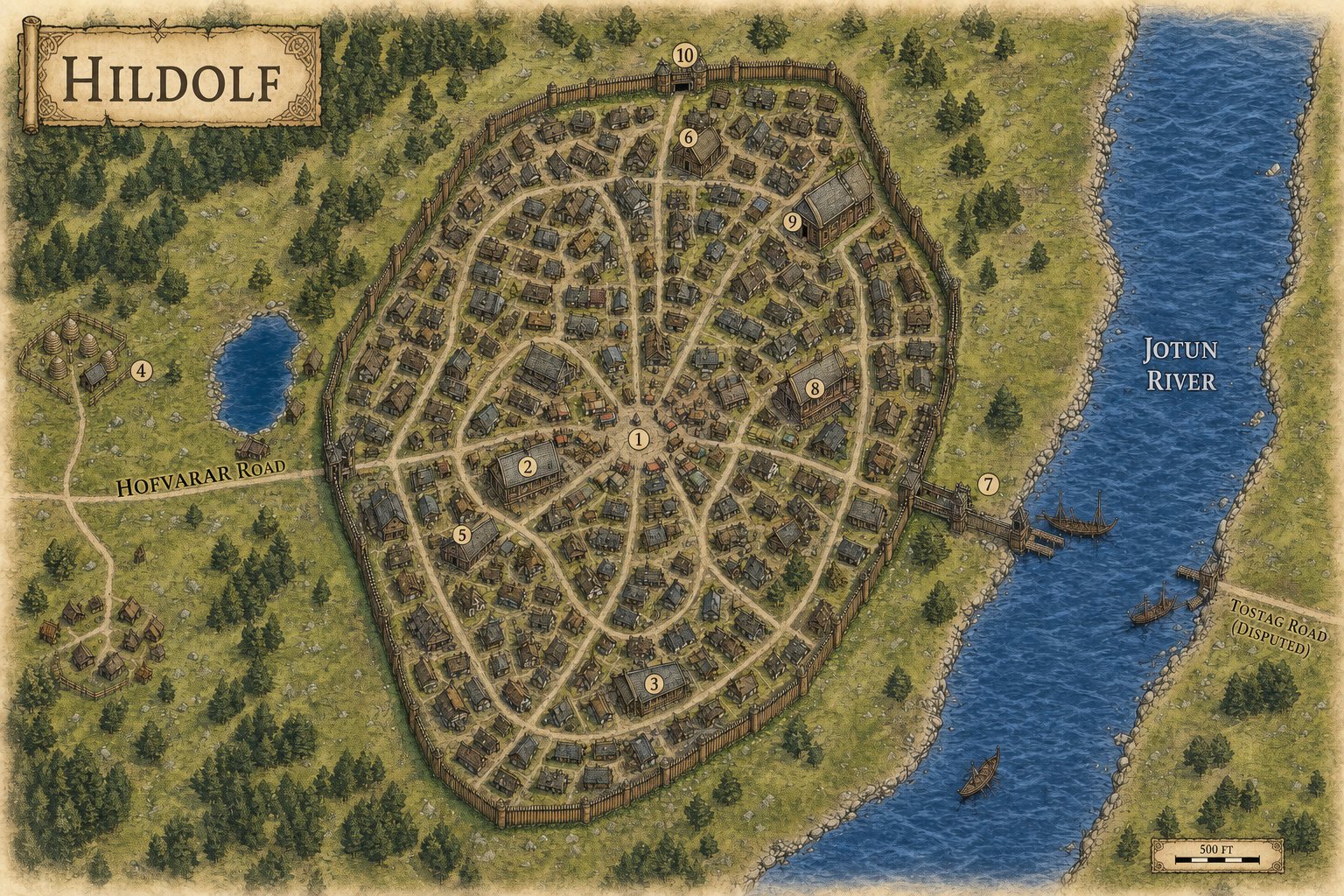
Hildolf is the chief settlement of the Hildolfar people in Anaria, and the nearest thing that fierce land has to a capital. It stands on the western bank of the Jotun River, enclosed by a high palisade and ringed by dark woods, stony fields, and cold water. The town is no marble seat of kings, nor would its folk want it to be. Hildolf is a timber-walled town of longhouses, smoke, axes, oaths, mead, and watchful men.
Hildolf is ruled by Jarl Brand Frodeson, a hard and capable lord who is supported by his six earls. Five of these are Goran, Bue, Rolf, Paal, and Faste, men of consequence among the Hildolfar and dangerous men to insult in public. Brand is sometimes opposed in council by Erin Oneye, a cleric of Edmund Steppenwolf, though rarely over anything that matters enough to threaten the Jarl's rule. Erin speaks when he thinks the old ways of honor, courage, and doom are being slighted, and Brand usually hears him out before doing what he intended to do anyway.
The town has a population of over 4,100 souls, almost entirely human. A small number of dwarves live within the walls, most of them armorers, smiths, traders, or stubborn old wanderers who have discovered that the Hildolfar respect anyone who works iron well and does not complain about the cold. The town's chief products are vodka, mead, timber, furs, and armor, though the armor made here is never finer than chainmail. Plate is regarded as foreign, expensive, and likely to drown a man who falls through river ice.
Brand keeps about 90 sworn fighting men in his service. These warriors serve him much as knights serve the lords of the south, though no man in Hildolf would use that word without spitting afterward. They keep order in the town, patrol the surrounding countryside, and make certain that Brand's law is more than noise in the mouth. In time of need, the Jarl can quickly call up another 500 or so berserkers and fighting men from the town and the nearby steadings. If the danger were great enough, still more could be raised, though such a mustering would mean that Hildolf had already smelled war on the wind.
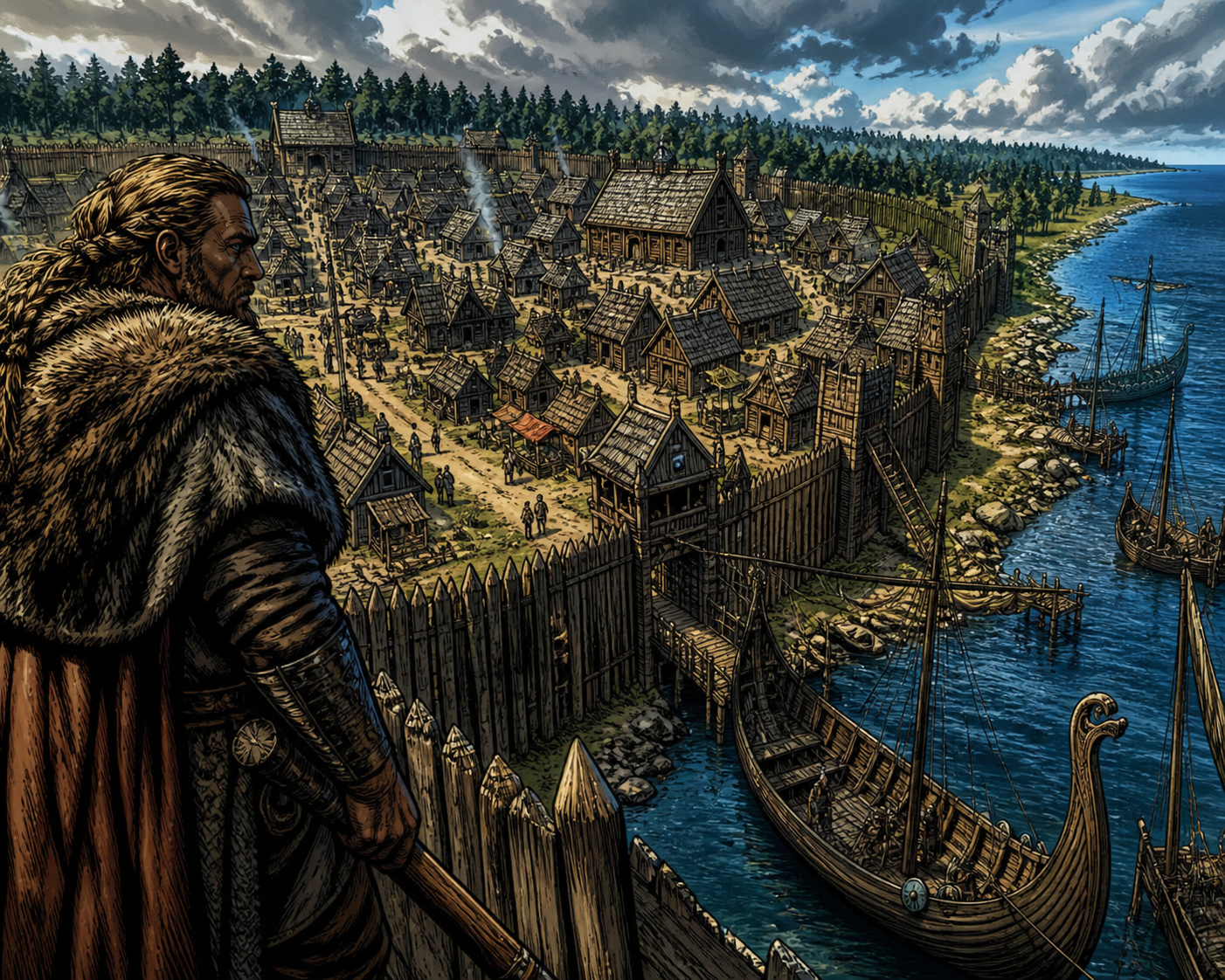
Because of its location and the culture from which it stems, Hildolf is a community designed for defense and war. Its high palisade wall is not decorative, and neither are the gates, towers, fighting platforms, and narrow streets inside it. The lanes bend and tighten at certain points so that a large body of men could not easily rush through them if they were defended. A mob entering Hildolf would soon find itself squeezed between timber walls, rooflines, spear points, and men who know exactly where to stand.
Most of the buildings are longhouses, stout timber structures with steep roofs, heavy doors, smoke holes, and enough interior space to hold kin, guests, animals, weapons, and grudges. They are eminently defensible, and more than one foreign visitor has noticed that even the homes in Hildolf look as if they are waiting to become forts. The wealthier halls are larger and better carved, with dragon-headed beams, bright shields, and old trophies hung above the doors. The poorer houses are plainer, but they are still made by people who expect winter, raiders, and ill luck to come sooner or later.
The center of the town is a broad meeting place where Brand's men gather, merchants shout, judgments are given, and insults sometimes become blood feuds before supper. From this center, the roads radiate through the town like the ribs of some wooden beast. The Hofvarar Road enters from the west, bringing traders, woodsmen, herdsmen, and the occasional nervous southerner. The river road to the east is more troubled, for the Tostag Road across the water remains disputed, and in Anaria, men have been killed over less than who owns a path.
The market square is the open heart of Hildolf, a hard-packed space of mud, gravel, timber stalls, shouting merchants, and armed men pretending not to watch one another. Here furs are weighed, mail shirts are haggled over, mead is sold by the skin, and southern goods are inspected with deep suspicion before being purchased anyway. Brand's men also use the square for proclamations, punishments, and judgments, so a visitor may come seeking a cloak pin and find himself watching a thief lose two fingers.
The square is also where news enters the town. River-men, hunters, traders, foreign envoys, and wandering fools all pass through it sooner or later, and the folk of Hildolf have sharp ears. A rumor spoken too loudly in the market will reach the Jarl's hall before nightfall, usually with several useful lies added to it.
The longhouse of Jarl Brand Frodeson is large, grim, and well-kept, built less like a palace than like the hall of a war-chief who expects his enemies to come through the door eventually. Its roof beams are carved with wolves, ravens, and river serpents, and the shields of Brand's sworn men hang within easy reach along the walls. The hall smells of smoke, pine pitch, old ale, wet wool, and iron.
Brand holds court here, though court in Hildolf is not the delicate affair it is in southern lands. Men stand before him to settle debts, blood feuds, trade disputes, accusations of cowardice, and other matters that can turn fatal if left too long untended. At night the hall becomes a place of feasting, boasting, and dangerous hospitality, for Brand is generous with meat and drink but quick to anger if a guest forgets whose roof covers him.
Mats Martinson is not one of Brand's earls, but only a fool would call him unimportant. His longhouse is one of the better halls in the southern part of Hildolf, built by a man who has made himself useful in trade, storage, and the quiet lending of silver to men who later discover that Mats remembers every debt. His household includes kinsmen, guards, servants, craftsmen, and several hard-eyed retainers who look more like raiders than clerks.
Mats deals often with foreigners and with merchants from the Kelerite cities to the south, which has earned him both wealth and distrust. Brand tolerates him because Hildolf needs men who can turn timber, furs, vodka, mead, and armor into coin. The earls tolerate him less easily, since a man who owns ledgers can sometimes injure a proud warrior more cleanly than a man who owns an axe.
West of the town lies the small pond called "Honey" Lake, though it is a lake only by the generous standards of local pride. Around it stand fenced beehive farms, low sheds, rough gardens, and a few small holdings whose folk keep bees, gather wax, brew mead, and curse bears with impressive creativity. The honey from this place is dark, strong, and prized throughout Hildolfar.
The beehive farms are outside the wall, which makes them vulnerable when trouble comes. In peaceful times they are quiet and prosperous, but in bad seasons their folk flee quickly through the western gate with children, tools, wax, and whatever hives can be saved. More than one raid has begun with smoke rising from the apiaries, for an enemy who burns the bees has already wounded Hildolf's pride.
The Deepwell Tavern is one of the oldest drinking houses in Hildolf, named for the stone-lined well beneath its rear room. The water is cold, clean, and said to be deep enough to reach the bones of the first settlers, which is exactly the kind of thing drunken men in Hildolf like to say before daring one another to climb down it. The tavern serves mead, vodka, smoked fish, coarse bread, and a famous venison stew.
The Deepwell is favored by Brand's lesser warriors, visiting traders who want to seem brave, and locals who prefer their drinking away from the greater halls. It is also a good place to hear the town's uglier truths, since men who fear speaking in the market often grow loose-tongued after the third cup. Fights are common, murders are less common, and both are usually dragged outside if the owner notices in time.
The temple of Edmund Steppenwolf stands in the northern part of town, a steep-roofed hall of dark timber, wolf carvings, iron lamps, and smoke-blackened rafters. It is not a soft place of kneeling cushions and whispered comfort. Warriors come here to ask for courage, widows come to speak names over the dead, and young men come to swear oaths they may later regret.
Erin Oneye, cleric of Edmund Steppenwolf, watches over the temple and its rites. He blesses weapons, counsels Brand when permitted, and reminds the Hildolfar that courage without honor is only savagery with better songs. The temple keeps old relics, battle trophies, and the names of those who died well, and no wise man mocks it unless he has already chosen the manner of his death.
The Foreigners Inn stands near the river gate, close enough to the docks that a nervous trader can sleep without walking too far into town. Its name is not affectionate, but it is accurate. Southerners, dwarves, river merchants, envoys, mercenaries, and the occasional scholar all find their way there when they need a roof and do not yet know whom they might safely offend.
The inn is watched more closely than its guests usually realize. Brand's men listen for treachery, Mats Martinson listens for opportunity, and the locals listen because foreign fear is often amusing. Still, the inn is safer than it looks. Hildolf wants trade, and a murdered guest is bad for business unless the guest richly deserved it.
The armory is a large timber building near the eastern side of town, guarded day and night by men who do not enjoy jokes. Within are spears, axes, shields, bows, helms, mail shirts, spare leather, shield bosses, arrowheads, and enough iron to arm the town in a hurry. Hildolf does not make armor greater than chainmail, but it makes mail well enough, and its smiths take pride in work meant to keep a man's blood inside him.
The armory also serves as a mustering point when Brand calls his warriors. In times of alarm, men gather here to receive weapons, repair gear, and learn whether the danger is a raid, a feud, a river attack, or something worse from the northern wilds. Anyone attempting to steal from the armory is either desperate, foreign, or very stupid.
Earl Goran's longhouse is one of the largest halls in Hildolf and the chief rival in grandeur to Brand's own. Goran is a powerful supporter of the Jarl, but he is no man's dog, and his hall reflects that fact. Its benches are full, its hearth is broad, and its walls carry enough shields and weapons to make a cautious visitor count exits before accepting a drink.
Goran's followers are loyal, proud, and quick to remind others that their lord's strength helps keep Brand on his seat. Many visiting jarls call first at Goran's hall before presenting themselves to the Jarl, not as an insult but as an acknowledgment of how power truly works in Hildolf. Brand allows this because Goran has remained useful, and because forbidding such things often gives them more meaning than allowing them.
Sven's Gate is the northern gate of Hildolf, a heavy timber entrance set into the palisade and watched from flanking platforms. It opens toward the colder country, the scattered steadings, the hunting tracks, and the darker roads by which trouble often comes. The gate is named for Sven, an old defender of Hildolf whose tale is told differently depending on who is drunk, who is listening, and whether Sven's descendants are nearby.
The gate is narrow by design, and the road inside it bends quickly, forcing any attacker to slow under the eyes of the defenders above. During councils, winter scares, and rumors of war, Sven's Gate is barred early and opened late. Men leaving by it often touch the posts for luck, though few admit doing so unless they have already survived whatever waited beyond it.
Every year, the various jarls of the Hildolfar tribe meet in Hildolf to discuss future war plans, settle disputes, renew alliances, and drink more than is wise. These gatherings are loud, dangerous, and politically important. A man may arrive with fifty followers and leave with a marriage pact, a blood debt, or a knife in his ribs. Brand's popularity and reputation for fairness are tested most severely during these meetings, when every proud man in Hildolfar wants his honor acknowledged and his enemies humbled.
Despite the nature of its people, Hildolf is usually not as hostile to foreigners as other towns in Anaria. This is partly because trade with the Kelerite cities to the south occurs on a regular basis, and partly because Brand understands that silver, iron, salt, and news are all useful things. Foreigners are watched, of course. They are mocked if they seem weak, cheated if they seem foolish, and challenged if they seem arrogant. But a trader who pays fair, drinks well, and keeps his hands away from other men's women may do business in Hildolf and live to do it again.
The town's exports have given it a rough prosperity. Its timber is valued in the south, its furs travel far, and its mead and vodka have made many men brave, stupid, or unconscious. Its armorers are respected, especially for mail, helms, shield bosses, spearheads, and axes. They cannot match the deep craft of the dwarves or the great forges of the more civilized kingdoms, but no warrior of Hildolf goes poorly armed unless he has angered his kin or lost everything at dice.
Brand Frodeson is popular, and not without reason. He has a reputation for fairness, which in Hildolf means that he rewards service, punishes betrayal, and does not let a rich coward escape a penalty meant for a poor brave man. He also has a quick temper, and this too is not entirely counted against him. The Hildolfar do not trust a lord who smiles too much. Brand can laugh, feast, and give gifts, but his anger comes fast when he thinks he is being lied to or played for a fool.
His rule depends on three things: the loyalty of his sworn men, the support of the earls, and the belief among the common folk that Brand is strong enough to keep the town safe. So far, he has managed all three. That does not mean his position is effortless. The Hildolfar admire strength, but they also test it. Every judgment, every feast, every raid, every insult answered or ignored becomes part of the long reckoning by which men decide whether their Jarl is still worthy.
Hildolf is not merely a town that can be defended. It is a town that expects to be defended. The palisade is thick, the towers are placed to command the gates and river approaches, and the streets inside the wall are hostile to invaders. An army that broke through the outer defenses would still have to fight from lane to lane, house to house, and hall to hall. The longhouses themselves would become redoubts, filled with archers, spearmen, axes, and smoke.
Brand's cohort of sworn men form the hard core of the town's defense. Around them gather the 500 fighting berserkers and militia who can be called up quickly in time of need. These are not polished soldiers in the southern style, but they are strong, local, and accustomed to violence. They know the roads, the river, the woods, and the weak places where enemies are likely to come. More importantly, they know that if Hildolf falls, there is no comfortable retreat behind them.
The Jotun River is both Hildolf's shield and its open door. Any enemy coming by water must face the docks, the towers, the current, and the boats of men who were born to the river. But the river also brings strangers close to the wall, and a clever foe might use fog, darkness, fire, or treachery to make the water serve him. For this reason the river gate is watched carefully, especially during council gatherings, feast days, and the deep hours before dawn.
RIver Dispute. A dispute over the Tostag Road has begun to turn bloody. Men from across the river claim the road by old right, while Brand's earls insist that no path so close to Hildolf can be held by outsiders. The characters may be hired to escort a delegation, spy on the rival claimants, recover proof of ownership from an old cairn, or prevent a skirmish from becoming a small war.
The Sixth Earl. One of Brand's missing earls has been conspicuously absent from council, and the five named earls are saying very little about it. The Jarl wants discretion, Erin Oneye wants truth, and someone else wants the matter buried before the annual gathering of jarls begins. The characters may find themselves searching halls, questioning warriors who do not like questions, and discovering that the missing man was involved in something more dangerous than ordinary politics.
The Dead Southerner. A southern merchant has been found dead near the docks, and his goods are missing. In another Anarian town this might barely matter, but Brand cannot afford to let foreign trade sour. The obvious suspect is a drunken berserker, which usually means the obvious suspect is either guilty, doomed, or being used. The trail leads through the market, the river gate, and one of the larger halls, where too many men are suddenly eager to talk about honor.
The Stolen Relic. Erin Oneye believes a sacred relic of Edmund Steppenwolf has been stolen from the northern hall. The theft is an insult to the god, the town, and Erin personally, which makes it a serious problem for everyone nearby. The thief may be a foreign agent, a jealous rival of Erin, a desperate townsman, or something worse that wants the blessing of Edmund withdrawn before an attack on Hildolf.
The Ghost Boat. A longboat drifts into the docks without oarsmen, its hull scored by claws and its hold filled with frozen corpses. The men aboard were Hildolfar, but they were not killed by any weapon the town's smiths recognize. Brand wants answers before panic spreads. The river folk whisper that something has come down from the north, and that the Jotun River has begun carrying more than trade.
The Powder Keg. During the yearly council of jarls, one of the visiting lords publicly insults Brand and challenges his judgment. The town becomes a keg of lamp oil beside a hearth. The characters may be asked to guard a guest, uncover who is provoking the quarrel, stop an assassination, or survive the feast where every man is armed and half of them are drunk. In Hildolf, peace sometimes lasts only because everyone understands exactly how bad war would be.